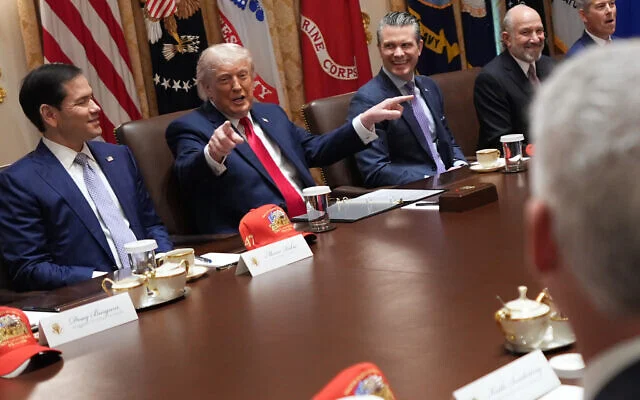
The White House confirmed on Thursday that US and Iranian negotiators have reached an agreement on a memorandum of understanding (MoU) to extend the current ceasefire by an additional 60 days. During this period, both sides are expected to engage in talks aimed at limiting Tehran’s nuclear program.
However, according to a statement shared with reporters, US President Donald Trump has not yet approved the agreement and must still sign off on it. A report by Channel 12, later confirmed by the White House, indicated that Trump intends to take several days to review the deal before making a final decision.
Despite this, a diplomat involved in the mediation process told The Times of Israel that the Channel 12 report did not accurately reflect the current state of negotiations, emphasizing that Iran’s final approval is also still pending.
Iran’s semi-official Tasnim news agency similarly cited a source close to the negotiating team, who denied that Tehran had given its final consent. The source stated that the agreement’s text is still being finalized and that Iran will publicly confirm its approval once a decision is made.
Israel has not issued an official response to the developments. However, Channel 12 quoted senior Israeli officials as saying there is no indication that Iran’s Supreme Leader, Mojtaba Khamenei, has approved the agreement. They argued that without such approval, “Trump has nothing to approve” at this stage.
Even the Channel 12 report appeared cautious, initially citing a senior US source who claimed that all levels of Iran’s leadership had agreed to the terms, but later noting uncertainty over whether Khamenei has formally endorsed the deal.
It remains unclear whether the White House’s confirmation was intended to pressure Iran into finalizing the agreement, or whether Tehran has privately approved the MoU but is delaying a public announcement until Trump grants his authorization.