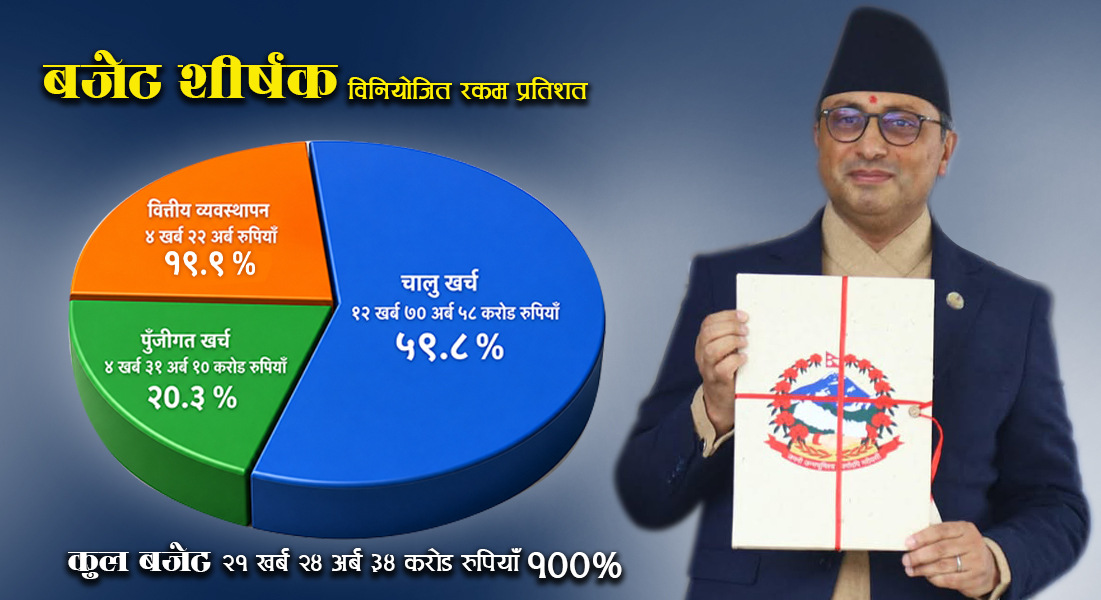
Kathmandu, 30 May: The government has allocated a budget of NPR 2 trillion 124 billion 34 million for the upcoming fiscal year 2083/84.
Presenting the budget statement at a joint meeting of the Federal Parliament, Finance Minister Dr. Swarnim Wagle informed that of the total allocated budget, NPR 1 trillion 270 billion 58 million (59.8%) has been allocated for recurrent expenditure, NPR 431 billion 10 million (20.3%) for capital expenditure, and NPR 422 billion (19.9%) for financial management.
The government had allocated a budget of NPR 1 trillion 964 billion 11 million for the current fiscal year 2082/83. Compared to the current fiscal year, the size of the budget for the upcoming fiscal year has increased.
The budget is focused on improving the economy
Finance Minister Dr. Swarnim Wagle stated that NPR 1 trillion 270 billion 58 million has been allocated for recurrent expenditure, NPR 431 billion 10 million for capital expenditure, and NPR 422 billion for financial management. Former Finance Minister Mahesh Acharya, economist and former Governor of Nepal Rastra Bank Dr. Chiranjibi Nepal, and economist Dr. Kalpana Khanal said that the government’s budget is focused on the overall improvement of the economy.
Former Finance Minister Acharya described the policy and legal reform efforts included in the budget as positive. Noting that the country currently has a majority government, he said it is timely to introduce broad economic reform programs. He added, “The budget has attempted to simplify administration, enhance efficiency, and address the demands of the private sector. It is encouraging that economic agendas are becoming central to political debate. Therefore, economic development is possible through positive dialogue among the ruling party, opposition, and private sector, and the budget should be implemented accordingly.”
Former Governor Dr. Nepal said the budget emphasizes the country’s digital transformation and the promotion of the private sector. He commented that prioritizing the information technology sector and focusing on the middle class are positive aspects of the budget. Referring to the target of raising NPR 410 billion in domestic borrowing, he said, “A large domestic borrowing target could create a shortage of funds for private sector investment, which may ultimately push interest rates higher.”
Dr. Nepal also expressed confidence that the plan to operate seven ailing industries, including Gorakhkali Rubber Industry, in partnership with the private sector, along with tax rate reforms, would provide some relief to middle-class families and the private sector.
Economist Dr. Khanal stressed that the budget should be reform-oriented in light of the country’s current economic situation. She said priority should be given to public administration, good governance, and structural reforms. She emphasized the need to merge various government institutions, improve the efficiency of existing bodies, and move forward with a focus on good governance.
She further clarified that revising the income tax threshold to provide relief to middle-class families is a positive step. She added, “It is necessary to adopt a policy of reducing the number of employees while increasing their remuneration based on performance. This would enhance efficiency in the bureaucracy and reduce the state’s expenditure burden.”