U.S. President Donald Trump has halted the supply of certain weapons intended to help Ukraine in its fight against Russia.
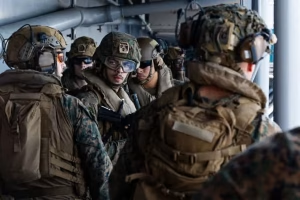
Among the weapons blocked are defensive missiles (interceptors) and other arms under the Patriot air defense system, which the Biden administration had decided to provide.
According to the U.S. online outlet Politico, the decision was influenced by comments from the Pentagon’s top policy official, Elbridge Colby, who pointed out that America’s stockpile of artillery, air defense missiles, and precision weapons is running low.
A week ago, during the NATO summit held in The Hague, Netherlands, Donald Trump had said he would consider selling Patriot air-defense missiles to Ukraine. However, he has now blocked the transfer of those weapons — including systems that had already been delivered to neighboring Poland for handover to Ukraine.
Officials in the Trump administration have emphasized that the U.S. must focus all its attention on the long-term threat posed by China. They have also cited the need to address immediate concerns in the Middle East as another reason for halting the arms supply to Ukraine.
Trump made this decision just a week after meeting Ukrainian President Volodymyr Zelenskyy in The Hague, where he had expressed sympathy for him. In contrast, back in February, Trump had publicly scolded Zelenskyy at the White House in a manner many saw as humiliating. However, after their June 25 meeting, Trump described Zelenskyy as “a good man.”
When asked by journalists whether the two had discussed ending the Russia-Ukraine war, Trump replied, “No, no — I just wanted to know how he was doing. During the conversation, he seemed like a really good guy. He’s fighting a tough war. It’s a difficult battle.”
Commenting on the earlier February exchange at the White House, Trump acknowledged that there had been a tense moment between the two in the past.
On the other hand, although former U.S. President Donald Trump is known to have had a good relationship with Russian President Vladimir Putin, he has recently made strong statements against him.
“Vladimir Putin must end this war. People are dying at a level we haven’t seen in a long time,” Trump stated.
He also commented on Putin’s proposal to mediate in the Iran-Israel conflict. “That’s not necessary. What Russia can do is help stop this war,” Trump reportedly told him.
Under Trump’s initiative, the United States has been mediating for a ceasefire in the Russia-Ukraine war. Trump has been exerting pressure—both publicly and privately—on both countries to accept a truce.
While Ukraine readily accepted the U.S.-proposed 30-day temporary ceasefire, Putin did not agree. He has demanded that Ukraine not join NATO, reduce its military, and cede not only the territories already occupied by Russia but also regions not currently under Russian control.
After Trump’s phone call with Putin on May 19, many expected progress toward ending the war. However, despite the two-hour conversation, Trump was unable to convince Putin. Following that, Trump backed away from his demand for an immediate Russian ceasefire.
Instead of taking steps toward peace, Putin intensified attacks on Ukraine. This led Trump to start issuing harsher remarks about the Russian leader in recent days. Reportedly, Trump now believes Putin has been “playing games” under the guise of peace talks and is considering new sanctions against Russia.
If Russia does not show genuine commitment to peace, Trump is expected to take a tougher stance.
Earlier in June, after Ukraine destroyed several Russian bombers using a large number of drones, peace talks between the two sides were held in Turkey. However, no concrete progress toward ending the war was achieved.
In that one-hour meeting, Russia formally presented its conditions. It stated that peace would only be possible if Ukraine agreed to surrender additional territories and reduce the size of its military.
Russia claims it is not pursuing a mere ceasefire, but rather a long-term solution. Ukraine, however, accuses President Putin of having no interest in peace.
According to conditions published by Russian news agency Interfax, Russia wants international recognition of the Crimean Peninsula—which it annexed in 2014—as Russian territory. It also seeks recognition of four other Ukrainian regions it claims as its own.
These four regions are not entirely under Russian control. Nevertheless, Russia is demanding that Ukrainian forces fully withdraw from those areas as well.
Russia has repeated its demands that Ukraine remain a neutral country, never join NATO, protect the rights of Russian-speaking populations, recognize Russian as an official language, and end so-called “Nazification.”
Ukraine, for its part, denies any discrimination against Russian speakers, and global observers widely consider Russia’s “Nazification” claims as absurd.
Ukraine insists on a complete and unconditional ceasefire—across air, land, and sea.
The proposed ceasefire would be monitored by the United States. Following that, all prisoners of war must be released, Ukrainian children forcibly taken to Russia must be returned, and a meeting between Ukrainian President Volodymyr Zelensky and Russian President Vladimir Putin must take place.
To prevent further aggression from Russia, Ukraine has demanded security guarantees.
Ukraine has also made it clear that no international recognition should be given to Russia’s claims over the Ukrainian territories currently under its control.
Furthermore, Ukraine insists that there should be no restrictions on its military capabilities, and that Western sanctions imposed on Russia—including those by the United States—should only be gradually lifted. However, Ukraine has also demanded that if Russia violates the agreement, those sanctions should be reinstated.
According to Ukraine’s conditions, the frozen Russian assets seized by the U.S. and other Western countries must be used for Ukraine’s reconstruction.