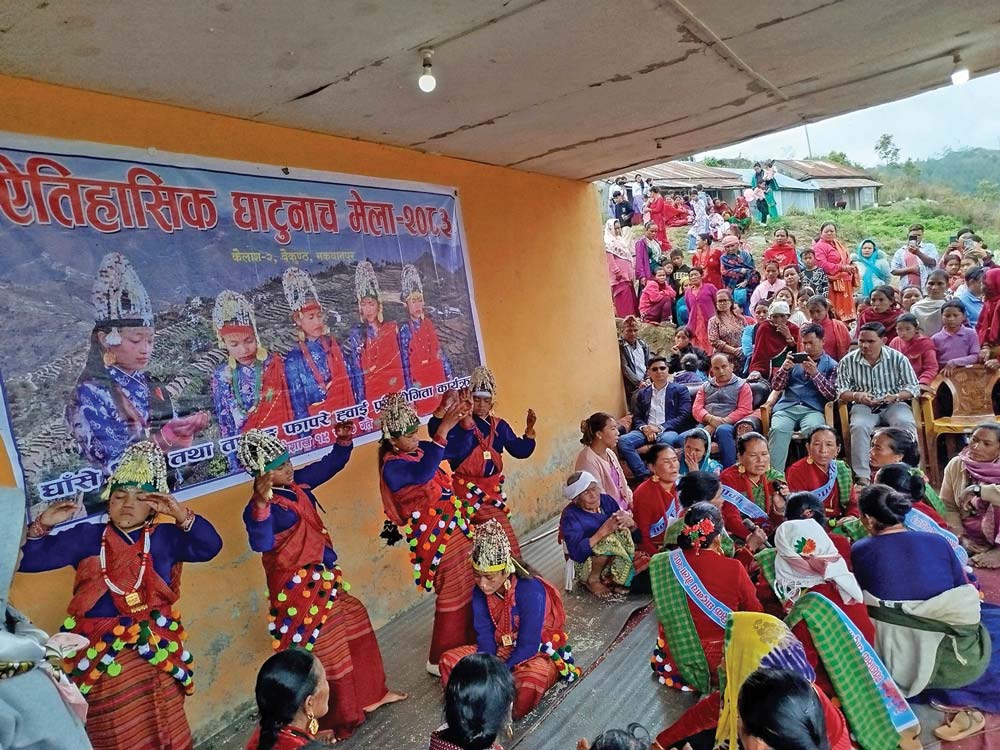
Lamjung 5 May: The Ghatu dance, based on Gurung culture, has brought vibrancy to villages. Along with preserving culture, it has also attracted domestic tourists. The Ghatu dance, which begins on the full moon day of Baisakh in Gurung villages, is concluded on Panchami. Purna Gurung of Marsyangdi–3, Dhangai, stated that the Ghatu dance has added liveliness to the village. According to him, visitors have come to watch the dance from Sanjapu, Mipra, Ghanpokhara, and Sildhunga of Marsyangdi Rural Municipality.
Kamsarki Gurung, chairperson of the Rock Garden Khanigaun Tourism Committee, said that the festival of Ghatu dance is ongoing in Gurung villages. He said, “Ghatu is being performed in village after village. The gathering of visitors has made the atmosphere lively. People are continuously coming and going to watch the dance.” The Ghatu dance has been performed in Gurung villages of Lamjung including Dhangai, Ghanpokhara, Siurung, Chhapa, Mipra, Pasgaon, Singdi, Gilung, Hiletxar, Taghring, Shrimanjyang, Ghalegaon, Karapu, Bhujung, Ghermu, Phaleni, Dhodeni, Pachok, Pyarjung Gauda, Ilampokhari, and Dudhpokhari. Local mothers’ groups and youth clubs have managed the Ghatu dance in different villages.
According to scholars of Gurung language and culture, the Ghatu dance is believed to have originated around the 15th century. In this dance, two unmarried girls who have not reached menstruation are chosen to represent the medieval King Parashuram and Queen Yampawati. After that, they may continue dancing at any age as they wish. The songs and performances of the Ghatu dance depict human life, including birth, deeds, romance, marriage, hunting, fishing, farming, and war. Ghatu is mainly of two types: Sati and Baramase. It also includes a special performance of the Kusunda dance.
According to Ghatu guru Buddhiras Gurung of Bhujung, the lyrical story of Ghatu begins with love and ends in death and separation. He explained, “After the king dies in battle, the queen prepares to commit sati, entrusting household responsibilities to her mother-in-law, property to her father-in-law, and placing her young son Balkrishna on the throne. When the household learns of the king’s death and the queen’s decision to commit sati, domestic animals like dogs, cats, elephants, and pigeons begin to cry.” He added that the moment when Yampawati (Ghatu dancer) cries while going for sati deeply moves everyone.
The Ghatu dance is performed for three to five days. During this time, songs are sung covering twelve stages, including invoking deities, love, farming, naming flowers, playing games, bathing, hunting, marriage, war, and the act of going for sati. According to Buddhiras, natural deities from all directions—such as Hiu Chuli, Bar Chuli, Deu Chuli, and Ganga Chuli—are invoked.
Grass Song Competition during Ghatu Festival
Similarly, according to a correspondent from Makwanpur, a grass song (Ghasse Geet) competition was held along with the historic Ghatu festival. Kailash Rural Municipality–2, which has been preserving the Ghatu tradition, organized the competition for the first time to revive endangered grass songs and Tamang Fapare Hwai songs. Although Ghatu is mainly practiced in the Gurung community, it has also traditionally been performed by the Tamang community in Baikuntha of Makwanpur. Ward Chairperson Rajendra Ghising said that the competition would help preserve the traditions, customs, and cultural heritage of the Tamang community.
In the grass song competition, which saw participation from 18 groups, the team of Pashupati Giri and Chinu Chauhan secured first place, Meena Rijal and Maiya Khatri came second, Vidur Giri and Shankar Giri placed third, and Kalawati Ghimire and Belimaya Diyali received consolation prizes. The winners received cash prizes of 25,000, 15,000, 10,000, and 5,000 rupees respectively, along with certificates. Similarly, in the Fapare Hwai song category, Ram Maya Syangbo was awarded 25,000 rupees and a certificate.