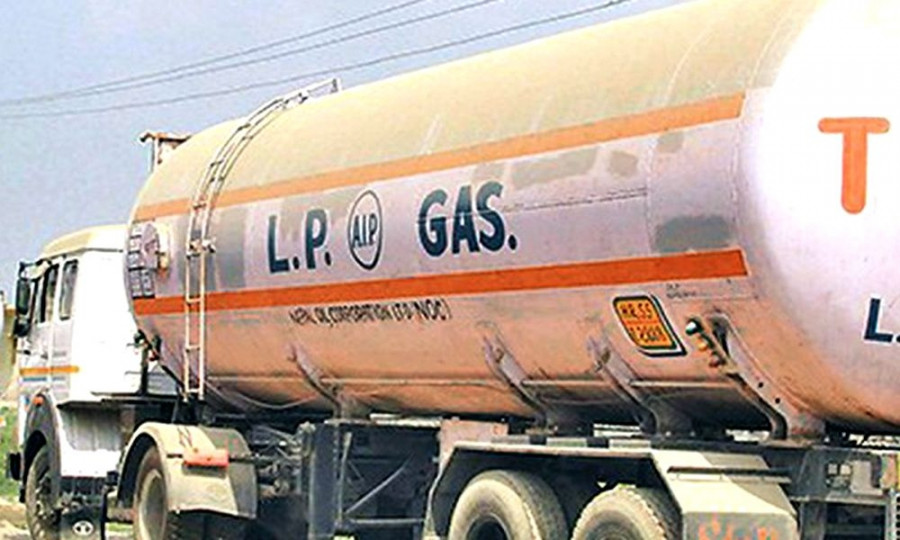
Kathmandu, 18 April: Due to the government’s decision to sell half-filled cylinders and the growing trend of cooking with electricity, gas cylinders have started piling up in the gas industry. On the other hand, industrialists say they are unable to refill gas from bullets (tankers) as a large number of cylinders are already in the market.
After the introduction of half-weight (7.1 kg) cylinders, the shortage of empty cylinders has caused gas to remain stored in bullets. With the regularization of gas supply, imports have also decreased. According to the Nepal Oil Corporation, while the normal monthly demand in the market is around 45,000 to 48,000 metric tons, only 18,000 metric tons of gas have been imported in the past 15 days.
When a shortage of gas began to appear in the market, the corporation had instructed industries from Falgun 28 (mid-March) to distribute half-weight cylinders to ease supply.
The Nepal LP Gas Industry Association has requested the corporation to allow the distribution of full cylinders, stating that the supply of empty cylinders has decreased and transportation costs have increased due to the distribution of half-filled cylinders.
The association said that distributing half-filled cylinders has led to all cylinders being utilized, while reduced gas consumption has forced businesses to hold gas in bullets and storage facilities, creating operational difficulties.
Association President Diwan Chand said that gas has been “held” in bullets due to the inability to refill cylinders. “Gas consumption in the market has dropped by 50 percent,” he said. “Due to the lack of empty cylinders for refilling, we have had to store gas in bullets.” He added that rising fuel prices and increased transportation costs have prompted a request to the corporation to allow full-cylinder distribution for the time being.
He stated that transporting a truckload of full cylinders costs around NPR 20,000, but transporting half-filled cylinders costs the same, increasing the financial burden on businesses. According to the association, there are currently 12,000 to 13,000 metric tons of gas stored in companies and about 350 bullets, each with a capacity of 18 metric tons.
Since the gas storage facilities in companies are already full, holding gas without space to refill cylinders could soon result in a shortage of bullets available for importing gas.
According to the corporation, under normal conditions, 75 to 80 bullets of gas arrive daily, while during shortages, imports had increased to 100 to 120 bullets per day. Corporation spokesperson Manoj Thakur said that gas imports have declined as market consumption has decreased. “As conflicts continue in the West, we need to consider the international situation,” he said. “Since the decision cannot be reversed immediately, we are not in a position to supply full cylinders right away.”
President of the Gas Sellers Federation Gyaneshwar Aryal said that due to the distribution of half-filled cylinders, gas has been held by consumers and bullets are also full, making it necessary to distribute full 14.2 kg cylinders.
According to the corporation, there are 14.2 million gas cylinders in the market.
Currently, the price of a half-filled cylinder is NPR 1,005, while a full cylinder costs NPR 2,010.