With the US and Israel accusing Hamas of not wanting a truce deal and talking about pursuing “alternative options” to bring home the 50 hostages still held in Gaza, Hamas has taken steps to fend off possible military operations aimed at rescuing the remaining hostages, the London-based Arabic daily Asharq Al-Awsat reported on Saturday.
Hamas sources on the ground in Gaza told the Saudi outlet that the terror organization was taking additional precautionary measures to undermine potential efforts by Israeli special forces or others to rescue the hostages.
For example, Hamas has reinstated a policy to kill hostages if captors believe that Israeli forces are approaching. The policy had been canceled since the most recent ceasefire came into effect in March, the sources said.
Hamas sources reportedly expressed confidence that any attempted rescue operations would likely fail. To date, eight hostages have been recovered alive by Israeli forces. The remains of 49 others have been found, including three hostages accidentally killed by Israeli troops during an escape attempt, and one soldier killed in 2014.
The remaining hostages — nearly 200 — were released through previous ceasefire agreements.
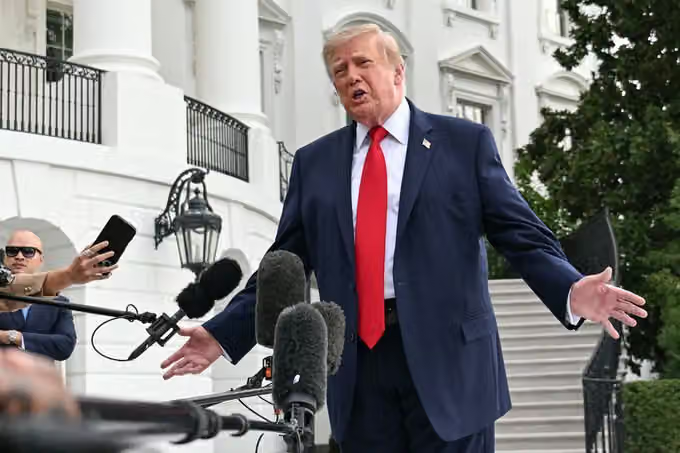
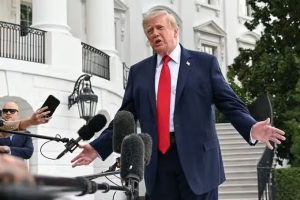
On Saturday, Hamas officials reacted with surprise to remarks made by former U.S. President Donald Trump, who accused the group of lacking genuine interest in a ceasefire or hostage release deal. Trump’s comments followed the withdrawal of Israeli and U.S. negotiators from indirect talks with Hamas in Qatar after nearly three weeks of discussions.
Hamas spokesperson Taher al-Nunu told AFP that Trump’s comments were “particularly surprising,” especially given recent progress on several key negotiation points. “So far, we have not been notified of any problems related to the files being discussed in the indirect ceasefire negotiations,” he added.
Nunu, a close associate of Hamas’s top political leadership, also expressed his surprise at the decision by Israel and the United States to withdraw from the talks.
On Thursday, U.S. Special Envoy Steve Witkoff, while announcing the recall of American mediators, accused Hamas of failing to “act in good faith.”

“We will now explore alternative options to secure the release of the hostages and to help stabilize conditions for the people of Gaza,” Witkoff stated.
Though not part of the Hamas negotiating team, Hamas politburo member Izzat al-Rishq insisted the group had shown “flexibility” in the talks.
“The American statements deliberately ignore the real obstructionist to all agreements — Netanyahu’s government, which continues to place obstacles, deceive, and evade commitments,” he said.
Two senior Hamas officials have urged the United States to act more impartially in its mediation efforts toward achieving a ceasefire, now overdue after more than 21 months of war. “We call for an end to the US bias in favor of Netanyahu, who is obstructing any agreement,” said Hamas spokesperson Taher al-Nunu.
While Washington and Jerusalem expressed frustration over Hamas’s Thursday response to the latest 60-day Gaza truce and hostage release proposal, Egypt and Qatar responded more diplomatically. According to an Arab diplomat and a mediation source speaking to The Times of Israel on Friday, the Hamas reply included excessive demands for revisions, but they believe the differences are still bridgeable.
Former U.S. President Donald Trump, however, painted a grim picture, suggesting the U.S. may not be able to secure the release of the 50 hostages still held in Gaza — 20 of whom are believed to be alive.
“I said this was going to happen,” Trump told reporters, claiming he had predicted the deadlock. “We got a lot of hostages out. But once it comes down to the last 10 or 20, I don’t think Hamas is going to agree to anything, because that leaves them with no protection. And that’s basically what happened.”
Trump further stated, “They’re going to be hunted down. It’s now at a point where [Israel] will have to finish the job.”
He added that Israel must “fight” and “clean it up,” saying, “You’re gonna have to get rid of [Hamas],” and admitted the current situation is “sort of disappointing.”
Meanwhile, Israeli Prime Minister Benjamin Netanyahu’s office released a statement Friday confirming that both Jerusalem and Washington are “considering alternative options to bring our hostages home.”
US Secretary of State Marco Rubio told former hostages and hostage families on Friday in Washington that the Trump administration needs to “rethink” its strategy regarding solving the war in Gaza, after being unable to end the conflict since coming into office in January, Channel 12 news reported, citing two unnamed sources who took part in the meeting.
Rubio said it was necessary to “come to the president with new options” on strategy regarding the war, the report quoted him as saying, without detailing what those options may be.
The IDF has been fighting the terror group for nearly 22 months, and Israeli officials had asserted that Trump’s entry to the Oval Office would allow for the IDF to deliver a knockout blow.
Trump allowed Israel to exit the previous hostage deal in March, rather than entering a second potential phase that would have included a permanent end to the war.

Israel then launched and is now nearing the conclusion of a new offensive aimed at occupying 75 percent of the Strip in order to pressure Hamas.
For nearly three months, Israel blocked all aid from entering the Strip, in what aid organizations say helped create the current hunger crisis.
The US then helped Israel establish the Gaza Humanitarian Foundation, which was designed to try and box Hamas out of the aid distribution process when Israel finally began to allow aid again into Gaza in late May. But GHF’s work was quickly marred by near-daily reports of deadly shootings of Palestinians seeking to pick up boxes of food.
The aid organization GHF claims to have delivered 90 million meals in Gaza, but distributes only dry food requiring scarce resources like clean water and cooking gas to prepare. It also doesn’t track recipients, raising concerns that Hamas could be benefiting.
Meanwhile, the U.S. has aligned with Netanyahu’s phased approach to a hostage deal. Hamas offered to release all hostages at once in exchange for a permanent end to the war, but Israel refused, fearing it would leave Hamas in control. Instead, negotiations continue over a proposed 60-day truce, with Hamas demanding conditions to prevent fighting from resuming afterward.