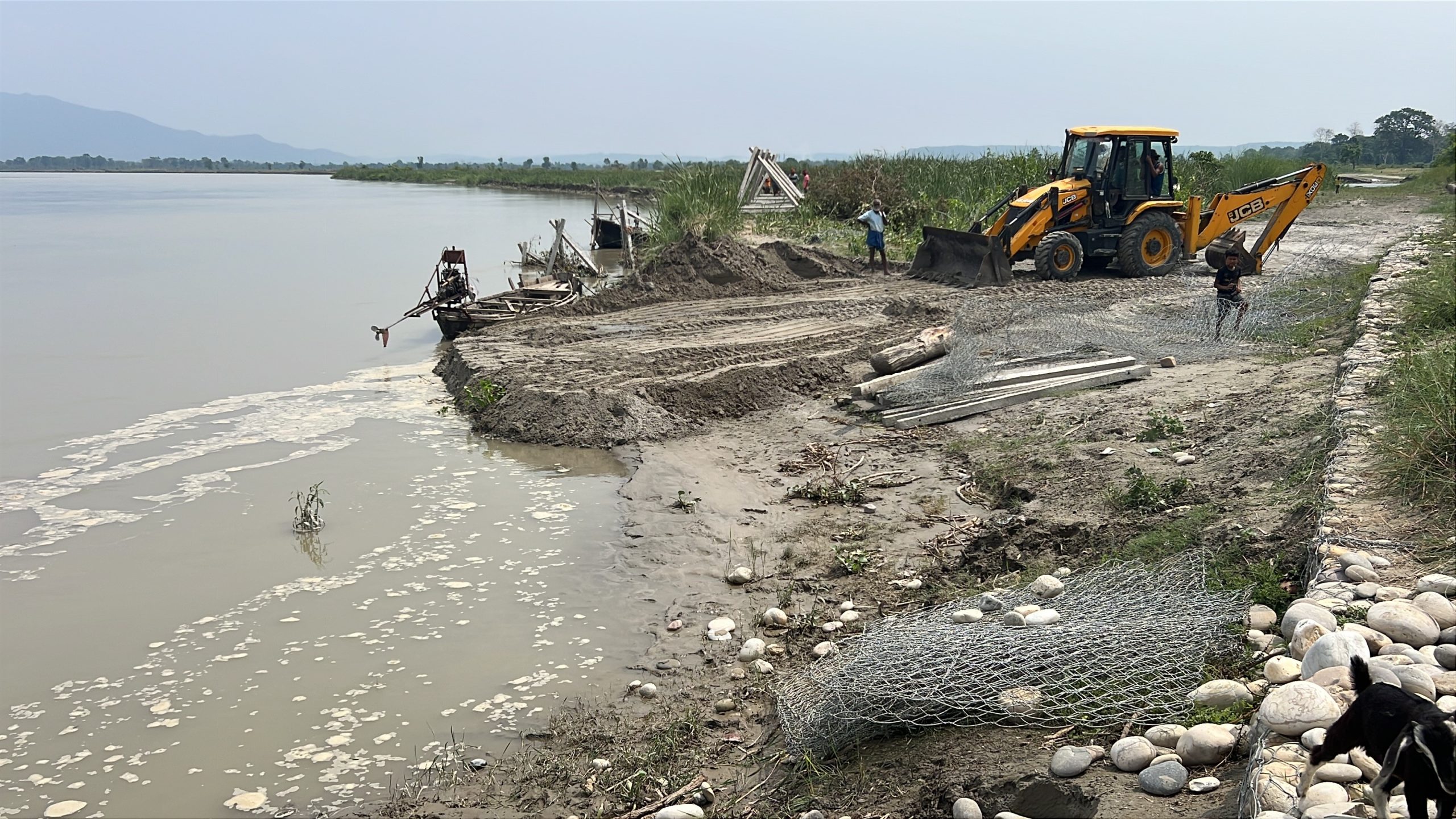
Kathmandu, 2 June: India’s Border Security Force (SSB) has obstructed Nepal’s efforts to construct an embankment in Susta Rural Municipality–5 of Nawalparasi to protect the area from erosion by the Narayani River.
According to project officials, the SSB has blocked construction even though Nepal is trying to build the embankment on its own land. Adam Khan, coordinator of the Susta Protection Campaign, said that the obstruction occurred when Nepal attempted to build a 132-meter-long embankment about 50 meters inside its own territory, north of the Susta bridge and away from the Nepal–India border.
“The area with the simal (silk cotton) tree is considered the boundary, but Nepal is trying to construct the embankment 50 meters inside its own land under a new project. However, the SSB from Valmikinagar in Bhainsalotan has stopped the work, claiming it is a disputed area,” Khan said.
Khan stated that they would not remain silent despite the obstruction. “This is Nepali land. We are ready to sacrifice our lives to protect our territory. This is part of India’s plan to encircle Susta from all sides. Tomorrow, all locals will gather at the construction site and stage a protest to pressure for the continuation of the work,” he added.
He suspects that India is trying to block the construction because if the embankment is not built, the Narayani River could flood Susta, and any change in the river’s course could alter the boundary.
Chief District Officer of West Nawalparasi, Deepak Raj Nepal, said that the obstruction by the Indian side has already been reported to the Ministry of Home Affairs, and further action will be taken based on directives from the central government.
“They have said the work violates an agreement made in 2023, claiming the area is disputed. We will study what agreement was made at that time and proceed according to instructions from the central government,” he said.
Under the federal government, the Irrigation and Water Resources Management Project in Bharatpur awarded a contract worth NPR 14 million to Hari & JV Construction Pvt. Ltd. for building the embankment. Project engineer Bel Bahadur BK said the obstruction occurred when the contractor arrived on site with the necessary equipment to begin work.
During last year’s monsoon, floodwaters entered the settlement from the northern side of Susta, forcing locals to stay awake all night and fill sandbags to protect their homes. Residents are worried that without a strong river control structure before the monsoon, Susta could be swept away by floods.
Susta is surrounded by the Narayani River on three sides and Indian territory on one side, making rescue operations difficult if flooding occurs, according to campaign coordinator Khan. Around 350 households with more than 3,200 people live in the area.
Out of Susta’s total area of 40,980 hectares, about 14,500 hectares are allegedly encroached upon by India. According to Armed Police Force (APF) BOP Susta Inspector Basant Pandit, 19,980 hectares are considered disputed, while Nepal effectively controls only about 7,000 hectares. Of this, only 556 bighas of land have official ownership certificates in the names of locals.
Previously, Susta was a village panchayat with nine wards. In 1977 (2034 BS), flooding in the Narayani River displaced the settlement. Since then, India has gradually expanded encroachment south of the displaced area, according to Kishan Sharma Gaire, an advisor to the Susta Protection Campaign.
In 1968 (2025 BS), administrative offices including a panchayat office, school, post office, and police station were established in Susta. However, during a land survey conducted in 1970 (2027 BS), Indian police reportedly detained Nepali survey officials.
They were taken to Bettiah jail in Champaran, India, and released on bail after one year. Later, in 1972 (2029 BS), a joint agreement between Nepal and India allowed a land survey in Susta, and land ownership certificates for 556 bighas were distributed.
Locals claim that India has been continuously encroaching on Susta since 2005 (2062 BS), and no boundary survey has been conducted there since then.