Myagdi, Asar 15 (29 June): Prakash Khatri, a 40-year-old youth from Kaulegauda in Beni Municipality–9, has become self-employed and self-reliant through banana farming. After working in Dubai for three years as a migrant worker, Khatri returned home and began cultivating bananas on his farmland and nearby slopes, achieving impressive income.
He initially started banana farming on three ropanis of land. Once the plants began yielding produce, he expanded into commercial banana cultivation.
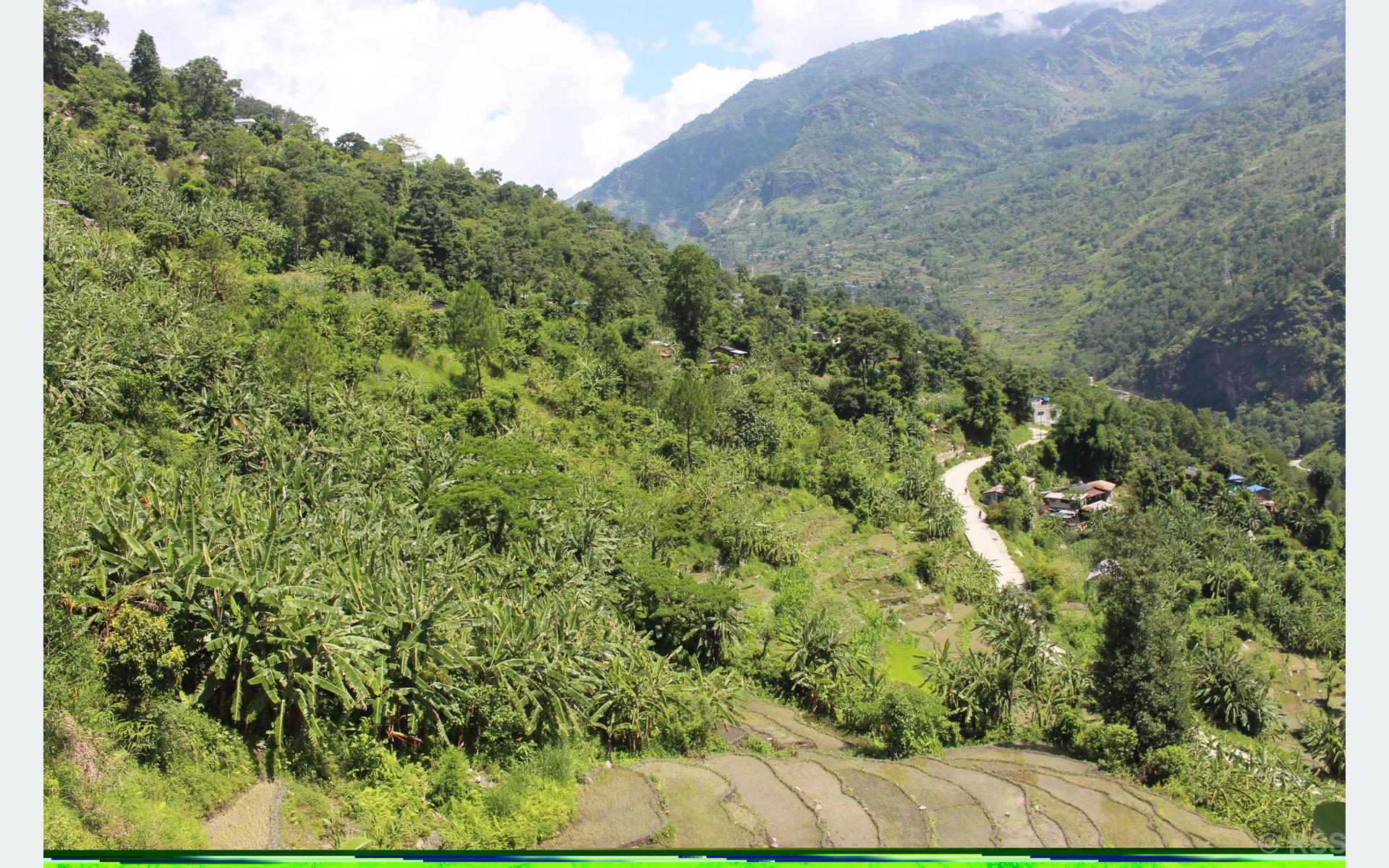
“Now, my entire land is covered with banana plants. I’ve expanded banana farming to about 25 ropanis. I earn between Rs. 1 to 1.5 million annually from bananas. I expect my income to grow further as the new plants start producing,” said Khatri. He has transformed traditional paddy fields and land previously used for crops like maize and millet into thriving commercial banana plantations.
To ensure a steady supply of fertilizer for his banana farming, Khatri has also started poultry farming. He has become a prime example of how traditional farming can be turned into a successful business and how one can earn well even while staying in Nepal through hard work and dedication. He now operates four banana plantations.
Over the past decade, banana farming has seen a surge in Kaulegauda. Around 150 households in the area are involved in banana cultivation. Commercial banana farming has expanded in areas such as Thakan, Gauthale, Mulbari, Patarukh, Barahthan, and Tusare within Kaulegauda.
Farmers like Rudra Chokhal, Deepak Khadka, Omkar Puri, Som KC, Bhagwati Basnet, and Rudra Bahadur Basnet are actively engaged in large-scale banana farming. According to Punya Chokhal, chairman of the Kaulegauda Agriculture Group, banana farming has spread over approximately 400 ropanis of land in various settlements of Kaulegauda.
A total of 25 farmers associated with the Kaulegauda Farmers’ Group have expanded banana farming over 120 ropanis of land, with Beni Municipality providing a subsidy of NPR 1.2 million and farmers contributing an equal amount in cost-sharing. According to group chairman Chokhal, two earthen ponds and one concrete reservoir have been constructed to collect water from local springs. Additionally, a 3,500-meter pipeline has been laid to supply irrigation to the banana fields.
Under the pocket area expansion program, agricultural tools and equipment such as ladders and seeders have also been purchased and distributed. Farmers in the area are cultivating banana varieties such as Hajari, Dhurse, and Murre.
In Kaulegauda, local water sources are being collected and managed for irrigation in banana farming. As commercial farming continues to grow, concerns have been raised about a potential shortage of irrigation during the winter season. For this reason, chairman Chokhal said that a request has been submitted for a lift irrigation project to draw water from the Raghu Ganga and Kaligandaki rivers.
Shifting from Grain Crops to Commercial Banana Farming
As many youths have left for foreign employment, it has become increasingly difficult to find labor for traditional grain farming in the villages. In response, locals began banana cultivation to prevent their fields from lying fallow. What started as a means to utilize unused land has now become a major source of income for the community.
Local resident Kul Bahadur Basnet shared that most villagers have planted banana trees not only on cultivable land but also on sloped, previously unused terrain.
“I’ve expanded banana farming to about eight ropanis of land. The plants have started producing now, and there’s no shortage of market to sell the bananas. It’s not hard to grow either,” said Basnet. In addition to banana farming, he also runs a small dairy business. By selling both milk and bananas in the nearby Galeshwar market, he shared that he earns around NPR 27,000 per month.
Most households in the village have now started earning cash income through banana farming. As traditional farming failed to generate cash returns and labor shortages became more common, banana cultivation quickly emerged as a viable alternative to grain crops.
Local farmer Tek Bahadur Bhandari shared that banana farming yields nearly three times more income compared to traditional grain cultivation.
For the past five years, Basnet has been growing bananas and has now expanded the cultivation to about eight ropanis of former paddy land. “Banana farming is far more profitable than growing grains. Once the saplings are planted, if irrigation is managed during the winter, the yield is very good. Previously focused on grains, we locals are now turning our attention toward fruit farming,” he said.
Pocket Area Expansion for Self-Employment and Prosperity
Myagdi district is still not fully self-sufficient in banana production. Khapra and Bagarphat in Beni Municipality–2, and Kaulegauda in Ward No. 9 are recognized as key pocket areas for banana farming. The municipality is prioritizing pocket area expansion to promote commercial farming, support farmers in becoming self-employed, make the district more self-reliant, and guide villages toward prosperity.
According to Akriti Dhungana, the agriculture officer at Beni Municipality, this fiscal year, the Banana Pocket Area Expansion Program has been implemented in Bhakimli of Ward No. 3 and Kaulegauda of Ward No. 9 to encourage farmers. She mentioned that out of the NPR 1.2 million jointly contributed by the municipality and farmer groups (each side contributing NPR 1.2 million), at least 60 percent has been invested in expanding banana cultivation.
Ward Chairperson Chakra Bahadur KC of Beni–9 stated that the farmers of Kaulegauda, who were once involved in subsistence farming, have now adopted banana farming commercially. What started as an effort to prevent farmland from lying fallow has grown into a movement that is now significantly improving local livelihoods.
The bananas produced in this area are currently being sold in the Galeshwar market and the district headquarters, Beni. With a steady local demand and traders coming directly to the village to purchase bananas, the appeal of banana farming has increased. Banana plants begin yielding fruit within two years of planting, and each plant gives rise to several clusters. Compared to other fruits, banana cultivation requires less weeding and fertilization, making it a preferred choice among farmers.
Since bananas are still being imported into Myagdi, the expansion of banana farming through pocket area development is expected to help the district become self-sufficient in banana production.