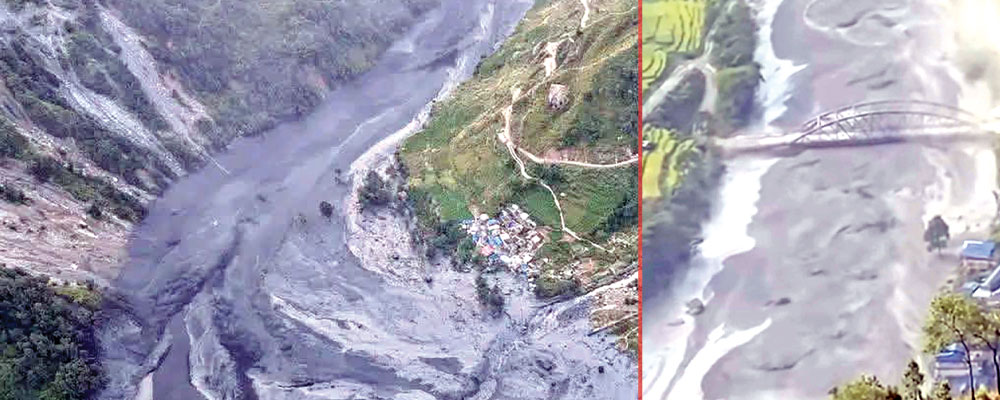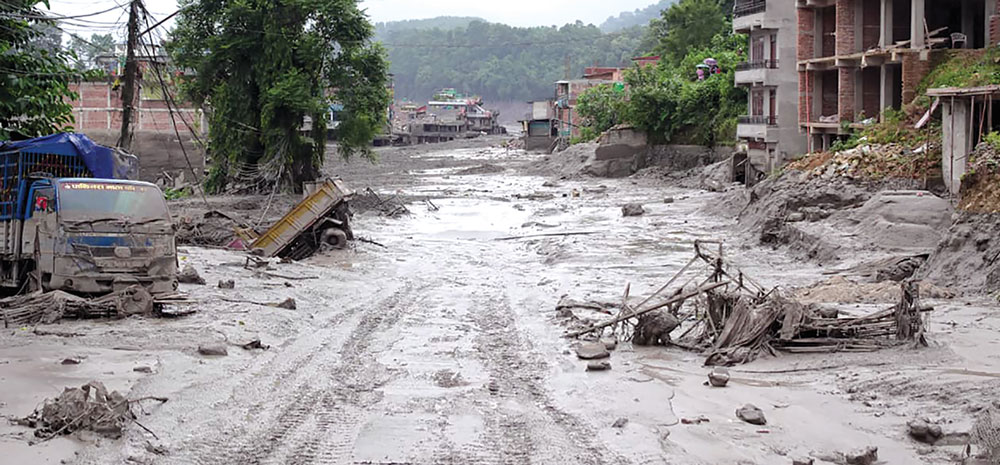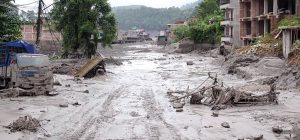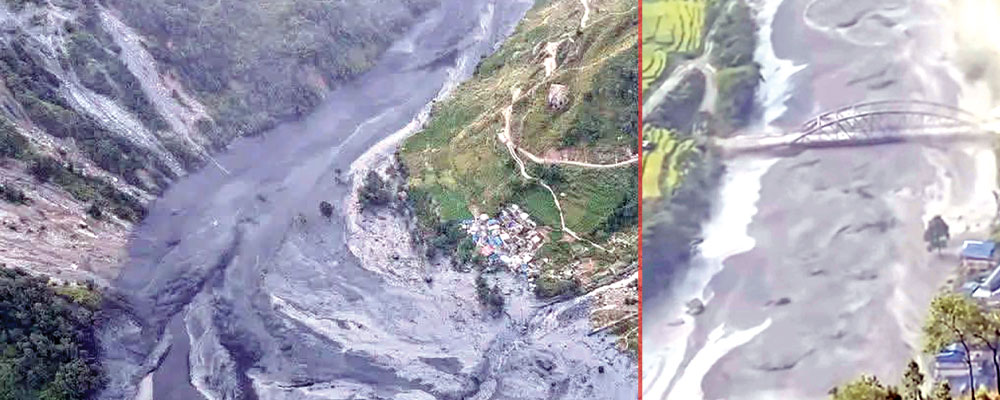
Kathmandu, 13 Oct: Multiple factors, including an avalanche, a dry landslide and ground tremors, appear to have contributed to the sudden flood carrying large amounts of debris in the Budhi Gandaki River in Chumnubri, Gorkha. A preliminary field study found that an avalanche carrying rocks fell into the Syar Khola, which flows between the Tamar and Siringe mountains, blocking the stream. Around one and a half hours later, the natural dam gave way, releasing a flood carrying soil, rocks, sand and other solid materials.
Immediately after the flood, the National Disaster Risk Reduction and Management Authority dispatched an expert team led by geologist Dr. Prakash Pokhrel to the site on Sunday.
The team used drones to study the area from the river’s source to the landslide site. It also analysed photographs, videos and materials carried downstream by the flood.
According to the team’s findings, the flood in the Budhi Gandaki River cannot be understood simply as the result of a dry landslide. The avalanche carrying rocks in the Himalayan region, the subsequent blockage of the stream by a dry landslide, and the large volume of debris released with the trapped water indicate that the flood was a complex natural event.
According to geologist Dr. Pokhrel, an avalanche carrying rocks appears to have occurred first in the Syar Khola. A subsequent dry landslide blocked the stream for around one and a half hours. The water accumulated behind the blockage did not escape all at once but was released gradually in several stages.
“The natural dam formed in the stream appears to have opened gradually in several stages rather than breaking all at once,” he said. “This may have helped reduce potential damage by preventing a huge volume of water from rushing downstream at the same time.”
Signs of an Earthquake During the Flood
The Hydrology and Water Resources Research Centre said it had also recorded indications of ground tremors around the time the landslide blocked the stream in Chumnubri. Rajan Bhattarai, the centre’s deputy executive director and spokesperson, said an earthquake measuring approximately 4.2 on the Richter scale was recorded at around 4:30 a.m. on Sunday.
Geologist Shiv Kumar Baskota said the nature of the flood provided evidence suggesting the involvement of an avalanche. He said the risks of such events in the Himalayan region must be taken seriously as glacier and glacial lake systems continue to change.
Large landslides in upper river catchment areas, rocks blocking river flows and the sudden release of water when such blockages burst are among the hazardous natural processes observed in the Himalayas. Baskota noted that because these floods carry large amounts of debris along with water, their impacts can differ significantly from those of ordinary floods and can be more destructive.
Risk from Debris, Not Just Water
Changes in flood patterns in Nepal in recent years have made disaster risk assessment and preparedness increasingly complex. Compared with floods caused primarily by rising river water levels, debris-laden floods carrying soil, rocks and sediment pose a greater risk of raising riverbeds, changing flow directions and damaging settlements along riverbanks.
According to geologist Baskota, several factors can increase these risks, including geological formations weakened by earthquakes, unplanned road construction, river blockages caused by landslides and climate change.
Assessing Changing Risks in Disaster Preparedness
Measuring water levels in rivers alone may not be sufficient to reduce the risks posed by debris-laden floods. Baskota said regular monitoring is also necessary to assess landslide conditions in upper catchment areas, identify locations where rivers could become blocked, and determine the potential routes water might take after a natural dam forms.
He stressed the importance of properly managing soil excavated during road construction, protecting natural river channels, building infrastructure based on scientific assessments and strengthening disaster preparedness.
Geological assessments should be prioritised when constructing settlements and infrastructure in high-risk areas. Since natural dams formed by river blockages in the Himalayan region can burst at any time, it is also crucial to ensure that warnings from upper catchment areas reach downstream settlements promptly.
321 People Rescued
The Nepal Army rescued 321 people by air and land on Monday. It also transported 6,170 kilograms of food and relief supplies to flood-affected areas.
According to the Army’s Directorate of Public Relations and Information, four helicopters, including an MI-17, were deployed to rescue people from various flood-affected locations in Gorkha.
On Monday, 308 people were rescued by air from locations including Philim, Chumling, Arughat, Dobhan and Hulchuk. An additional 13 people were transported to safety by land, the directorate said.
To prevent shortages of food and relief supplies in the affected areas, the Army transported 6,170 kilograms of relief materials from Kathmandu to Philim. Search operations were also underway for five people reported missing in the flood.
According to the National Disaster Risk Reduction and Management Authority, 96 people, including nine foreign nationals, were rescued on Sunday. An additional 10 foreign nationals were rescued on Monday.
Ram Bahadur KC, chief of the authority’s Disaster Response Division, said people who were at risk because of the flood, as well as those stranded in various locations because road connections had been disrupted, were rescued by air.