Kathmandu, 20 May: The Government of Nepal has proposed amendments to the Muluki Criminal Code to introduce more flexibility regarding the legal age of marriage and consensual relationships between adolescents.
Currently, marriages conducted before the age of 20 are automatically deemed invalid. However, under the proposed amendment, marriages between individuals over the age of 16 would no longer be automatically annulled. The Ministry of Law, Justice, and Parliamentary Affairs recently released a draft of the amendment stating:
“If individuals aged 16 or above get married with mutual consent and agree to live separately until the age of 20, investigation authorities may release them after documenting the agreement.”
The existing Muluki Criminal Code, in effect since Bhadra 1, 2075 (August 17, 2018), prohibits marriage before the age of 20, with violations punishable by up to 3 years in prison and a fine of up to NPR 30,000.
Now, the government is preparing to revise this seven-year-old law. If the proposed amendment is passed, only marriages involving individuals under the age of 16 will be automatically void. Marriages involving individuals between the ages of 16 and 18 will not be voided, but those involved could face up to one year in prison and a fine of NPR 10,000. For marriages involving individuals aged 18 to 20, the penalty would be a fine of up to NPR 5,000.
The draft also proposes allowing individuals to annul such marriages upon reaching the age of 20 if they do not wish to continue. However, if a child has been born or the wife is pregnant, annulment will not be possible.
Deputy Secretary of the Ministry, Prakash Neupane, said after long deliberation, the government concluded that the existing legal minimum marriage age of 20 would remain, but marriages involving individuals aged 16 and above would not be annulled if they had already taken place. He also acknowledged that the proposed 16-year threshold has drawn significant public feedback, with many suggesting that the non-annulment clause should only apply from age 18.
“We are still discussing the issue and will soon reach a conclusion,” Neupane told Onlinekhabar.
In Nepali society, many individuals still marry before reaching the legal age of 20, even though such marriages are considered illegal. While the legal age for marriage is 20, early childbirth means the minimum age of motherhood is often at least 21.
According to the Nepal Demographic and Health Survey (NDHS) 2022, 14% of girls aged 15–19 are pregnant. When this statistic is applied to the adolescent population from the 2021 Census (approximately 1.47 million), it translates to over 206,000 teenage pregnancies.
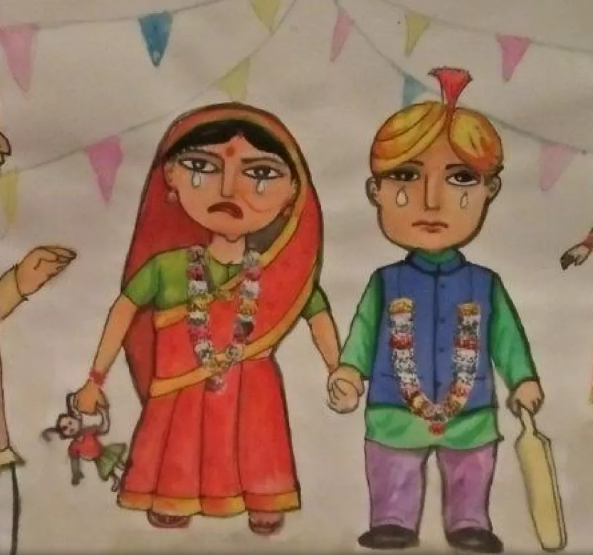
Experts argue that in such a context—where child marriages and underage pregnancies are already prevalent—the proposed legal provision to validate marriages from age 16 could worsen the situation.
They emphasize that setting the legal marriage age at 20 is based on scientific reasoning: particularly that women are not physically or mentally mature enough for childbirth before 20. The existing law was introduced with the belief that individuals should be capable of taking on family responsibilities and should be both physically and mentally mature before having children.
Obstetrician and gynecologist Dr. Kirtipal Suvedi warns that unofficial acceptance of marriage at 16 could have severe consequences on girls’ physical and mental health. He states that early pregnancy at this age could lead to long-term psychological effects on teenage girls.