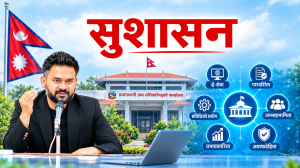
Kathmandu, March 3: Vice-Chairman of the National Planning Commission, Prof. Dr. Shivaraj Adhikari, has said that more clarity is needed in the distribution of ‘royalty’ of ‘radio frequencies’ under natural resources.
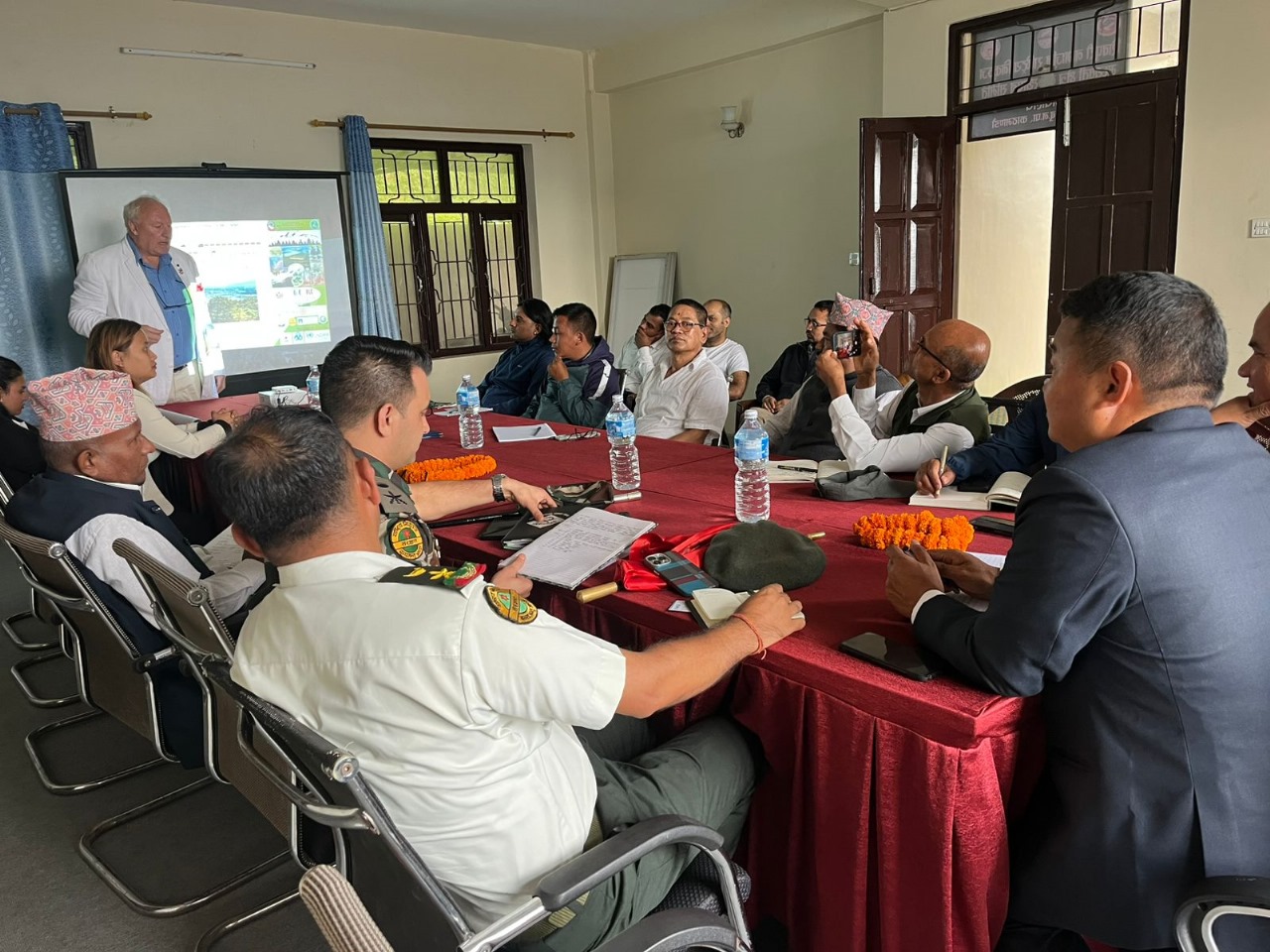
During a discussion organized by the Society of Economic Journalists of Nepal (SEJON) here today regarding the distribution of radio frequency royalties, he expressed the view that more clarity is needed in the new recommendation regarding the distribution of radio frequency royalties.
“It is also important to first clarify whether the revenue received from the use of natural resources is a royalty or a fee,” he said. “The issue of how much money to distribute at which level can be done initially on the basis of compensation and later on the basis of benefit distribution. I believe that further discussion is necessary, rather than my disagreement with the recommendation.” He mentioned that a comprehensive discussion is necessary on the distribution of such funds.
National Natural Resources and Finance Commission member Juddha Bahadur Gurung said that the commission has already submitted a report with recommendations for the distribution of royalties for radio frequencies under natural resources. He said that they have informed the Finance Minister about this matter and that the recommendation for distribution has been made in accordance with Article 69, Clause 4 of the Constitution.
The commission has based the royalty distribution on the geographical area of the province as 30 percent, BTS towers as 30 percent, population as 25 percent, and the number of mobile users as 15 percent. “In 1972, the US Supreme Court had already ruled that radio frequencies should be considered a natural resource and royalties should be collected from service providers,” he said. “It is mentioned as a natural resource in the constitutions of various countries, and in Nepal, it has also been mentioned as a natural resource in various policies.” He said that the highest royalty is being received from ‘cellular’ under radio frequencies.
Kiran Raj Sharma, Secretary of the National Natural Resources and Finance Commission, said that fair distribution of radio frequency royalties among all three levels of government is necessary and the commission has recommended accordingly. He stressed that the distribution of natural resources should be equitable. “The commission has recommended that the distribution of radio frequency royalties should be among all three levels. The report of the commission is yet to be discussed in the concerned parliamentary committee,” he said. “We expect the system to be implemented from the upcoming fiscal year.”
He said that the income generated from natural resources would be of great help to the government at a time when there is a shortage of resources. He said that if the distribution of income from natural resources reaches the local level, it would help in ensuring the resources of the local level and this would facilitate the budget formulation. He said that as mentioned in the constitution, it is based on the principles of cooperation, coexistence and coordination between the federal, provincial and local levels.
On that occasion, E. Khimananda Kandel and E. Bhuvan Poudel gave a joint presentation on the distribution of radio frequency royalty. The government is currently collecting four percent of the annual profit from service providers as radio frequency royalty.
According to the statistics of the Nepal Telecommunication Authority, frequency licenses worth Rs. 2.3 billion were received in the fiscal year 2074/75, Rs. 3.87 billion in the fiscal year 2075/76, Rs. 3.72 billion in the fiscal year 2076/77, Rs. 3.52 billion in the fiscal year 2077/78, and Rs. 3.52 billion in the fiscal year 2078/79.
Letters of appreciation to sixteen journalists
At the event, an electronic book, a collection of local and regional reports on public finance management, was released by Sejan. In addition, 16 people who contributed to the work were awarded certificates of appreciation.
According to Biswas Regmi, general secretary of SEJON, the fellowships were divided into two groups and awarded. According to him, Achyut Puri and Ranjit Tamang were awarded certificates of appreciation by the association.
In addition, China Thapa and Junu Bhattarai from Koshi Province, Mo Intekhab Alam and Hadish Khuddar from Madhesh Province, Sunil Shrestha and Keshav Samarpan from Bagmati Province were awarded certificates of appreciation. Durga Rana Magar and Reena Thapa from Gandaki Province, CP Khanal and Sudip Bhandari from Lumbini Province, Om Shahi and Tekraj KC from Karnali Province, and Gokarna Dayal and Mukesh Chaudhary from Sudurpaschim were awarded certificates of appreciation. They had done geographically focused reporting related to public finance management.