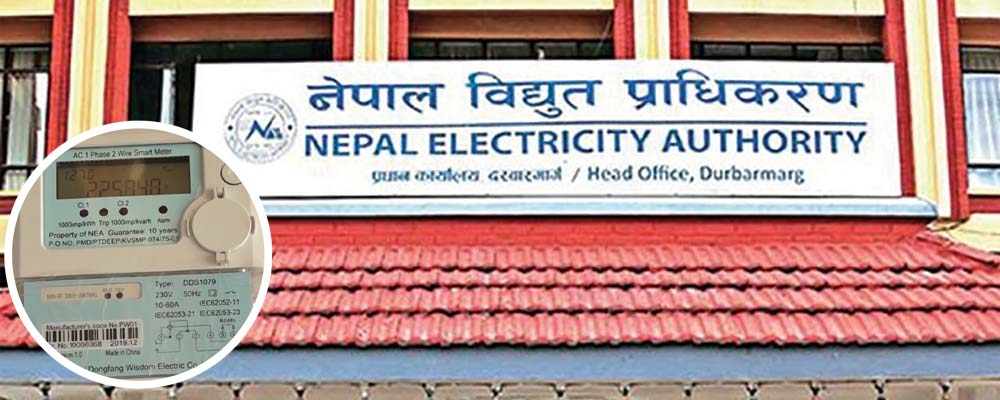
Kathmandu, 31 May: The government’s decision, through the budget for the upcoming fiscal year 2083/84, to impose value-added tax (VAT) on electricity consumption exceeding 50 units per month is expected to affect ordinary consumers. At a time when consumers are gradually becoming accustomed to using electrical appliances for household purposes, the provision of a 5% VAT is likely not only to frustrate consumers but also to hinder the country’s plans to expand electricity consumption.
Through Clause 55 of the Financial Bill presented in both houses of Parliament, Finance Minister Dr. Swarnim Wagle has proposed an amendment to the Value Added Tax Act, 2052. It states that “a tax at the rate of five percent shall be levied and collected on the taxable value from the final consumer in accordance with this Act and the rules framed under it.” Likewise, the budget speech announced that VAT at a concessional rate will be imposed on electricity consumption exceeding 50 units per month.
In recent years, the government has also been promoting the replacement of cooking gas by providing subsidies for electric stoves. Local governments, in coordination with the Alternative Energy Promotion Centre, have been implementing this campaign. Additionally, various organizations active in environmental protection and green energy promotion have been running similar programs. Stakeholders say that this budget provision will negatively affect households that have just begun adapting to increased electricity use.
Former Energy Minister Kulman Ghising has publicly opposed the government’s move. He stated that the decision to impose a 5% VAT on consumers is against public interest, contrary to energy transition goals, and against the national campaign to increase the use of domestically produced clean energy.
“At a time when electricity use for cooking, water heating, and other household purposes should be encouraged, the government appears to be penalizing consumers by adding an extra tax burden,” he wrote on social media. “Most consumers who use more than 50 units per month are ordinary households.”
“In such a situation, this decision will increase the monthly expenses of millions of families and make kitchens more expensive.” He also warned that it could reduce the use of electric stoves and push consumers back toward dependence on LPG gas. At a time when there are demands to make electricity cheaper and shift subsidies from LPG gas to electricity consumption, he believes such a policy contradicts the goals of national energy security, reducing the trade deficit, and building a green economy.
“Electricity tariffs should be made more just, progressive, and consumer-friendly; additional tax burdens should not be imposed,” Ghising wrote. “For the benefit of the general public, I strongly urge the government to immediately withdraw this additional 5% tax imposed on electricity consumers.” Not only Ghising, but other long-time experts in the energy sector have also opposed the move.
Biraj Gautam, Chief Executive Officer of the Center for Energy, Environment and Development, also described the government’s step as regressive. “At a time when national and international support is being mobilized to encourage people to adopt green energy and expand domestic electricity consumption, the government appears to be moving in the opposite direction,” he said.
Although there is no exact data on how many consumers will be affected by the implementation of VAT on electricity, millions of households are expected to be impacted. Out of around 6 million customers of the Nepal Electricity Authority, about 2.1 million consume less than 20 units. According to former Executive Director Hitendra Dev Shakya, around 2 million households consume more than 50 units. There are about 6,000 industrial customers. According to electricity sales data, around 40% of revenue comes from domestic consumers, with a similar share from industrial users.
However, it is still unclear how industrial customers will be affected by this VAT provision. Generally, since VAT allows for credit adjustment, entrepreneurs believe it will not significantly impact industrial users. According to former President of the Confederation of Nepalese Industries, Rajesh Kumar Agrawal, further clarification is needed. “Since VAT is credit-adjustable, this provision will not affect industrial customers, but as it is a new arrangement, more detailed clarification is necessary,” he said.