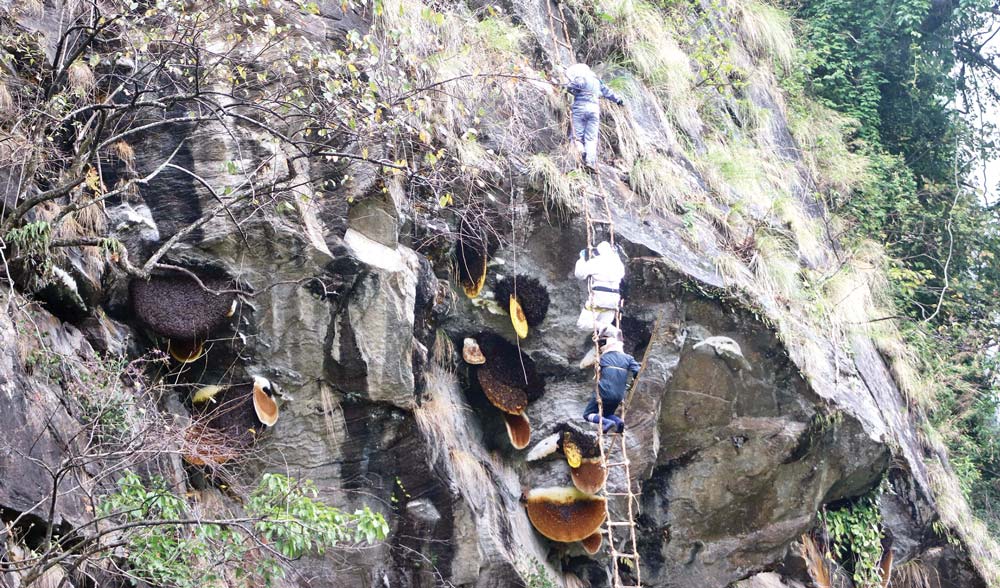
Kathmandu, 13 May: A frightening cliff—so steep that if you look up, your hat would fall off. On the cracks of the cliff, rows of wild honeybee hives hang. In places like Chipli Cliff in Mipra village of Marsyangdi Rural Municipality–4, Lamjung, as well as in other parts of the district, there is intense competition among local honey hunters to harvest honey from these cliff hives.
Anyone who watches this honey hunting—performed while hanging from ropes on such terrifying cliffs—finds it truly fascinating. In recent times, both domestic and international tourists have begun to be attracted to witness this thrilling activity.
How Honey Hunting is Done
Before starting the hunt, there is a tradition of worshipping the forest deity at the top of the cliff where the bees reside. After the पूजा (ritual), around midday, the honey hunters head toward the cliff carrying ropes with a ladder (made from babiyo fiber and wooden sticks), bamboo poles, and baskets.
A group at the top lights green leaves to create thick smoke near the hive. As the smoke rises, millions of wild bees from dozens of hives start buzzing and flying around. Despite bees as large as hornets swarming around their heads, neither the hunters nor the assisting villagers panic.
A rope about 100 hands long, fitted with the ladder, is lowered directly toward the hive. The hunters hang from this rope and begin the hunt. Some bees attack and sting them, but the hunters remain steady and focused, aiming their bamboo tools at the hive.
At the top, ropes are secured to trees and poles. Three hunters position themselves along the rope ladder—one at the top, one in the middle, and one at the bottom.
When the bees are driven away by smoke, the hunter at the bottom uses a long bamboo pole to bring the basket close to the hive. The middle hunter cuts the honeycomb using a sharp tool, while the top hunter pulls up the basket filled with honeycomb.
This process continues throughout the day.
According to honey hunter Tek Bahadur Gurung, the hive has three sections: honey at the top, bee waste in the middle, and larvae at the bottom. First, the lower and middle parts are removed, and only then is the honey collected.
From below, helpers guide the hunters using signals. They shake the rope or shout instructions like “Koitev Koitev” (poke it) and “Tochan Tochan” (pull it up), and the hunters act accordingly, said local resident Pradeep Gurung.
Tourist Attraction
This type of honey hunting is extremely rare in the world and is practiced by skilled hunters on the dangerous cliffs of Lamjung. It is carried out annually in places like Ghanpokhara, Siurung, Taghring, Bhujung, Dudhpokhari, Bansar, and Dhodeni.
Known as “Honey Hunting,” it has now become a unique attraction for tourists. Although the tradition is very old, it was first organized as a “Honey Hunting Festival” in 2006 (2063 BS) at Kapre Cliff in Taghring to promote tourism.
Since then, many villages have started showcasing honey hunting as a tourist attraction. According to Marsyangdi Rural Municipality Chairperson Arjun Gurung, watching fearless hunters extract honey from such terrifying cliffs is an unforgettable and thrilling experience for those who have never seen it before.