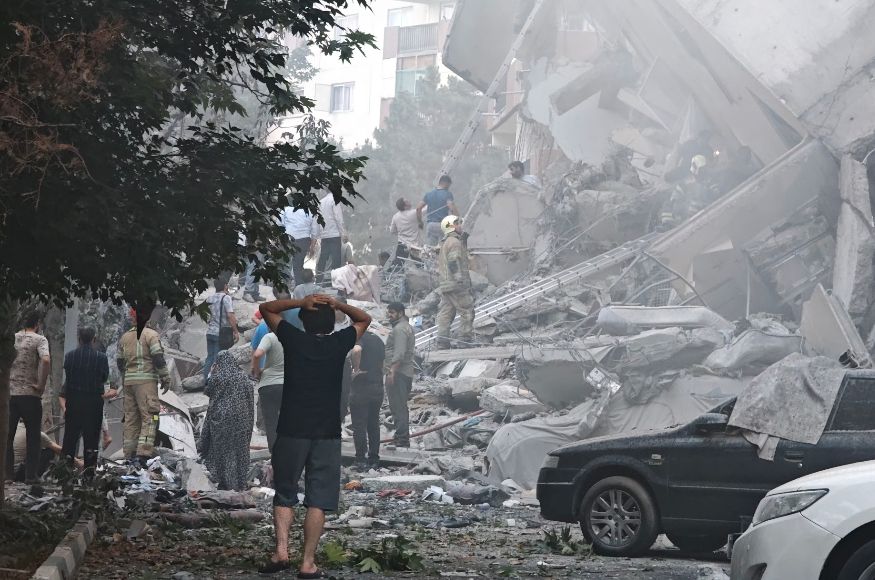
Prime Minister Benjamin Netanyahu said Saturday that Israel had “paved the way to Tehran,” amid ongoing attacks, including in Iran’s capital, against the Islamic Republic’s nuclear and ballistic missile programs, as well as strikes against fuel depots.
“We will hit every site, every target belonging to the ayatollahs’ regime — everything that they’ve experienced until now will be nothing compared to what they will feel” in the coming days, the premier said in a Hebrew video statement.
He defined Israel’s goal in its ongoing operation as “eliminating the double threat from Iran to destroy the State of Israel” — its nuclear program and its ballistic missile program.
“Very soon, you will see IAF planes above Tehran’s skies. We will hit every target belonging to the ayatollahs’ regime,” Netanyahu added.
Israel struck two fuel depots in Tehran, the Iranian oil ministry said early Sunday morning, shortly after Iran announced the launch of a new wave of strikes against Israel.
The IDF confirmed early Sunday morning striking the Iranian Defense Ministry headquarters as well as the “headquarters of the SPND nuclear project, and additional targets.” Israeli jets also struck fuel depots in the country, the military confirmed, noting that it had completed “an extensive series of strikes on targets in Tehran related to the Iranian regime’s nuclear weapons project.”
In a terse post on X shortly after midnight Sunday, Defense Minister Israel Katz wrote: “Tehran is burning.”
Katz warned Saturday that “If [Iran’s leader Ali] Khamenei continues to fire missiles at the Israeli home front, Tehran will burn.”
Iranian media earlier reported a “massive explosion” following an Israeli drone strike on the South Pars gas field.
The semi-official Tasnim news agency said production of 12 million cubic meters of gas was suspended following the South Pars attack, which resulted in a fire that the Iranian oil ministry said was later extinguished.
Oil fields — crucial to Iran’s economy — were not targeted in the first round of strikes, but a senior Israeli security official warned on Friday that if Iran were to target Israeli population centers with ballistic missiles — which it then did — Israel would target Iranian regime leaders and state infrastructure such as oil refineries.
Later Saturday evening, the IDF confirmed it was conducting airstrikes on military targets in Tehran, in a statement issued as a fourth barrage of Iranian missiles was launched toward Israel. The barrage killed at least three people in the northern Arab city of Tamra.
Iranian news agency Tasnim reported early Sunday that an Israeli strike had targeted the country’s defense ministry headquarters in Tehran and damaged one of its buildings.
In “an attack on Tehran this evening by the air force of the Zionist regime, the headquarters of the defense ministry was targeted. One of the headquarters’ buildings was lightly damaged,” the agency said. The Iranian defense ministry did not comment.
An Israel Defense Forces spokesman said Saturday evening that “Air Force pilots are continuing to strike and carry out significant blows in various areas in Iran — a sequence of strikes that has not stopped for 40 hours, including over 150 targets.”
The spokesman, Brig. Gen. Effie Defrin, focused on the Iranian capital, declaring that from Tehran, “the murderous terror regime is managed, which poses a threat to the entire Western world, and that “Tehran is no longer immune.”
Following overnight strikes between Friday and Saturday on Iranian air defenses, Defrin said “hundreds of Israeli jets and aircraft are currently holding air superiority over western Iran and Tehran.”
“The aircraft are completing a wave of strikes on strategic military industry targets, nuclear program targets, and senior officials in the Iranian terror leadership,” he added.
The security cabinet met in an underground bunker Saturday night, with the meeting ongoing as of midnight.
In footage of the sit-down released by the Prime Minister’s Office, Netanyahu was joined by, among others, Defense Minister Israel Katz, Foreign Minister Gideon Sa’ar, Finance Minister Bezalel Smotrich, Justice Minister Yariv Levin, and Energy Minister Eli Cohen.

Israelis across the country were also urged Saturday to remain near protected spaces — including apartment safe-rooms or building bomb shelters, but not underground spaces that aren’t specifically designated as safe — as the country braced for further missile barrages from Iran.
Israeli officials have emphasized — in public and in private — that the country launched its campaign on Friday in order to avert an imminent, existential threat.
Channel 12 reported Saturday that IDF Chief of Staff Lt. Gen. Eyal Zamir had told Israel’s political leaders: “The operation in Iran is an operation to defend the existence of the Jewish people. History will not forgive us if we do not act now.” He reportedly added: “This is the last opportunity to effect change.”
President Isaac Herzog called on world leaders in a public address on Saturday to support Israel “in an uncompromising manner” as it fights against Iran.
“We are at a historic crossroads, for the entire Middle East — between a terrorist jihad that seeks to dominate the region and a horizon of partnership and peace, of the day after,” he said in a video address. “This is not our war alone, but of all those who seek a common future in our region.”
He stressed that the Iranian regime “has worked against us for generations, to kill us. It has worked to create global and regional terrorism, to spread antisemitism and hatred of Israel, and above all – to develop nuclear weapons — in order to realize its ambition to destroy Israel.”
He called for national unity domestically.
From: The Times of Israel