After signing a memorandum of understanding with Ukraine to exploit its mineral resources, the Trump administration approved the sale of weapons to Ukraine for the first time last week. This sale suggests how U.S. foreign and defense policy under Trump is being increasingly guided by economic interests. According to the U.S. Defense Security Cooperation Agency (DSCA), on May 2, the Trump administration approved the sale of spare parts for F-16 fighter jets worth $310 million to Ukraine.
Prior to this, the defense magazine The War Zone had reported that unusable F-16 aircraft were being sent to Ukraine from the U.S. Air Force’s dumping site in Arizona. The recent sale did not include operational F-16 aircraft or missiles. However, European allies have reportedly pledged to provide around 85 operational F-16s to Ukraine.
This May 2 arms deal marks the first time the Trump administration has provided weapons to Ukraine since taking office. Under former President Joe Biden, the U.S. had provided $130 billion in economic and military aid to Ukraine. Ukrainian President Volodymyr Zelenskyy had publicly stated on April 15 that Ukraine wanted to purchase American weapons systems, specifically requesting the Patriot air defense system.
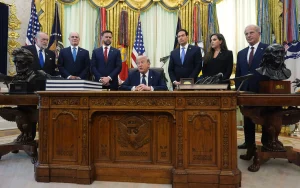
On April 30, U.S. Treasury Secretary Scott Bessent and Ukraine’s First Deputy Prime Minister Yulia Svyrydenko signed an agreement for the joint extraction of Ukraine’s mineral resources—including metals, oil, and gas. This agreement is seen as having paved the way for the subsequent weapons sale. “The agreement sends a clear message to Russia that the Trump administration is committed in the long term to an independent, sovereign, and prosperous Ukraine,” said Bessent after signing.
The agreement between the U.S. and Ukraine states that half of the revenue Ukraine earns from royalties and licensing fees related to the extracted minerals will go into a reconstruction fund. However, it does not disclose how much of their profits American investors will reinvest, nor does it mention any specific support measures from the U.S. government for facilitating the investments. Likewise, no timeline for investments is mentioned in the agreement.
Deputy PM Svyrydenko said the U.S. government would contribute to the reconstruction fund but did not specify the amount. In his May Day address, Zelenskyy called the mineral agreement a “truly equal partnership” and said it would enable both countries to “earn money together.”
Backing Away from Peace Efforts
One day after signing the mineral agreement, the Trump administration began distancing itself from efforts to establish peace in Ukraine. When Trump took office on January 20, he had promised swift peace in Ukraine. On April 17, the administration issued a final call to Russia and Ukraine to agree to a ceasefire. “Now the responsibility to reach a settlement and stop the brutal conflict lies with them,” said U.S. Vice President J.D. Vance on Fox News a few days ago.
“We don’t go around the world organizing mediation meetings,” echoed State Department spokesperson Tammy Bruce, aligning with Vance’s message. Acting National Security Advisor and Secretary of State Marco Rubio remarked that “even more pressing matters” were on his agenda—hinting at U.S. competition with China and Iran’s nuclear program.
Although Ukraine agreed to a U.S.-proposed 30-day ceasefire plan, Russia rejected it. Instead, Russian President Vladimir Putin declared a three-day ceasefire during Moscow’s grand Victory Day celebration on May 9, marking the end of World War II. Kremlin spokesman Dmitry Peskov said the ceasefire was meant to “test the willingness for a path toward long-term sustainable peace.” Ukraine, however, rejected the offer and challenged Russia to agree to a full 30-day ceasefire.
Is Russia Serious?
In the first week of May, Russia carried out 1,300 attacks, signaling its intention to continue the war against Ukraine. However, it also suffered significant casualties, according to Ukraine’s Defense Ministry. In April alone, Russia reportedly suffered 35,000 casualties, and the number rose to around 126,000 in the first four months of 2025. Despite these losses, Russia captured only 1,627 square kilometers of territory during this period, including the Kursk region which was briefly recaptured by Ukrainian forces in March, according to the Institute for the Study of War (ISW).
ISW noted that Russian advances have been slowing. “The recent fighting has been concentrated in major cities like Kupiansk, Chasiv Yar, Toretsk, and Pokrovsk, where strong Ukrainian defenses have slowed Russian progress,” said Ukrainian Commander-in-Chief Oleksandr Syrskyi.
Russia has also escalated its use of Controlled Aerial Bombs (CABs) this year. According to Ukraine’s joint military task force, 4,800 such bombs were dropped in March, 3,370 in February, and 1,830 in January. This number increased to 5,000 in April. Weighing 1.5 tons, these bombs have become one of Ukraine’s biggest challenges. Ukraine had previously asked the U.S. for long-range weapons to destroy the locations where these bombs are stored.
Ukraine’s Counteroffensive
Despite increasing Russian aggression, Ukraine has managed to maintain its frontline. In several locations, it has forced Russian forces into a defensive position. Ukraine’s military intelligence chief, Kyrylo Budanov, told The War Zone that a Ukrainian “Magura-7 unmanned drone” successfully downed two Russian Su-30 fighter jets using AIM-9 Sidewinder missiles. One pilot was rescued near the Russian Black Sea port of Novorossiysk by a civilian ship, while the other jet crashed over Crimea.
Ukraine has also intensified its use of kamikaze drones to target Russian naval vessels in the Black Sea. On December 31, one such drone attack destroyed two Russian helicopters, marking the first time a ground-launched drone was used to hit an aerial target—a new Ukrainian innovation. Since the end of 2022, Ukraine has been deploying lightweight, man-portable drones to strike enemy troops and equipment.
“In just the past two months—March and April—our drones have destroyed over 160,000 enemy targets,” said Syrskyi on Telegram. In April alone, Ukrainian drones destroyed over 83,000 targets, an 8% increase from March. Ukrainian forces also launched strikes on 62 targets inside Russian territory in April.
Last week, Ukrainian drones struck Russia’s fiber-optic systems plant in Saransk, Mordovia, for the second time in a month. This plant is Russia’s only facility producing fiber-optic systems for unmanned aerial vehicles. Ukraine also reportedly attacked another equipment production facility nearby in Saranskabel. Additionally, Ukraine has claimed attacks on airbases in Moscow and Kaluga, where cruise missiles, Tupolev Tu-22M3 strategic bombers, Su-27, and MiG-29 fighter jets are stationed.