South Korea’s Supreme Court has unanimously upheld the impeachment of impeached President Yoon Suk-yeol, formally removing him from office. Although martial law was declared last December and was in effect for a short time, it caused political turmoil in South Korea. Immediately after he announced the imposition of ‘martial law’, voices were raised against him both on the streets and in parliament.
Thousands of people gathered outside the parliament building to protest his move. MPs attended an emergency vote to override the declaration, voting against the president’s move to impose martial law, and ultimately defeated Yun’s move. Within hours, he had withdrawn martial law, accepting the parliament’s decision through a vote.
However, after the president announced his withdrawal, parliament moved forward with impeachment proceedings against the president and the motion was passed. There is now a legal requirement for elections to be held within 60 days of the impeachment being upheld. Yun is also facing a separate charge of treason, which will be heard separately.
Yun was suspended by lawmakers on December 3 for attempting to overthrow civilian rule by deploying armed soldiers to parliament. He was also arrested as part of a separate criminal case on charges of sedition. Millions of Koreans watched the Constitutional Court deliver its verdict live on television.
“Considering the serious negative impact and far-reaching consequences of the defendant’s constitutional violation, we uphold the parliament’s decision to impeach the defendant President Yun Suk-yeol,” acting court president Moon Hyung-bae said in delivering the ruling.
The ruling allows Yun to be removed from office with immediate effect and orders a new presidential election to be held within 60 days. Authorities will announce the date in the coming days. The judges noted in their ruling that Yun’s actions “violated the rule of law and the fundamental principles of democratic governance.”
Yun’s sending armed soldiers to parliament to prevent lawmakers from voting on his decree is a ‘violation of the armed forces’ political neutrality’. The judges have ruled that he deployed the army for ‘political purposes’.
“Ultimately, the defendant’s unconstitutional and unlawful actions constitute a betrayal of the public trust and a serious violation of the law that cannot be tolerated,” the ruling said. Opposition lawmakers applauded the verdict, calling it “historic,” while lawmakers from the United Party filed a petition outside the court.
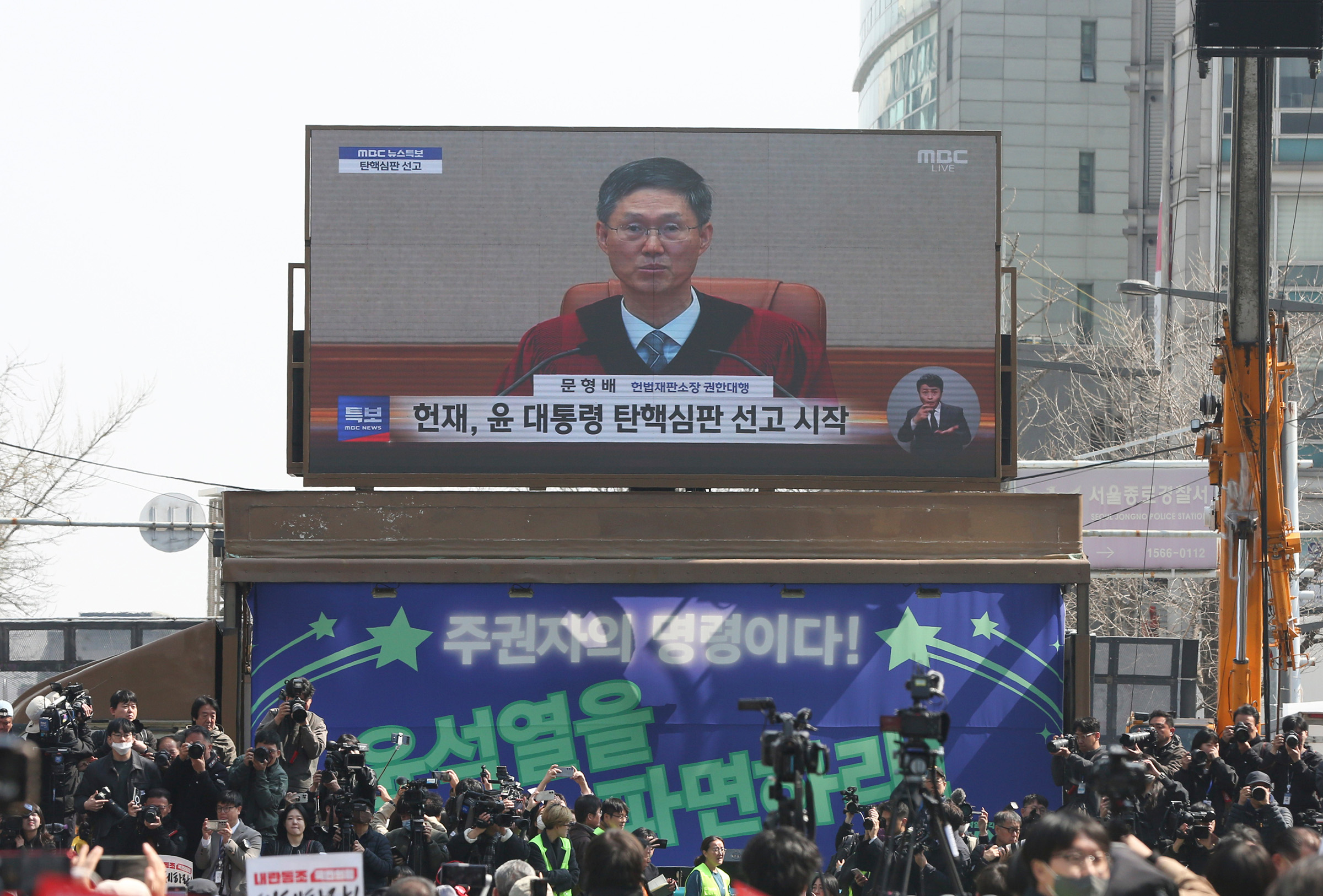
South Korean President Yoon Suk-yeol was ousted from office Friday as the constitutional court upheld a motion by the parliament to impeach Yoon over his short-lived martial law imposition last December.
Moon Hyung-bae, acting chief of the court, read out a ruling on Yoon’s impeachment, which was broadcast live nationwide, saying it was a unanimous decision of eight justices. (Xinhua/Yao Qilin)
Reactions for and against the decision
In a brief statement released after the verdict, Yoon apologized for failing to meet the public’s “expectations.” He is the second South Korean leader to be impeached by a court, after Park Geun-hye in 2017. Yun’s supporters have claimed injustice against him, while opponents have expressed joy.
“We fought for months against the UN’s move in favor of democracy, and finally we have received justice from the courts,” said one protester at the anti-UN demonstration, speaking on condition of anonymity. After weeks of tense hearings, the judges deliberated on the case for more than a month, and public unrest flared.
Police raised security alert to the highest level on Friday. Authorities surrounded the courthouse with vehicles and deployed special security forces in the vicinity. This year, at least two staunch Yun supporters have died after setting themselves on fire in protest against the leader’s impeachment.
“This decision demonstrates, first and foremost, the resilience of South Korean democracy,” Byung-hwan Son, a professor at George Mason University, told AFP. “The fact that the system has not collapsed shows that Korean democracy can survive even the worst ‘coup’ against it.”
According to Yonhap, Yun’s picture will be removed from the military office on Friday. According to Defense Ministry regulations, a picture of the country’s commander-in-chief must be kept in their office.
Yoon’s tenure and the moral pressure he faced
Yoon, a hardline conservative, was elected president in 2022, but came under moral pressure after the opposition party won a landslide victory in parliamentary elections in April. Since then, his government has been unable to pass the laws it wants and has been limited to vetoing bills passed by the liberal opposition.
His popularity has also declined as he has been implicated in several corruption cases. He was accused of receiving an expensive designer handbag as a gift from his wife and of manipulating the stock market.
Then last month, he apologized on national television and announced the creation of an office to monitor the responsibilities of his wife, who is also the “First Lady,” but rejected calls for a thorough investigation into the matter.