Myagdi, 3 March: The family of Dhruba Khatri of Mangala Rural Municipality-2 Sim, Myagdi, who spent three years in Singapore and five years in Cyprus in the course of employment, was residing in Pokhara before 2076 BS(2020). KC, who came to his birthplace from Pokhara during the lockdown imposed to prevent the spread of the Corona epidemic, has been residing in SIM village for the last five years.
“After we, the five descendants of our grandfather, moved abroad and into the city, we gave the land here to others to lease,” he said. “After the coronavirus pandemic, I returned to the village and have been cultivating indigenous rice by renting 100 ropanis of land from my ancestors and my brother.”
Through Simkaji Brothers Venture Pvt. Ltd., Khatri has cultivated native gauriya, old paddy, maize and wheat, as well as buffaloes. The fertile Sim, Simalchaur, Babiyachaur, Pok, Satbise, Shera, Pipalbot, Ranwang and Chhiswang fields with irrigation facilities on the banks of the Myagdi River are considered to be the best food crop producing lands in the district.
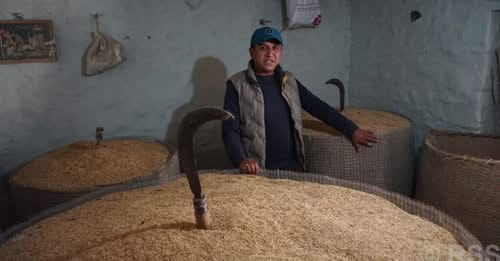
Khatri’s ancestors came from Pokhara three hundred years ago and bought land in Sima. Khatri has grown 100 muri of paddy this year. He has set up an electric mill at home to turn unsold paddy into rice. “I keep 25 muri of paddy at home and sell 75 muri,” Khatri said. “Paddish is sold at Rs. 400 per muri and rice at Rs. 1,000 per muri.”
Gauriya rice, which has a distinct aroma when cooked and is delicious when eaten, is a native crop of Myagdi. From star hotels in the city market to businessmen, high-level leaders, and employees, consumers of Gauriya rice.
“When Gauria rice is cooked, the whole field smells good. When Gauria rice is cooked in the kitchen, the aroma spreads all the way to the entrance,” said Khatri. “Those who eat Gauria rice do not like other types of rice. They only seek Gauria.” According to locals, the scientific and English names of Gauria, which have been cultivated for four generations, have not yet been identified.
Chabi Lal Kandel, a farmer of Pipalbot, says that Gauriya is named after the rice fields on the banks of the Myagdi River. Gauriya rice is suitable for making rice, pulao, kheer and bread. Gauriya rice plants grow in warm places and require a lot of water for irrigation. Gauriya rice, which is planted on Asar 15, is harvested around Kartik 15.
The grains of Gauriya rice are smaller than other varieties. Gauriya’s productivity is lower than other varieties. Consumers have experienced that consuming Gauriya rice, which looks more ricey when cooked, also helps in weight loss. It is said that pregnant and lactating women should consume Gauriya rice.
Khatri, who has entrusted his Pokhara property to his children, has also started a restaurant with a grocery shop and buffalo farming in Sima. Khatri said that he sells more than Rs 1 million worth of paddy, rice, milk, goats and chickens annually. Along with one local Lime-Parkote and two advanced Murra buffaloes, Khatri has also raised goats to produce goats. He currently sells 10 liters of milk daily and is planning to increase the number of buffaloes.
Khatri’s wife has supported him in farming and business. He has provided employment to one person regularly and to many others during the import season. Khatri has considered the lack of manpower to work in the fields due to the increasing attraction of foreign employment, the increase in wage prices, and the change in farming patterns due to rising temperatures as challenges.
Khatri, who is preparing to run a ‘homestay’ in a house built by his ancestors three hundred years ago, plans to offer guests local dishes of Gauriya rice, buffalo milk and curd, chicken and goat meat. Khatri, who is also involved in social activities, has plans to develop Sim as an agricultural and tourist village. Sim, which is accessible by a blacktop road 12.5 kilometers west of Beni, is 4.5 kilometers from Singa Tatopani, a natural healing site.
At a time when migration and going abroad are increasing in many Nepali cities for employment, opportunities and facilities, Khatri, who returned to his village from abroad and for market distribution, has given a positive message, said Dhan Bahadur Khati Khatri, ward chair of Mangala Rural Municipality-2. “We have also supported the efforts of Dhruba, who has set an example that there are possibilities and opportunities in the village,” he said. “The Ghureni Kotrabang Irrigation Project is under construction with the investment of the Gandaki Province government for irrigation facilities in Sim, Kotrabang and Torahet.”