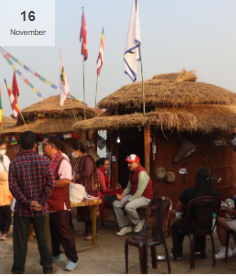
Nawalpur (Nawalparasi), 16 of November: In the second edition of Gandaki Prades Mahotsav-2081 which is being conducted at Gaandkot-2 in Nawalparasi (Bardaghat-Sustapurba), efforts have been made to preserve ethnic culture. In order to preserve the original culture of the various tribal tribes in Nawalpur, the festival visitors are given cultural awareness by building their traditional houses.
In the festival, Tharu, Magar, Gurung, Tamang and Chepang caste houses were built and traditional household tools used by them were exhibited along with original food. In the festival, which has been running since last November 26, along with the cultural house of the Chepang tribe, their clothes, their food, bantarul, githa, vyakur, pindalu(malanga) and syakhu are kept. Similarly, in the cultural house of the Magar caste, the tools they use are Nhangli (Nanglo), Pirankhu (Perungo), Khurpa Tac, Khanchri, Mujura, Janto, Odan, Dhiki. Similarly, Masrangi Magar, President of Nepal Magar Association, Gaindakot City, said that visitors are welcomed by cooking meat batuk, which is eaten during the festivals of the Magar tribe.
Magar, who is also the coordinator of the cultural committee of the festival, said that since the culture of the tribes is disappearing, the cultural houses have been placed in the festival to inform the new generation about this and to draw the attention of the local government for preservation. According to him, the traditional materials used by those castes are kept along with the ethnic cultural houses as long as they are available. “Because the new generation is not interested, the culture of tribal tribes is disappearing,” he said, “Our efforts can make the new generation aware of conservation, and people from other communities will understand our culture easily.”
Amrit Bhattachan, President of Nepal Confederation of Industry and Commerce Gandaki Province and coordinator of the main committee of the festival, said that they are aware of cultural preservation as well as financial gain. “You can get information about their culture and the materials they use by visiting the cultural house of ethnic people,” he said. He informed that the traditional foods eaten by those castes are kept for display and sale in the cultural house. “Ghongi, chichar, duck dishes, dhikar (a type of bread cooked by steaming rice flour) are kept for exhibition and sale in Tharu’s cultural house,” President Bhattachan said. Traditional instruments such as Juwa and Nara are also kept. In the houses of all the five castes, the traditional but endangered materials used by them have been displayed.
President Bhattachan said that cultural houses were built in the festival to preserve the original culture of the castes. “The present generation has no knowledge about the traditional settlement and culture” he said, “This house has been built to include the endangered caste with the aim of informing them about the cultural things of our caste, the dress and lifestyle.” Bhattachan said that building a cultural house during the fair will be important for all communities to know and be aware of the culture of the caste and for the transfer of culture from generation to generation.
The cultural committee coordinator of the festival, Magar, said that a cultural house was built in the festival by including the communities living in the plains to the mountains and the Himalayan regions of Nepal. Magar said that cultural houses that reflect the art, culture and lifestyle of the Gurung, Magar Tamang, Bhawar area, Chepang and Terai communities have kept the history alive and also increased the attraction of the festival. He said that today’s young generation listens, but audiences come to the cultural house to taste Githa and Vakur, which were used earlier, and to understand the culture through direct observation.
Lalit Bahadur Gurung, former president of Gaindakot Adivasi Tribes Association, said that not only the cultural houses of the tribals, but also the cultural houses of the Chhetri and Brahmin communities should be kept in the Mela Mahotsav. “Kshetri, even the Brahmin community has its own art and culture, they have reached a state of extinction.” Mentioning that everyone loves their art and culture, the former president Gurung said that the cultural identity held at the festival will help to understand each other’s culture and strengthen the brotherly relationship between Nepalese people.
He said that he has initiated the construction of a cultural house for the identity of the castes who have come from other places and are living in Nawalpur and for their originality. According to Gurung, traditional tools and food items that reflect their lifestyle are kept in the festival along with the cultural house so that every audience can see and learn about their culture. It has been taken with interest because it was built in the beginning so that the eyes of anyone who enters this festival will go to the cultural house next to the entrance.
The roofs of houses built in a very artistic way are covered with thatch. In the house wrapped with bamboo, various arts and figures can be seen painted on the walls reflecting the ethnic culture. Kaligarhs of the same caste were used for the construction of the cultural house in the festival.
Youth Ramprasad Khanal, who came to see the festival in Chitwan’s Bharatpur, said that the cultural house at the festival helped him to understand the art and culture of the tribe. “I had heard a lot about the Chepang who live in the Bhawar area, I had heard about the kandamul they eat, but I was not able to see it,” said Khanal, “I got to see and understand the ethnic identity of Chepang and other races directly when I came to the Gandaki province festival.” At the festival, he said that keeping the food and culture that reflects the originality of the tribe along with the traditional house is a good effort to preserve the culture.
Sujata Kunwar, who arrived at this festival from Pokhara in Kaski, said that it was fun to see and taste Dhikar, Ghongi, which she had never experienced in her life. “The materials that reflect our originality help us to understand our history, art and culture,” he said, “along with that, they also contribute significantly to the preservation of culture along with internal and external tourism promotion.” He says that understanding the culture and understanding the way they cook and cook the dishes they use will be beneficial for food connoisseurs.