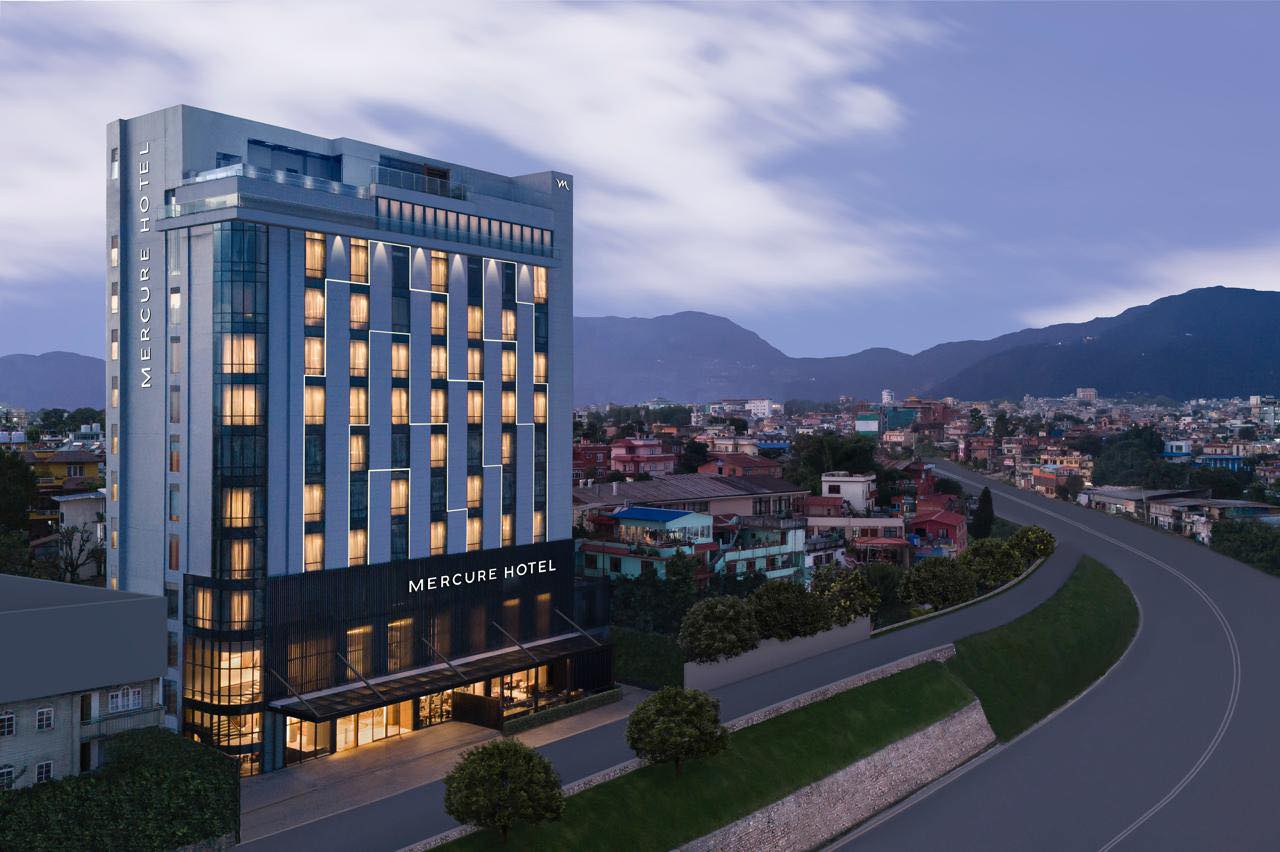
Kathmandu, 31 Chaitra(13 April): The five-star hotel ‘Mercure Kathmandu’ came into operation in Sukedhara, Kathmandu in January. The hotel, brought into operation by tourism entrepreneur Deshbandhu Basnet with an investment of 3 billion rupees, is being managed by French hotel management company Accor Group.
Before that, the five-star hotel ‘Hilton Kathmandu’ came into operation in Naxal, Kathmandu, last July. The hotel was brought into operation by Shankar Group at a cost of 8.35 billion rupees. Also, Temple Bell Boutique Hotel and Spa Pvt. Ltd. came into operation at Lakeside in Pokhara at the end of this Chaitra. It was operated by the Chilli Group led by tourism entrepreneur Bishwaraj Poudel with an investment of 1.25 billion rupees.
In addition, Siddharth Hospitality has been aggressively expanding its business as a chain hotel. This year, a three-star ‘Siddharth Hotel Damauli’ has been launched in Damauli, Tanahun under the management of Siddharth Hospitality. Siddharth had recently launched Siddharth Cottage in Butwal and has started construction of a five-star hotel in Dhangadhi. Siddharth has stated that he is aggressively expanding his business and is working to establish hotels in other places soon. Similarly, from the beginning of the new year, i.e. 1st of Baisakh, he is also expanding his services through Central Plum Hotel in Bharatpur and Sarang Wildlife Sanctuary in Meghuli.
The trend of opening five-star to tourist-level hotels not only in the federal capital Kathmandu but also in various cities of the country continued this year. In this, foreign chain hotels as well as domestic companies have continued to expand the hotel business.
In addition, last month, the Guna Group launched Hotel Royal Tulip with an investment of Rs 6 billion, while last month, the four-star West Western Plus Hotel in Gaushala Pingalasthan, Kathmandu, with an investment of Rs 1.5 billion, was launched. Similarly, the under-construction hotel in Shesh Ghale could not be launched this year either. Experts say that the investment in the hotel has now reached 12 billion rupees. According to the Hotel Association of Nepal (HAN), investment in hotels has been flowing in the last few years, which continued in 2081. According to HAN, hotels have now been built to accommodate 3.5 million tourists annually.
Despite billions of rupees being invested in hotels, businessmen complain that the expected returns have not been achieved. HAN Chairman Binayak Shah says that although the infrastructure to accommodate 3.5 million tourists has been built in hotels with billions of rupees invested, only one-third has been utilized. “Hotels are being built, but the expected benefits have not been realized,” he said.
According to him, although it was a good year in terms of investment, the returns have been low. “On the one hand, the trend of international chain hotels coming one after another continues. When world-famous chain hotels come, a positive message about Nepal is spread in the international world,” he said.
Adding international chain hotels
According to the Hotel Association, this year alone, about a dozen five-star and chain hotels have come into operation. Another half a dozen are in the pipeline. In the last decade, chain hotels including Marriott, Lemon Tree, Ramada, Dusit Thani, Sintamani, Princess, Aloft, Hyatt Palace have come into operation. Star hotels are being built in Kathmandu, Pokhara, Lumbini, Biratnagar, Butwal, Bhairahawa, Nepalgunj and other areas.
The government has recently introduced a new law and recognized the hotel industry as a national priority industry. This has encouraged businessmen who have invested in the hotel industry. Association President Shah expressed confidence that foreign tourists will increase in the future and hotel occupancy will increase.
He said, “The government has recently classified the hotel industry as a national priority industry in the act it introduced. This has encouraged hotel entrepreneurs. The government has addressed an issue that tourism entrepreneurs have been raising for a long time, and this has encouraged the entire tourism industry and entrepreneurs.”
According to the Department of Tourism, there are 337 tourist-level hotels operating across the country so far. Currently, only 23 five-star hotels are operating in Nepal. There are three five-star deluxe hotels. There are 41 four-star hotels across the country. Similarly, there are four heritage (four-star) hotels in the deluxe category and 37 three-star hotels in operation. There are about fifty two-star and one-star hotels. In addition, hotels of various levels, including luxury boutique and heritage, resorts and ordinary resorts, are also operating. The number of hotels affiliated with the Hoteliers’ Federation is also significant.
Aggressive international marketing
The Nepal Tourism Board has stated that with the increase in investment in infrastructure including hotels, they have also prioritized international marketing. The board’s Chief Executive Officer (CEO) Deepak Raj Joshi informed that the board is aggressively promoting internationally. He said, “In the last four to five months, we have organized 17 B-to-B programs and Nepal promotion programs abroad, in which more than 200 Nepali tour operators, hoteliers, and airline representatives have participated and promoted Nepal as a destination.”
According to CEO Joshi, tourism has been promoted by taking foreign ‘influencers, media’ to Nepal’s destinations. So far, 114 people have been taken on tours. “Foreign tourist arrivals in Nepal have reached pre-corona levels, international tourism has also recovered by 95 percent, in the context of Nepal, if more airlines are added and three international airports are fully operational, the number of tourists will definitely increase in the coming days,” he said.
If the air infrastructure and road network are good, it will be easier to achieve the set target. Tribhuvan International Airport is operating at full capacity. However, Gautam Buddha International Airport in Bhairahawa and Pokhara International Airport have not been able to operate effectively.
Ministry of Tourism on policy departure
The Ministry of Culture, Tourism and Civil Aviation has stated that it has taken forward significant policy and structural reforms in a year. The formulation of laws and regulations related to culture, tourism and civil aviation has been effectively taken forward. The Civil Aviation Authority Bill has been registered in the Federal Parliament. If passed, it is believed that it will help remove Nepal from the European Union (EU) security list.
Tourism Minister Badri Prasad Pandey said that the law-making process has been accelerated. According to him, a draft of the aviation policy has been prepared. A draft of the formation of the Air Accident Investigation Commission has been prepared. The draft of the Tourism Act has been prepared and is under discussion in the Council of Ministers and will be submitted to the Parliament soon. Minister Pandey informed that the tourism policy, culture policy and aviation policy are in the process of being taken to the Parliament.
Minister Pandey said that some steps have been taken to make the Tourism Board and Nepal Airlines active. He said that work has been taken forward by making an action plan for the effective operation of Gautam Buddha International Airport in Bhairahawa and Pokhara International Airport. He also informed that various measures are being sought to improve the management of the Nepal Airlines Corporation. Stating that the corporation cannot be made profitable without increasing the number of aircraft, he informed that measures are being sought to improve management.
Achievements in the tourism sector
In the year 2081, there have been positive efforts for policy and structural reforms in the tourism sector. Work has been started for structural reforms of the Nepal Airlines Corporation. Initiatives are being taken to make the service more effective by adding aircraft. Work is underway to upgrade the regional hub airport and build a modern terminal building. Work is underway to increase the capacity of Tribhuvan International Airport (TIA). This year, the airport has been upgraded for about five months by closing flights for 10 hours daily.
The Air Transport Capacity Enhancement Project under the Civil Aviation Authority of Nepal is expanding the parallel ‘taxi way’ on the south-west side of the airport, the ‘international apron’ on the north side and the ‘hangar apron’ on the east side of the airport at a cost of Rs 15 billion. The project has stated that about 95 percent of the work has been completed so far. The ministry has claimed that it is working effectively for the protection and promotion of culture, sustainable development of the overall tourism sector and upgradation of the civil aviation sector.
Acceleration in infrastructure construction
Tourist police units have been expanded in Khaptad in Sudurpaschim Province and Rara in Karnali Province. The ministry’s progress report states that a detailed project has been started by selecting one location in each of the four provinces with the aim of building a hill station in each province.
Rajbiraj Airport has been made operational with night landing capability. With this, 10 airports are now capable of operating night flights. Additional land acquisition in the area identified as an archaeological site, on-site observation by a UNESCO ICIMOD mission, and other activities have been carried out to include Tilaurakot in Kapilvastu in the World Heritage List.
Kumarmani Thapaliya, president of the Nepal Association of Tours and Travel Agents (NATTA), said that overall, the year 2081 was a year of hope and disappointment. “It was a year of hope and disappointment,” he said. “There were international flights at Bhairahawa Airport, but flights were suspended in the latter half of the year. Overall, a lot of good work has been done, although there is a lot of work to be done.”