Mustang, 2 March: Recently, the conflict between snow leopards and humans in Upper Mustang has started to put the livestock farming industry in crisis. The centuries-old livestock farming business of farmers in Upper Mustang is facing crisis as the fear of snow leopards repeatedly attacks local livestock and causes damage.
There is no reliable data on snow leopards in the district. In Upper Mustang, which is owned by the Annapurna Conservation Area Project (ACAP), snow leopards have entered pastures, pastures and cattle sheds and damaged livestock, which has increased the risk of extinction for livestock farmers in Upper Mustang. Climate change has started shrinking pasture areas in the high Himalayan mountains, grass has stopped growing in pasture areas, and it has been found that the main food of the snow leopard, the narwhal, is coming down to the settlements in search of grass. The risk of damage to domestic livestock has increased when the queen of the Himalayas, the snow leopard, follows the narwhal in search of food. However, conservationists have different opinions on the snow leopard’s entry into roads and settlements.
In the last two years, snow leopards have been seen near roads and settlements in Upper Mustang. Last year, two snow leopards were seen near Kagbeni village in Mustang. As snow leopards began to be seen on roads and settlements in broad daylight, the risk of damage to domesticated horses, mules, yaks, and sheep raised by local livestock keepers has increased.
Two years ago, a snow leopard attacked and killed 79 sheep belonging to local farmer Mingmar Gurung in Dhakmar, Loghekar Damodarkunda-2. Four snow leopards climbed over the mesh in the sheep pen, which was also fenced, and entered the cage, causing damage to a large number of sheep belonging to Gurung. Similarly, in the first week of Falgun this year, four out of the 33 sheep kept in the pen of local livestock farmer Navin Kumar Gurung of Samar, Baragung Muktikshetra-3, Mustang, were attacked and killed by snow leopards. Navin and Mingmar are just representative characters. In Mustang, snow leopards have caused damage to the livestock of dozens of livestock farmers in Lomanthang, Loghekar Damodarkunda, Baragung Muktikshetra, Gharpajhong and Thasang. Due to this, the risk of snow leopards and wildlife in the livestock farming business in Mustang has increased.
The National Trust for Nature Conservation, Annapurna Conservation Area Project (ACAP) Lomanthang has said that snow leopards have damaged 13 livestock in the 10 months of the current fiscal year. According to Umesh Poudel, head of the ACAP Lomanthang office, three horses, six hyenas and four yaks were attacked and damaged by snow leopards from Shrawan to mid-Magh of the current fiscal year 2081/82(2024/025).
Similarly, last year, snow leopards damaged a total of 180 livestock belonging to various livestock farmers under Lomanthang and Loghekar Damodarkunda rural municipalities of Upper Mustang. According to the records of the ACAP Office Lomanthang, last year, snow leopards killed 14 horses, 154 wild boars and 12 sheep. In Mustang, 65 livestock belonging to 13 households across all five municipalities of Mustang were damaged in the fiscal year 2079/80(2023/024).
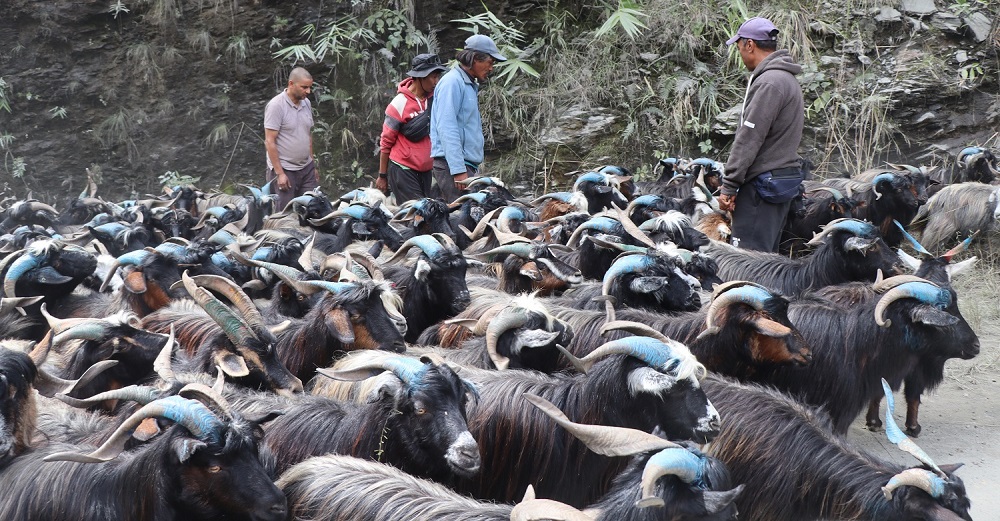
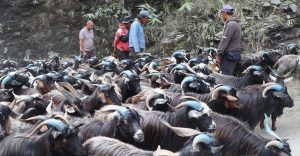
Yaks, horses and sheep are reared as ancestral businesses in the district. This is not limited to the economic business here, but is also linked to the Himalayan culture. The ACAP office distributes relief to the yak and sheep farmers reared in this way after completing the necessary procedures as per the rules. However, although ACAP distributes relief for wildlife damage, the number of livestock farmers in Upper Mustang contacting ACAP for relief is low, according to Poudel, head of the ACAP Lomanthang office. He said that even if wildlife victims occur, they are unable to contact them for relief, which makes it difficult to collect accurate data on wildlife damage. “We have asked the community to report any wildlife damage. There is also a conservation area management committee and a police unit,” said Poudel, head of the ACAP Lomanthang office. “The ACAP office facilitates all paperwork processes from collecting details of wildlife damage to deploying staff.” Office Chief Poudel informed that the wildlife damage money will arrive soon and will be distributed to the victims after reaching the community.
Although wildlife victims in Upper Mustang under ECAP Lomanthang have not been able to receive relief for the past two years, the ECAP Jomsom office has been continuously distributing damage relief to wildlife victims.
In case of livestock damage, relief is distributed after estimating the cost of damage with the presence of the ACAP office, police, Conservation Management Committee and veterinarians of the Animal Veterinary Hospital. ACAP has implemented the Wildlife Damage Directive, 2080, exercising the authority granted by Section 33 ‘A’ of the National Parks and Wildlife Conservation Act, 2029. ACAP says that the new directive, which has been implemented with the aim of making the process of distributing relief to wildlife victims easy and systematic, will help in providing relief to livestock farmers.