Kathmandu, 01 June: Public transport operators staged a protest in Kathmandu, claiming that the government is preparing to introduce regulations allowing private vehicles to operate like public transport.
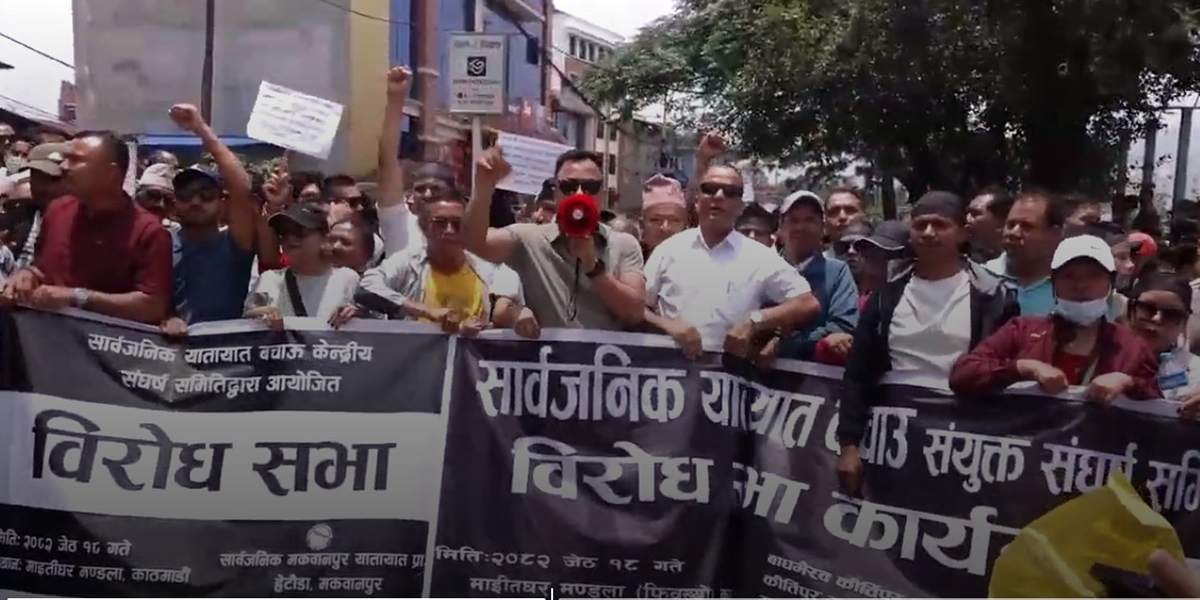
The Central Struggle Committee for the Protection of Public Transport organized a protest on Sunday, marching with black banners from Maitighar to Bijulibazar. They argue that the provincial governments are drafting regulations that contradict the Vehicle Act and conflict with the federal government’s authority by permitting private vehicles to carry passengers like public transport. The protest disrupted transportation across the Kathmandu Valley.
They have demanded the cancellation of the regulation introduced by the Gandaki Province government to allow private vehicles to operate. Transport entrepreneurs allege that the Gandaki Province government, in violation of the Vehicle Act 2049 (1992), has permitted private vehicles to carry passengers under the name of ride-sharing, thereby disrupting the entire public transportation sector.
President of the Nepal Transport Entrepreneurs’ Federation, Bijay Swar, announced that from Monday onwards, public vehicles will be halted as part of a nationwide protest. He stated that they will not resume public transport services until their demands are met.
Transport operators claim they were compelled to launch the protest after the regulations formulated by the provincial governments began to threaten the very existence of the public transportation sector.
The Ministry has called transport entrepreneurs, who have taken to the streets in protest against ride-sharing, for talks.
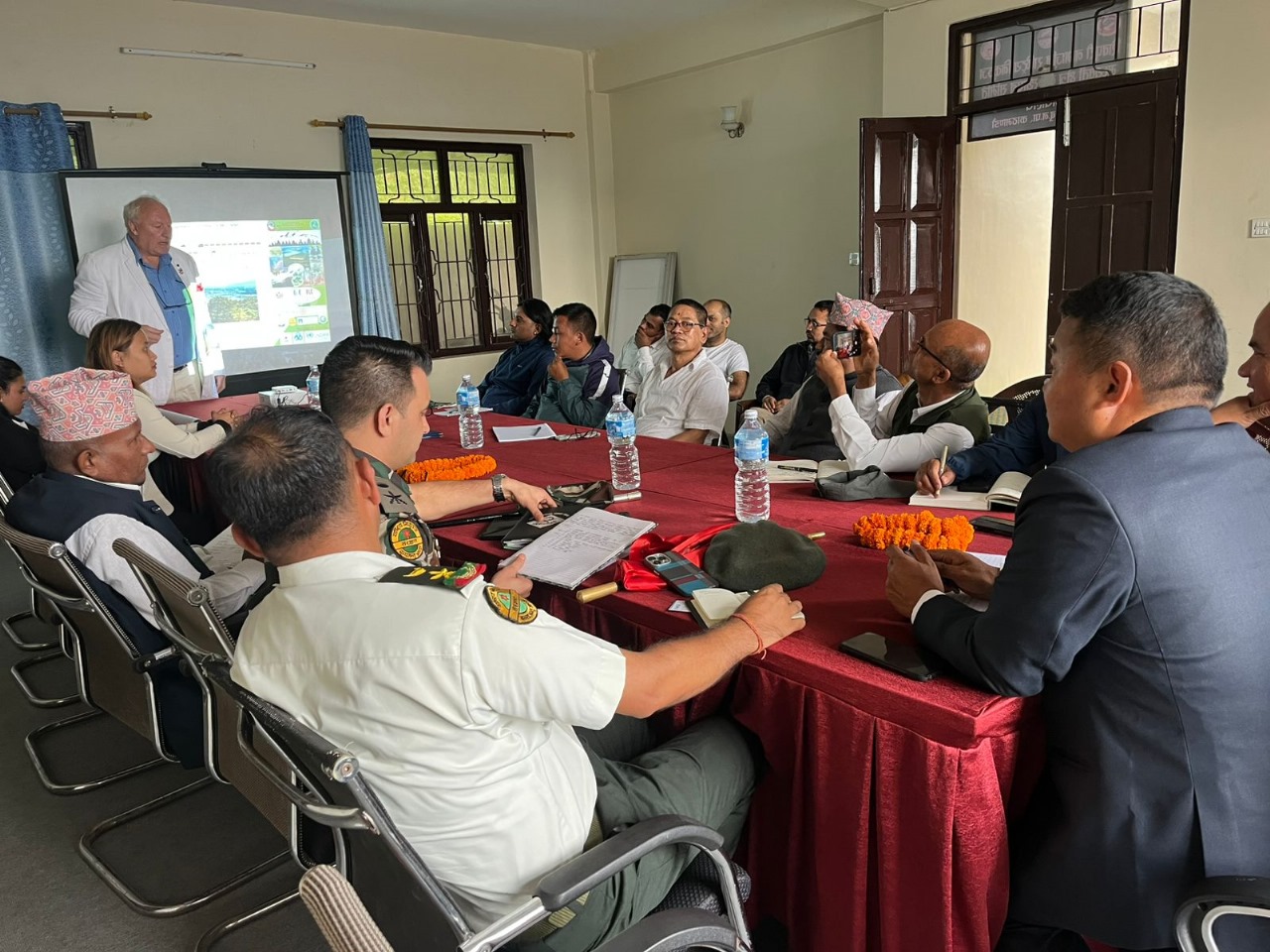
The Gandaki Province government has once again called on protesting transport entrepreneurs to come to the negotiation table. On Sunday, the Ministry of Physical Infrastructure Development and Transport Management held a press conference, inviting transport operators for talks to discuss their demands and find a solution. The transport entrepreneurs, who have halted public transportation in protest against the legalization of ride-sharing, had previously been invited for talks on Wednesday, but they did not attend.
A five-member high-level negotiation team has been formed under the coordination of the Secretary of the Ministry of Transport to hold discussions with the transport entrepreneurs. Engineer Kamal Kumar Adhikari, Provincial Secretary and coordinator of the negotiation committee, stated that the provincial government is always ready for open discussions if any party has been affected by the law introduced by the provincial government.
He emphasized that the provincial government believes such issues should be resolved through dialogue and urged transport entrepreneurs to suspend the ongoing strikes and come to the negotiation table.
Earlier, eight organizations—including the Nepal Transport Entrepreneurs National Federation, Nepal Transport Independent Workers’ Union, Nepal Transport Workers’ Union, All Nepal Transport Workers’ Union, Public Transport Central Federation, and the Integrated Trade Union Federation Gandaki—jointly held a press conference and released a 17-point demand.
The demands include scrapping the provision that allows private vehicles to transport passengers like public transport, removing the age limit for public vehicles, and not giving legal recognition to ride-sharing services. Due to the public transport strike, which began on Jestha 16 (May 29), the general public in Gandaki Province has faced significant difficulties.
In relation to this issue, transport entrepreneurs also staged a protest in Kathmandu. Accusing all seven provincial governments of drafting regulations that contradict the Federal Vehicle Act and permit private vehicles to operate as public transport, the Central Struggle Committee for the Protection of Public Transport held a demonstration on Sunday from Maitighar to Bijulibazar with black banners. The protest disrupted transportation services throughout the Kathmandu Valley.