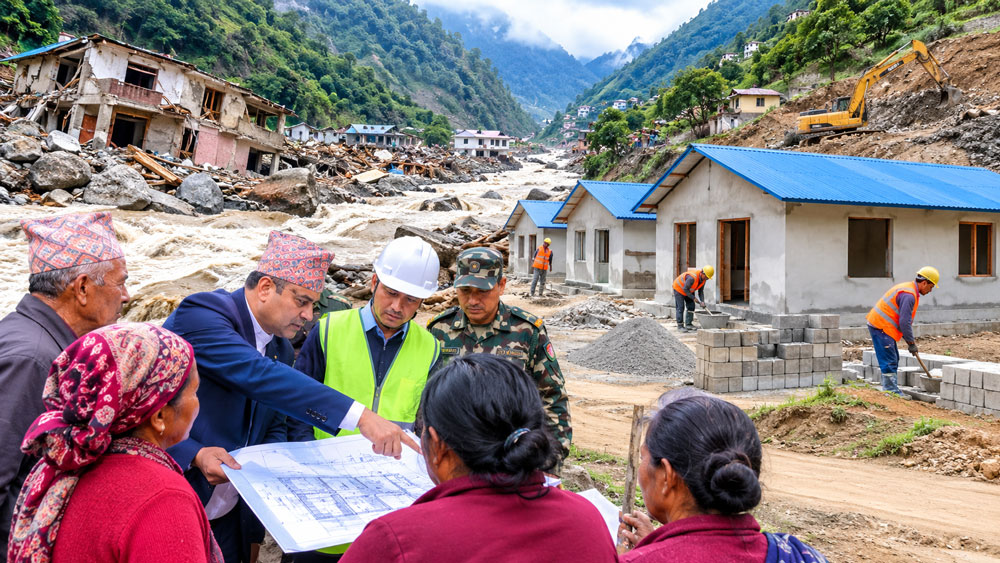
Kathmandu, 29 Oct: The government is preparing to construct temporary and permanent houses for people affected by the devastating glacial flood in the Rasuwa–Bhote Koshi region, based on the preferences of the affected families. The National Planning Commission (NPC) is working to finalize the Post-Disaster Needs Assessment (PDNA) report. The government is also seeking additional international support and assistance for rehabilitation and reconstruction.
According to Hem Raj Aryal, spokesperson for the Office of the Prime Minister and Council of Ministers, reconstruction following the August 26 Bhote Koshi disaster is one of the government’s top priorities.
He said discussions were underway with relevant ministries and authorities to determine the total reconstruction cost and the way forward.
“The comprehensive PDNA is being prepared, and discussions are ongoing with various ministries and authorities to determine the total expenditure and implementation strategy,” Aryal said.
He added that the Ministry of Physical Infrastructure Development and the National Disaster Risk Reduction and Management Authority (NDRRMA) were working seriously to rebuild private houses for affected families.
The preliminary assessment prepared by a steering committee coordinated by Dr. Gunakar Bhatta, Vice-Chairman of the National Planning Commission, covers six major sectors and 22 related areas.
The assessment examines the impact on downstream areas, the national economy, poverty and rehabilitation needs. According to the preliminary figures, 1,464 people have died in the floods, while more than 5,000 remain missing. A total of 13,795 households have been displaced following the disaster.
The devastating floods are estimated to have caused total damage and losses worth Rs. 472.66 billion. Approximately Rs. 706.65 billion is estimated to be required for reconstruction and rehabilitation.
Reconstruction of private houses, non-residential and commercial buildings, agriculture and livestock, vehicles, cash and valuables, as well as essential goods and supply systems, has been identified as a major priority.
Preparatory Work Underway
According to Sushil Kumar Shrestha, chief of the Private Housing Reconstruction, Rehabilitation and Disaster Preparedness Section at the National Disaster Risk Reduction and Management Authority, work is underway to provide cash assistance to affected families to help cover rental expenses, as well as to construct temporary and permanent housing.
He said all local governments in Rasuwa, Nuwakot and Dhading districts had been informed to ensure that no affected family was left out or counted twice.
“We have instructed all local governments in the three districts to work with the objective of ensuring that no one is excluded and no one is counted more than once,” he said.
A total of 43 organizations interested in working with the government on temporary housing have submitted proposals. Their technical expertise and capacity are currently being reviewed.
Shrestha said the organizations had expressed their readiness to work collectively in 12 local governments and construct around 9,000 houses.
The organizations have offered to spend between Rs. 50,000 and Rs. 900,000 on each temporary house.
As many organizations appear to be concentrating on the same local governments, the authorities are studying ways to distribute their work more systematically. Bidur and Uttargaya in Nuwakot have attracted considerable interest from several organizations, while others are interested in working in Gosaikunda and various parts of Dhading.
Hope for Permanent Housing
Although the government is moving ahead with plans for temporary shelters, most affected families and local governments are seeking permanent homes.
Some local governments have even published model designs for permanent houses on their official websites.
During the collection of household details, affected families appreciated the government’s cash assistance but also requested permanent housing support.
Shrestha said discussions were underway on both temporary and permanent housing options.
The Ministry of Physical Infrastructure Development has identified locations for temporary housing. Model transitional housing settlements have also been established in Dhading, Nuwakot and Rasuwa for people who have neither land nor a place to live.
For families who prefer to move directly from rented accommodation into permanent homes, the Department of Urban Development and Building Construction is developing standard house designs.
Meanwhile, discussions are underway about relocating settlements away from areas that have suffered severe damage and remain vulnerable to future disasters.
The government is also considering nationalizing land in high-risk areas and using it for other purposes.
At a parliamentary committee meeting held just before the Tihar festival, NDRRMA Chief Executive Officer Dharma Raj Upreti had proposed relocating residents to nearby safer areas and implementing integrated development projects.
44 Safe Locations Identified
The Ministry of Land Management, Cooperatives and Poverty Alleviation has already identified 44 locations for safe settlements. According to Shrestha, these locations are situated at least 50 metres above the flood-affected areas.
For residents who are unwilling to leave their ancestral homes in Rasuwa and surrounding areas, the government and experts are also discussing how the concept of ecosystem-friendly development can be implemented.
Authorities are examining the history of settlements and trade routes along the Nepal-China border. Previously, pedestrian trade routes were located on higher ground. However, as economic activities expanded and vehicle transportation began operating at lower elevations, settlements gradually shifted towards lower areas.
The government is now exploring ways to balance people’s attachment to their ancestral land with the need for safer settlements and sustainable development.