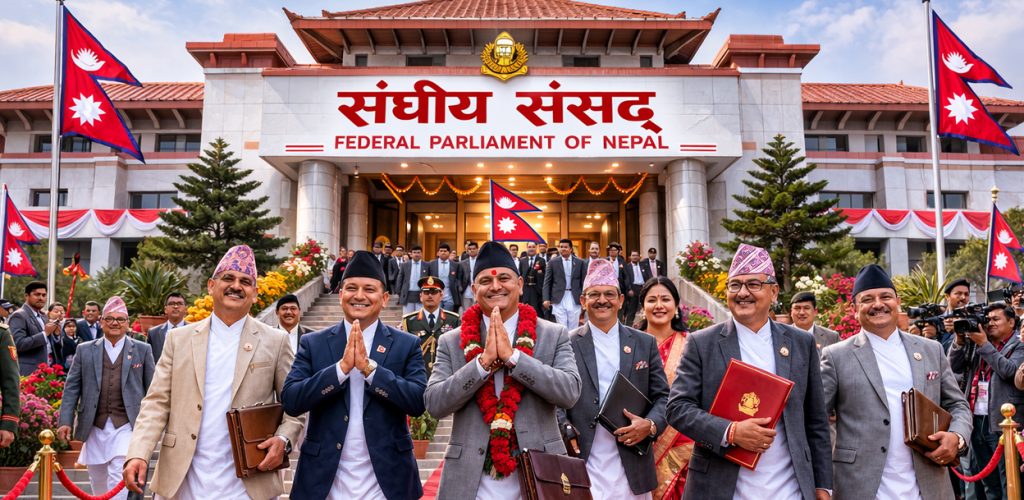
Kathmandu, 17 March: After the Election Commission of Nepal on Monday announced the names of 110 lawmakers elected through the proportional representation (PR) system, the final composition of the House of Representatives of Nepal has now become clear.
The commission plans to hand over certificates to the 110 proportional representation lawmakers on Wednesday morning. Within a few hours after that, it will submit the final report on the completion of the election to the President. The new election was held to address the political transition created after the Gen Z movement, and the results have now determined the shape of the future parliament.
RSP close to a two-thirds majority
The election has significantly changed the political balance compared to the previous parliament. The Rastriya Swatantra Party (RSP) will hold nearly two-thirds of the seats in the House of Representatives. The party will fall short of a two-thirds majority by only two seats. Altogether, RSP has secured 182 seats in the lower house, combining both first-past-the-post and proportional representation seats.
Traditional parties such as the Nepali Congress, Communist Party of Nepal (Unified Marxist–Leninist), and the Communist Party of Nepal (Maoist Centre) have been significantly reduced. Even if these three parties combine their seats, their total would still be about 100 seats fewer than RSP.
RSP had won only 21 seats in the previous parliament but received an unexpected surge of public support in this election. However, the party lost one potential seat after its candidate in Dhanusha-1 was blacklisted and had their candidacy cancelled.
Nepali Congress becomes main opposition
With 38 seats, the Nepali Congress will now serve as the main opposition party in the House of Representatives. The leader chosen by the party’s parliamentary group will automatically become the Leader of the Opposition. This position carries the privilege of participating in the Constitutional Council of Nepal as a member.
In parliamentary practice, Nepali Congress, UML, the Shram Sanskriti Party, or the Rastriya Prajatantra Party may claim the chairpersonship of the Public Accounts Committee. In most other parliamentary committees, however, RSP lawmakers are expected to dominate. The Parliamentary Hearing Special Committee will also include members from the National Assembly of Nepal.
Mostly new faces in parliament
Apart from 20 lawmakers, almost all members of the new House are first-time parliamentarians. Nearly half of those 20 had previously been elected under the RSP banner. Both the direct and proportional systems have brought a large number of new representatives into parliament.
In the election held on February 21, most senior political figures lost their direct races. Only Pushpa Kamal Dahal and Barshaman Pun from the Maoist leadership managed to remain in the political spotlight, while many long-time leaders were defeated. A few familiar figures returned through the proportional list, but the majority of lawmakers are newcomers.
Many politicians who had remained influential since the democratic change of 1990 were defeated in this election. As a result, many individuals who had rarely been seen or heard in national politics will now have their voices represented directly in parliament.
Youth-dominated parliament
The new House of Representatives will be dominated by younger lawmakers. A total of 94 members are under the age of 40, while more than half of the parliament is under 45. Many of them were born after the 1990 democratic movement. Nineteen lawmakers are under the age of 30, while only 30 members are older than 60.
The average age of lawmakers, including both direct and proportional representatives, is 45 years and four months. The oldest member of the House will be Arjun Narsingh KC (78) from Nepali Congress, who will chair the first meeting of parliament as the senior-most member. Only five lawmakers are above 70 years of age.
Young leaders in new parties
According to the data published by the Election Commission of Nepal, most of the young lawmakers have been elected from RSP. The party prioritized younger candidates in both the direct and proportional elections.
In contrast, most of the older lawmakers belong to traditional parties such as Nepali Congress, UML, and Maoist Centre. The youngest Nepali Congress lawmaker elected is 30-year-old Gita Gurung, although there are 26 lawmakers younger than her in the House. The youngest UML proportional lawmaker is Esoda Kumari Baral, who ranks 46th in terms of age among all members.
Among RSP lawmakers, the oldest is Sitaram Sah (65), elected from Saptari-4. Fourteen lawmakers from other parties are older than him. Only three RSP lawmakers are above 60. Meanwhile, 71-year-old Mahabir Pun, who won from Myagdi, contested as an independent candidate but had RSP’s support.
Gains and losses
RSP secured 125 direct seats and 57 proportional seats, bringing its total to 182. Compared to the previous parliament, the party has gained 104 additional seats.
Nepali Congress won 18 direct and 20 proportional seats, totaling 38 seats—70 fewer than in the previous parliament.
UML secured 9 direct and 16 proportional seats, giving it a total of 25 seats, also about 70 fewer than before.
The Maoist Centre won 8 direct and 9 proportional seats for a total of 17, a decline of 24 seats from the previous election.
The Shram Sanskriti Party secured 3 direct and 4 proportional seats for a total of 7 seats, while the Rastriya Prajatantra Party won 1 direct and 4 proportional seats, totaling 5 seats.
Independent candidate Mahabir Pun from Myagdi is the only independent lawmaker elected in this election.