On Wednesday, Canadian Prime Minister Mark Carney announced that Canada plans to officially recognize a Palestinian state during the upcoming United Nations General Assembly in September. This decision adds to the mounting diplomatic pressure on Israel, which is already under increasing global scrutiny over its ongoing military campaign in Gaza.
Carney clarified that Canada’s recognition would depend on key reforms by the Palestinian Authority. These include holding elections in 2026, implementing strong anti-corruption policies, and ensuring the creation of a demilitarized Palestinian state. He acknowledged the complexity of the situation, stating that the path ahead is difficult and long.
“This is not something that can be achieved immediately,” Carney said, emphasizing that Canada is joining other nations in a collective effort to keep the vision of a two-state solution alive.
“A great deal still needs to occur before a functional, democratic Palestinian state can be realized,” Carney remarked.
Canada has traditionally maintained that it would only recognize Palestinian statehood following a successful peace agreement with Israel. However, Carney noted that the evolving situation on the ground—particularly the deepening humanitarian crisis and growing hunger in Gaza—has made that vision increasingly unattainable. “We are watching the very possibility of a Palestinian state vanish before our eyes,” he said.
He cited several contributing factors, including ongoing Hamas threats to Israeli security, the rapid expansion of Israeli settlements, and a recent Knesset vote supporting the annexation of the West Bank.
“Canada strongly condemns the Israeli government’s failure to prevent the humanitarian disaster that is now unfolding in Gaza,” Carney stated.
Responding to Carney, the Foreign Ministry said Israel “rejects” Canada’s announcement on recognizing Palestinian statehood.
The Israeli Foreign Ministry, in a post on X, criticized Canada’s shift in stance, calling it a “reward for Hamas” that undermines ongoing efforts to reach a ceasefire in Gaza and secure the release of hostages.
Israel’s ambassador to Canada, Iddo Moed, voiced strong opposition, stating that Israel would not yield to what he described as a “distorted campaign of international pressure.” In a statement, Moed declared, “We will not risk our survival by accepting the creation of a jihadist state on our ancestral land—one that openly seeks our destruction.”
He further argued that recognizing a Palestinian state without ensuring responsible governance, stable institutions, and ethical leadership only serves to legitimize Hamas’s brutality. “It is an affront to both Israeli and Palestinian victims of Hamas’s violence, and a victory for Hamas’s extremist agenda,” he said.
Meanwhile, Palestinian Authority President Mahmoud Abbas praised the Canadian decision as a “historic” step forward. During a phone conversation with Prime Minister Carney, as reported by the PA’s official news agency Wafa, Abbas said the move would contribute to regional peace, security, and stability.
Canada’s announcement follows similar commitments from France and the United Kingdom—both G7 nations—as frustration mounts among Israel’s Western allies over the worsening humanitarian crisis in Gaza. Earlier the same day, Malta, a member of the European Union, also declared its intention to recognize a Palestinian state.
Emmanuel Nahshon, former Israeli ambassador to Belgium and current deputy director-general for public diplomacy at the Foreign Ministry, downplayed the impact of Canada’s announcement, characterizing it as largely symbolic.

“They know it’s ultimately a rhetorical gesture,” Nahshon said. “But the primary target of that message is the Israeli government—it’s a clear expression of dissatisfaction, not just with our operations in Gaza, but also with the leniency shown toward radical settler activity in the West Bank.”
British Prime Minister Keir Starmer announced Tuesday that the United Kingdom intends to recognize a Palestinian state this coming September—unless Israel takes significant steps to end the war in Gaza, address the deepening humanitarian crisis, and recommit to a genuine peace process.
The announcement, first shared with cabinet ministers and later made public from 10 Downing Street, drew sharp criticism from Israeli Prime Minister Benjamin Netanyahu. He denounced the move as a decision that “rewards Hamas’s monstrous terrorism.”
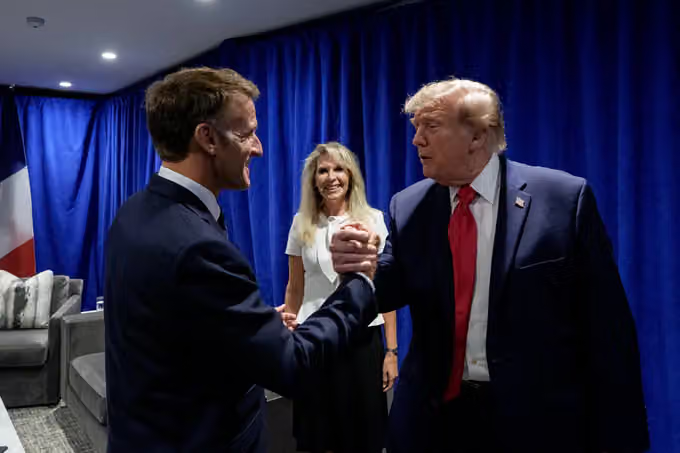
Just days earlier, French President Emmanuel Macron surprised many by declaring that France would move forward with recognizing Palestinian statehood in September. Macron’s decision included no alternatives or conditions for Israel to avoid the recognition. He has reportedly encouraged Starmer to take a similar step, a position also gaining traction within Britain’s Labour Party, especially amid growing fears of mass starvation in Gaza.
“It’s a symbolic gesture, in my view,” said Pascaline Wagemans, Director of the Forum of Strategic Dialogue at the European Leadership Network. She warned that such declarations could weaken the negotiation process and “inadvertently reward terrorism, particularly the events of October 7.”
Despite the shifting positions of some Western powers, not all European nations are on board. Germany—considered one of Israel’s strongest allies—has stated it does not intend to recognize a Palestinian state anytime soon. Italian Prime Minister Giorgia Meloni echoed similar sentiments, calling the move “counterproductive.”
Norway, Spain, Ireland and Slovenia all announced recognition following the outbreak of the Gaza conflict, along with several other non-European countries.
Approximately 145 nations now either recognize or are moving toward recognizing Palestinian statehood. However, the White House reaffirmed on Wednesday that U.S. President Donald Trump will not be joining them.

In a statement issued to reporters following Canada’s announcement, a White House official explained, “The president believes that recognizing a Palestinian state at this moment would be tantamount to rewarding Hamas—something he firmly opposes. His priority right now is making sure people in Gaza are being fed.”
Trump, when asked about the decisions by the UK and France to support Palestinian statehood, avoided direct criticism, instead noting that world leaders are entitled to make choices that align with their own policies.
This stance reflects a broader trend in Washington’s recent messaging. While some in Israel may have hoped for more active U.S. intervention to prevent further recognitions of Palestine, the White House has not taken any concrete steps to discourage such moves by other nations.
Instead, President Trump’s focus appears to be squarely on the humanitarian crisis. Earlier this week, he unveiled a new aid initiative aimed at establishing additional food distribution centers across Gaza. The White House said further details on the plan are forthcoming, though no follow-up has been provided as of yet.
Interestingly, Wednesday’s statement made no mention of the stalled hostage negotiations—a notable omission given the current impasse in ceasefire talks.