Kathmandu, 14 August: Banks have been struggling to increase lending, but the automobile sector has raised some hopes of a revival in credit demand. The public turnout at the Naima Mobility Expo 2026, which began this Tuesday, along with increased inquiries about auto loans at banks, has raised expectations that demand for loans could improve.
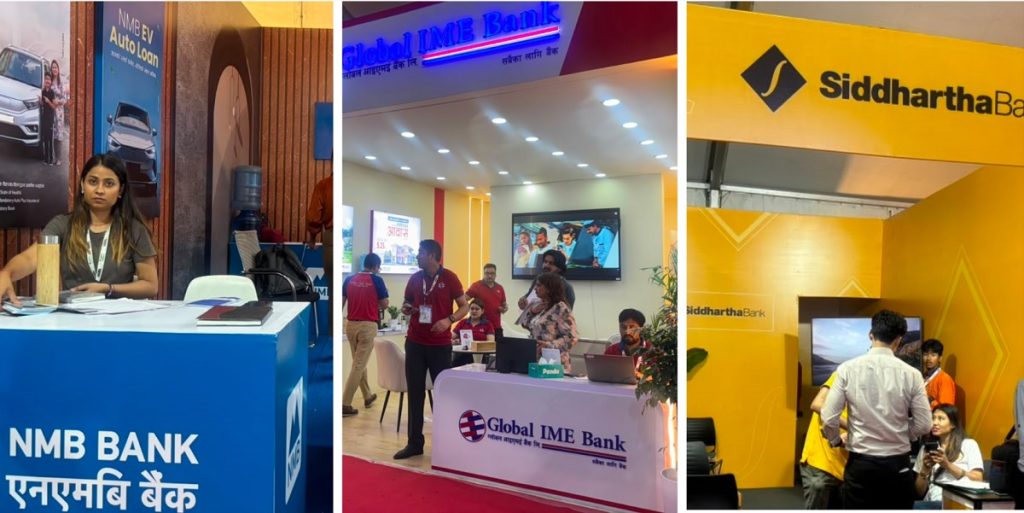
Banks also have their own stalls at the expo. Many visitors are seen heading to bank stalls after learning about the features of vehicles they like. Global IME Bank, NMB Bank and Siddhartha Bank are participating directly in the expo.
Auto loans account for a significant share of banks’ lending portfolios. Therefore, banks and financial institutions have introduced various schemes under hire-purchase or auto loans. At the Naima Expo, however, banks have introduced relatively targeted loan schemes, promising information and financing facilities at concessional rates for visitors interested in purchasing vehicles.
According to Manzil Bista, a representative of Global IME Bank, public participation in the Naima Expo has increased compared to previous years. He said the number of customers visiting the bank’s stall to view vehicles and discuss loan plans has also increased.
“In the past, only a small number of customers visiting auto expos would come to the bank stalls after looking at vehicles,” Bista said. “Now, however, people planning to buy vehicles are coming to the bank to discuss financing and make plans. There is a growing understanding that vehicles can be purchased through financing.”
Similarly, representatives of NMB Bank and Siddhartha Bank said their stalls have been receiving visitors almost as frequently as the vehicle stalls. They said the practice of purchasing vehicles through financing from banks and financial institutions, rather than paying in cash, has become increasingly common.
Banks have introduced auto loan schemes by adding a small premium to their base rates. They are also offering procedural assistance and waivers on various fees.
Global IME Bank has introduced a special personal vehicle loan scheme on the occasion of the Naima Auto Expo. Under the scheme, customers purchasing new vehicles at the Naima Auto Expo can obtain loans by paying a minimum premium of 0.5 percentage points over the bank’s base rate.
For customers purchasing new EVs at the Naima Expo, the bank has also introduced a fixed interest rate of 5.99 percent for three years. After three years, the loan interest rate will be set at a maximum premium of 2 percentage points over the bank’s base rate.
The bank has also introduced an auto loan transfer scheme. Under this arrangement, vehicles purchased through financing from other banks or financial institutions can be revalued and refinanced by Global IME, allowing the outstanding loan with the previous institution to be settled and transferred to Global IME. The bank said this facility is not available for vehicles more than three years old.
Similarly, Siddhartha Bank has introduced a special vehicle loan scheme on the occasion of the Naima Nepal Mobility Expo 2026. As the banking partner of the expo, the bank is offering vehicle buyers loans with a processing fee of only 0.5 percent and an annual interest premium of 1 percentage point over the base rate.
Banks and financial institutions are permitted to charge service fees of up to 0.75 percent of the loan amount. According to the bank, the special scheme will remain in effect throughout the expo, which runs until the 31st.
NMB Bank has also introduced a special scheme targeting the expo for electric vehicle purchases. Under the scheme, customers purchasing new electric vehicles will receive loans at an interest rate set by adding a 0.5 percentage-point premium to the bank’s base rate. The bank said visitors and prospective buyers at the Naima Auto Expo can easily apply at NMB Bank’s stall at the expo or at any of its branches across the country. The bank has 198 branches nationwide.
Although the banks mentioned above have introduced Naima-focused schemes, other banks and financial institutions also provide auto loans. For such loans, banks and financial institutions determine interest rates by adding a premium to their respective base rates. Loan limits vary from one institution to another. Interest rates also differ by institution, with both fixed and floating-rate options available.
Regarding the loan-to-value ratio for vehicles, the central bank has set a specific limit. Banks and financial institutions are required to maintain vehicle loans at a maximum of 60 percent of the vehicle’s value. This limit applies to all-purpose electric vehicles and other privately used personal vehicles.
However, for large electric passenger vehicles used for public transportation, and for loans provided to replace vehicles and transportation equipment damaged at industries and commercial establishments directly affected by the Gen-Z movement, the loan-to-value ratio may be maintained at up to 80 percent.
According to Nepal Rastra Bank, banks and financial institutions had provided around Rs. 150 billion in auto loans as of Jestha of the last fiscal year.
More than 55 brands of electric, diesel and petrol-powered vehicles, along with various automobile-related products and services, are being showcased at the expo.