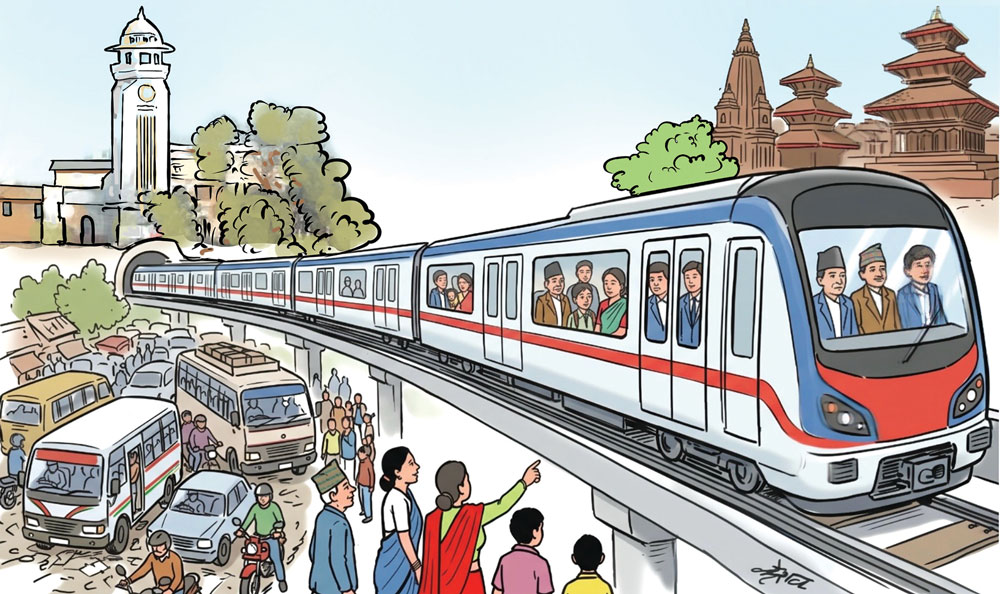
Kathmandu, 15 Oct: With road transport struggling to cope with the rapidly growing population, the Ratan Park–Bhaktapur Metro Rail Project has been initiated with the aim of easing traffic congestion in the Kathmandu Valley.
The government has prepared and publicly released the Kathmandu Valley Urban Transport System Master Plan 2050 to advance the project. The master plan was developed over three years with financial and technical assistance from the Japan International Cooperation Agency (JICA).
Sushil Babu Dhakal, Joint Secretary at the Ministry of Infrastructure Development and Chief of the Development Assistance Coordination Division, said the master plan was prepared with JICA’s support to improve the Kathmandu Valley’s transport system. The Ratan Park–Bhaktapur Metro Rail Project is being advanced under the same plan.
He explained that the master plan considers not only the current situation but also future traffic demand, population growth and market expansion. According to him, the project is being advanced in line with the plan’s recommendation to replace smaller vehicles with larger-capacity transport systems to improve traffic management.
The master plan also recommends locations for metro rail and Bus Rapid Transit (BRT) systems across Kathmandu.
Report Expected Within Six Months
Division Chief Dhakal said the master plan has recommended operating a metro rail service from Ratan Park in Kathmandu to Jagati in Bhaktapur as the first phase.
“Although the master plan identifies metro rail as a suitable option along this route, a feasibility study is necessary to determine whether it can be operated and to assess its social and environmental impacts. Accordingly, JICA has deployed a team and already started the study,” he said.
According to Dhakal, the JICA team will conduct a comprehensive assessment of the structures required for metro rail construction, their potential impacts, their financial viability and the measures needed to make the project economically viable. The team will then submit its report to the government.
The Ratan Park–Bhaktapur Metro Rail Project can move into the implementation phase only after the report has been submitted. The team is expected to present its findings within the next six months.
Dhakal said the construction method and design of the proposed metro rail would become clear only after the preparation of a Detailed Project Report (DPR).
According to the master plan, the metro rail would run above ground from Jagati in Bhaktapur along the Araniko Highway to an area near Tribhuvan International Airport. It would then pass underground within the airport area before returning above ground from the airport to Maitighar and continuing above ground from Maitighar to Ratan Park.
The feasibility study will also identify locations for depots, stops and stations along the proposed route. It will examine passenger boarding and alighting arrangements, parking facilities and other infrastructure requirements, Dhakal said.
Metro Rail Proposed Along 77 Kilometres
Although the idea of introducing metro and monorail services in Kathmandu has been discussed for more than a decade as a means of improving transport management and developing a cleaner, more attractive city, no significant visible progress has been made so far.
In 2012, South Korean company Chungsung Engineering conducted a feasibility study on the possibility of operating metro rail services in the Kathmandu Valley. However, most of the alignments identified as feasible in the study have yet to undergo even a pre-feasibility assessment.
The study found that metro rail services could potentially operate along a total of 77 kilometres of routes in the Kathmandu Valley. Of this distance, 52 kilometres were considered suitable for elevated metro rail and 25 kilometres for underground metro lines.
The report recommended elevated metro rail along the following routes:
-
Satdobato–Ratan Park–Narayan Gopal Chowk: 12 kilometres
-
Kirtipur–Kalimati–New Baneshwor–Airport: 11 kilometres
-
Koteshwor–Chabahil–Swayambhu: 29 kilometres
It also recommended underground metro rail along these routes:
-
Swayambhu–Dillibazar–Bauddha: 12 kilometres
-
Dhobighat–Singha Durbar–Naxal–Gongabu: 14 kilometres
Metro Rail Can Carry Up to 50,000 Passengers Per Hour
A comparison of different transport systems shows that buses can carry around 8,000 passengers per hour per lane, while cable cars can transport approximately 2,000 to 3,000 passengers per hour per lane. Metro rail, however, can carry between 25,000 and 50,000 passengers per hour per lane.
The Department of Railways maintains that constructing an underground metro system in Kathmandu is essential for efficiently managing transport demand over the next 50 years. It argues that there is no viable alternative to an underground metro capable of transporting up to 50,000 passengers per hour at high speeds.
Underground infrastructure is also considered safer than above-ground structures during earthquakes. Given Kathmandu Valley’s high seismic risk, tunnels may offer greater safety than elevated transport structures, according to the department.