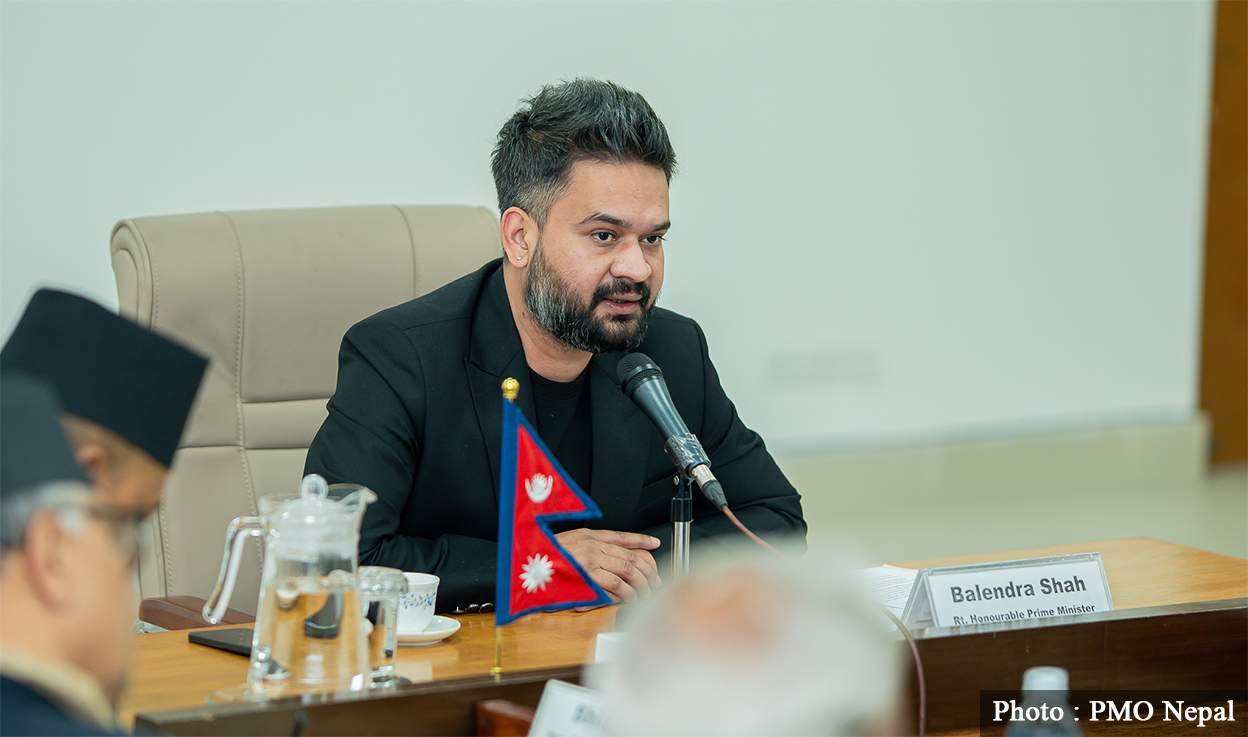
Kathmandu, 4 May: President Ram Chandra Paudel has once again been recommended by the government to issue the same ordinance, even before 24 hours had passed since he returned it asking for “reconsideration.”
Rejecting the President’s move to return the ordinance with a message, the government has sent it back again. Now, it appears the President has little option but to promulgate the ordinance. The Constitution allows the President to return bills passed by both houses of Parliament once for reconsideration. However, there is no clear provision regarding returning an ordinance recommended by the Council of Ministers for reconsideration. The President had returned the ordinance, stating that it should not undermine the spirit of the Constitution and the principle of majority decision-making in the Constitutional Council.
Chairperson of the Nepal Bar Association and law professor Dr. Vijay Mishra had said in a reaction to Onlinekhabar on Sunday that the government should respect the President’s message. However, he also stated that if the ordinance is resubmitted, the President cannot refuse it and must issue it.
Government spokesperson Sasmita Pokharel informed that the Cabinet meeting held on Monday decided to recommend again the Constitutional Council (First Amendment) Ordinance, 2083. According to Pokharel, the ordinance was sent back unchanged. Out of the eight ordinances recommended by the government, the President had issued seven, but had not issued the one related to the Constitutional Council.
Without addressing the President’s concerns, the government resent the same ordinance unchanged, signaling that it did not consider it necessary to respond to the President’s message.
Previously as well, the President had returned an ordinance, after which the government had shown little interest in it. This time, however, the government made a prompt decision and symbolically demonstrated its concern regarding the ordinance.
What are the President’s concerns?
Despite the government framing it as an issue of ego, some analysts say the President’s message was purely in favor of democratic values and the balance of power.
According to officials at Shital Niwas, the President’s letter mainly raised questions about quorum and the principle of majority decision-making. The provision in the ordinance—which allows meetings with 50% of members including the chairperson (Prime Minister) and decisions by a majority of those present—was seen by the President as undermining the fundamental structure of the Constitutional Council.
The letter also recalled a full bench decision of the Supreme Court, which had emphasized that the majority system in the Constitutional Council must remain meaningful, and suggested amendments to ensure the balance of power is not disturbed.
What is the Prime Minister’s interest?
Ignoring the President’s suggestion and resending the ordinance unchanged raises questions about whether the move is driven by a policy stance or a desire for administrative shortcuts.
Although the new election has given a near two-thirds majority to RSP, the structure of the Constitutional Council could limit the Prime Minister’s ability to make decisions. The Council recommends appointments to key institutions such as the anti-corruption body, Election Commission, and even the Supreme Court. Under current law, appointments are not possible without agreement from the opposition leader or the Chief Justice.
Therefore, there is suspicion that the aim is to pass the ordinance as it is, restructure the Council in favor of the government, and appoint preferred individuals to sensitive state bodies.
However, defending its move, the government and the Prime Minister’s office argue that the provision is necessary to prevent the Council from being stuck in indecision. They claim that due to the absence of opposition leaders or the Speaker, important constitutional bodies have remained vacant for a long time, affecting state functioning.
What happens next?
Now the matter is again in the court of Shital Niwas. According to Article 113(4) of the Constitution, if a bill passed by Parliament is returned once and then resent unchanged, the President must authenticate it within 15 days. However, in the case of ordinances under Article 114(1), the Constitution is relatively silent and different.
According to legal experts, although it is generally practiced that the President should issue an ordinance once recommended by the Council of Ministers, there is no explicit provision requiring issuance if it clearly violates the Constitution or contradicts Supreme Court precedents.
If the President, acting as the “guardian of the Constitution,” decides to hold the ordinance at Shital Niwas or reject it again, the political situation could take a new turn. This has already signaled the beginning of a new phase of tension between the executive and the head of state.