Kathmandu, 22 April: The reconstruction of Singha Durbar, which carries a rich and prestigious history in South Asia, appears to be more complex and challenging than it was after the 2015 earthquake. Singha Durbar is regarded as one of the finest architectural structures in South Asia.
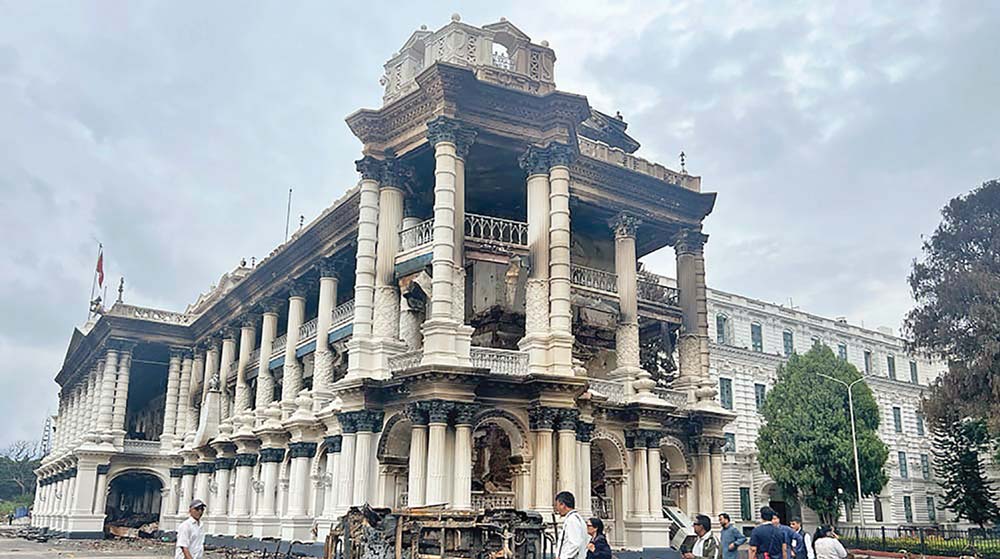
The reconstruction has become more difficult because the fire that broke out during the protest on Bhadra 24 caused greater damage than the earthquake. While the earthquake had only damaged parts of the structure, the fire reduced much of it to ashes. Among the eastern, northern, and southern facades, the western facade has been completely destroyed.
According to Engineer Chakravarti Kantha, head of the Federal Secretariat Construction and Management Office under the Ministry of Urban Development, the reconstruction after the earthquake was relatively easier because the structural integrity had not been significantly affected. However, the recent fire has burned the structure to ashes, making reconstruction far more complicated. The office is responsible for the maintenance and management of Singha Durbar.
He stated, “During the earthquake, the damage to Singha Durbar was less than what we see now. Only parts of the structure had collapsed, mainly affecting the joints. The core structure remained intact, making it easier to restore. But now, most of the structure has turned to ashes. Materials like bricks have been burned beyond recognition, and some have deformed. Walls, roofs, and pillars have been destroyed, and even the materials used during post-earthquake reconstruction have been completely burned.”
He added that rebuilding from ashes is naturally more difficult and challenging. The current reconstruction is expected to be several times more complex and expensive than after the earthquake. “Even though Singha Durbar still appears standing from the outside, nothing remains inside,” he said.
Loss of Archaeological Artifacts
Engineer Kantha also mentioned that the fire destroyed valuable archaeological and historical items located in the western wing of the building. “We had managed to preserve these items even after the earthquake. At that time, they had only fallen to the ground and some were damaged. But now, everything has been reduced to ashes,” he said.
According to him, wooden beams burned to ashes, causing ceilings of rooms—including the British-style meeting hall—to collapse. The widest carpet in the country laid in that hall has also been destroyed. Gifts and artifacts from different countries, old photographs, a valuable Rana-era piano, intricately carved glass works, paintings, and antique clocks have all been lost. “The fire was so intense that it is now impossible to even find support or footing inside the building,” he added.
Reconstruction Without Altering Its Original Form
Despite the difficulty, challenge, and high cost, reconstruction of the damaged Singha Durbar is still possible. He emphasized that, due to its archaeological and historical significance, the building cannot be demolished. Therefore, it will be reconstructed and strengthened without altering its original form.
Built in 1960 B.S. during the tenure of then Prime Minister Chandra Shumsher Jang Bahadur Rana, the historic Singha Durbar is a highly artistic structure and Nepal’s main administrative building, designed in the European “Neo-Classical” architectural style. It was originally constructed as a private residence using materials imported from Britain.
From an architectural and artistic perspective, the five-story building with a unique basement has four major sections. The total built-up area of the northern, southern, and eastern wings is 12,461.81 square meters.