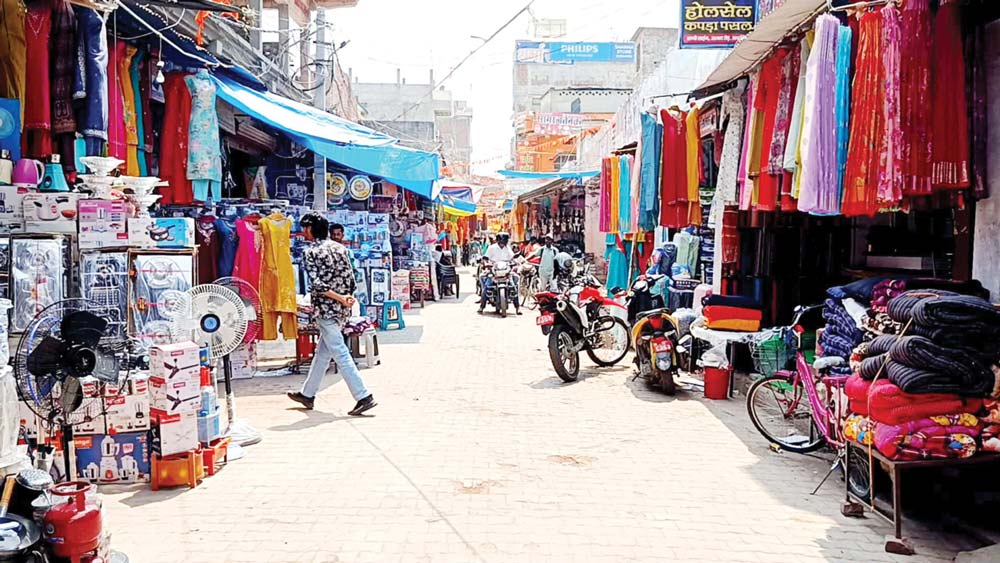
Nepalgunj 20 April: The strict enforcement of a rule requiring customs duty on goods worth more than 100 rupees at the Nepal–India border has begun to show a significant impact on daily life and trade in border areas. As fewer Nepali consumers bring goods from India through the Jamunaha checkpoint in Banke, the market in Rupaidiha across the border has started to appear deserted, while consumers on the Nepali side are facing difficulties.
Traders say that since authorities began preventing the import of goods worth more than 100 rupees without paying customs duties a few days ago, the number of Nepali customers in the Rupaidiha market has dropped sharply. According to clothing trader Raza Imam, business has fallen by more than half, and customer flow has decreased significantly. Another trader, Suresh Mittal, said that a market that used to be busy throughout the day now appears almost empty.
On the other hand, traders on the Nepali side have welcomed the move. Tank Dhami, president of the Nepalgunj Chamber of Commerce and Industry, expressed a positive view of the stricter customs enforcement, stating that it would help promote local trade. He added that this has been a long-standing demand and should be implemented more effectively.
However, ordinary people and residents of border areas have criticized the rule as impractical. Local resident Mubarak Siddiqui accused authorities of targeting small consumers while failing to control smuggling. Another local, Ramesh Thapa, complained that the rule only creates hardship for ordinary people while illegal imports continue.
Meanwhile, Janardan Paudel, chief of the Nepalgunj Customs Office, clarified that this is not a new policy but rather the effective implementation of existing legal provisions. He stated that stricter monitoring in coordination with Nepal Police and the Armed Police Force has started to show results.
The impact of this rule is also being observed in other border areas, including West Nawalparasi. The Department of Customs stated that the stricter enforcement aims to control revenue leakage and promote formal trade. According to department official Prem Subedi, this is being implemented in accordance with state laws.
The issue has also entered the political arena. Rastriya Swatantra Party (RSP) lawmaker Bikram Khanal said that the 100-rupee threshold should be reconsidered based on the realities of border areas. He emphasized the need for arrangements that reflect the long-standing “roti-beti” (people-to-people) relationship between Nepal and India. Similarly, another RSP lawmaker, Narendra Kumar Gupta, argued that commercial imports and household use should not be regulated under the same rule.
While the current strict measures have reduced trade in markets across the border, they are expected to provide some relief to Nepali markets. However, the impact on the daily lives of ordinary people, along with concerns about customs procedures and practicality, has highlighted the need for policy review.