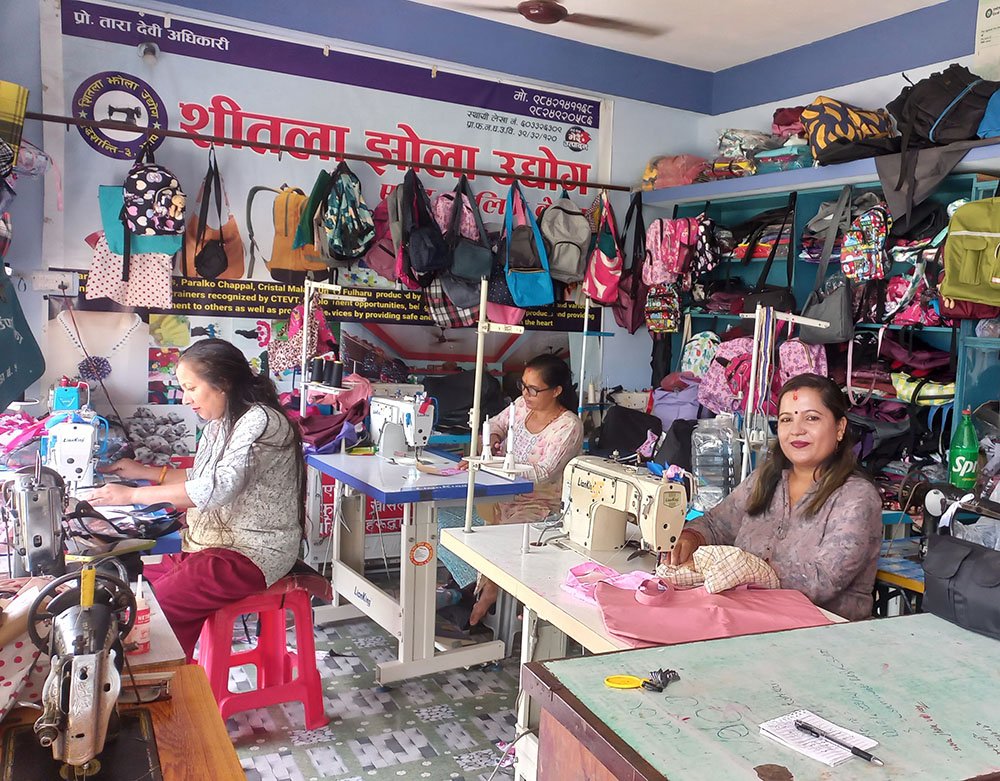
Jhapa, 23 Sep: In Buddhashanti Rural Municipality-3, Pragati Tole, lies the story of a woman’s struggle and success. That woman is Tara Devi Adhikari, proprietor of Shitala Bag Industry. With a humble nature and a confident face, she runs a small workshop on the ground floor of her home, where piles of fabric, colorful threads, scissors, and the hum of sewing machines reflect the vitality of her enterprise.
Her journey began about 12 years ago when she took a tailoring course coordinated by the Cottage and Small Industries Office. Without her own machine, she worked for several years using a rented one. One day, she stitched three simple cloth bags from leftover scraps and placed them in a shop. They sold immediately. Encouraged, she began making three to four bags a day, but demand kept rising. This success inspired her to turn bag production into a business.
Creating Jobs and Building Empowerment
Since 2019 (2076 BS), Tara Devi has been running a bag industry using local raw materials such as dhaka and allo. Today, her factory produces bags in different sizes, styles, and designs, priced from Rs 50 to Rs 3,500. The raw materials are sourced from Kathmandu and Silgadhi, India.
Currently, the factory provides regular jobs to 18 women, with another 15 women working part-time after completing household chores. Depending on their skills, women earn Rs 20,000 to Rs 30,000 per month. This income has made them economically stronger and more confident.
Her products are not limited to Jhapa district. They reach various hill districts of Koshi Province and as far as Kanchanpur in Sudurpaschim. Recently, her factory delivered 110 bags to Bhimdatta Municipality within four days. During the COVID-19 lockdown, her business actually found better markets. Even Buddhashanti Rural Municipality distributed her bags to local community school students.
Beyond production, Tara Devi actively conducts training programs. On request from local governments and community organizations, she trains women in bag-making, helping them start their own small-scale production.
Expanding Horizons and Inspiring Women
With the profits from her enterprise, Tara Devi purchased land in Pragati Tole and built a three-storey house, continuing to operate her factory on the ground floor. After expenses, she earns about Rs 1.5 million annually in net profit.
To promote her products, she uses Facebook, TikTok, and local fairs/markets. Shitala Bag Industry has become more than a business—it is a pillar of women’s empowerment, enabling many women to finance children’s education, healthcare, and household needs.
Looking ahead, Tara Devi plans to expand training programs across Nepal to create more employment opportunities for women. She also intends to invest in new technologies and designs to improve quality and attractiveness.
Her story is not just one of personal success. It is proof that entrepreneurship can be born out of struggle, and that women can make significant contributions to society. From a small village in Jhapa, her journey has become a symbol of self-reliance, dignity of labor, and success.