Kathmandu, 8 Sep: In the past three months, 15,191 new complaints have been registered with the Truth and Reconciliation Commission. According to the information provided by the Commission on Sunday, 3,912 of those complaints are related to rape or sexual violence.
According to Devi Khadka, coordinator of the National Organization of Women Rape Survivors of the Conflict, more than 90 percent of the 4,000 complaints registered with the Commission were collected directly by the victims themselves. She said that 150 victims were mobilized across 66 districts to gather these complaints.
According to Commission Secretary Nirmala Adhikari Bhattarai, less than 10 percent of the 3,912 complaints registered with the Commission were submitted voluntarily.
Victims Found Living While Suppressing Heartbreaking Pain
When victims went into villages and neighborhoods to look for others like themselves and collect their complaints, they encountered unusual incidents. How can people continue to live while suppressing such heart-wrenching stories?
Victims also learned, in this process, that a Maoist leader who had gone to deliver the news that someone had been martyred raped the martyr’s widow. A complaint has also been filed on behalf of that victim.
Some of the representative incidents collected by victims are so painful that even today, when recounting them, the victims are left speechless.
Incident 1
During a crossfire, a civilian woman was injured. She was in a state of disability, unable to move from place to place.
In that condition, security personnel repeatedly raped her. On one hand, her body was wounded and disabled; on top of that, she endured rape and torture.
Assuming her broken body was dead, they left her behind. Later, villagers rescued and treated her.
It has been over 20 years since the incident. To this day, she has not only been denied justice but has not even been officially recognized as a victim.
Incident-2
This incident took place in a Maoist base area. There, the army burned down the entire village during an operation.
In the village, there were two friends, both around 12/13 years old. They had been friends since childhood. They got married at the age of 13. By a strange coincidence, they became sisters-in-law (Deurani and Jethani) in the same family.
One had a one-and-a-half-year-old daughter and was also seven months pregnant.
The other was eight months pregnant. Their house caught fire. Both their husbands were killed.
The one with the daughter threw her one-and-a-half-year-old child onto a nettle bush, and the child survived.
Both of them were subjected to gang rape. Their genitals were brutally pierced. Stomped on their bellies.
They became so weak that they couldn’t lift their husbands’ bodies; the situation reached a point where dogs were about to eat the corpses.
There was no one left in the village to collect the bodies. They dragged themselves and shooed the dogs away.
After that, they have no house to live in, no clothes to change into. They are sitting on the edge of a field. They are pregnant.
Due to the torture, the one who was seven months pregnant miscarried. She couldn’t even dispose of that fetus.
The superstition there is that if a husband dies, the wife cannot even go to her parental home for three months.
The locals did not call the brutality inflicted on their genitals with weapons “rape.” The victims themselves don’t know that this was rape. But this is also considered rape.
For three months, the same white clothes. No proper food arrangements. No health treatment. Sitting on the edge of a field. Struggling to survive with a one-and-a-half-year-old child. They barely managed to cremate their husbands’ bodies after five days.
The torture exists on so many levels.
Where is the question of them getting justice? They are left to get lost in a jungle of torture and suffering.
If the victims had not reached for complaint collection, there would have been no system for them to file a complaint. Our state machinery neither recognizes nor listens to them.
Incident-3
It appears that men also suffered a great deal of sexual violence during the war. However, because it was women who went to collect the complaints, the men could not easily talk about everything.
After the army captured key male and female figures, they forced them to engage in physical contact with each other. If they refused, they were tortured by being cut or wounded on their genitals.
Male victims were also found who were forced to perform oral sex while in military custody.
Their hands were tied, they were tortured. They were forced to perform oral sex while in a semi-conscious state.
Young girls were subjected to the same treatment. Their mothers were taken captive. The girls were forced to perform oral sex. Those victimized girls have now grown up. They are adults. They are all waiting for justice. But to this day, they haven’t even received recognition as victims.
Incident-4
A woman who was raped became infected with HIV/AIDS.
She still hasn’t been able to tell her family. She is continuing her treatment while keeping the report confidential with her doctor. With what kind of morale—she is still surviving. Hiding, running away from her family and society.
She is also waiting for justice. Along with that, also support in her treatment.
The Joy of Registering the Complaint
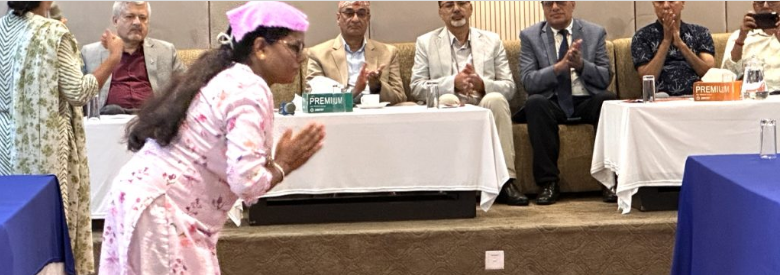
4 Bhadau, 2082 (approx. August 19, 2025). Over four dozen women from across the country, victims of rape during the conflict, had gathered in Kathmandu. On the stage were Home Minister Ramesh Lekhak, the Prime Minister’s Chief Advisor Agni Kharel, party leaders Pradeep Gyanwali, Janardan Sharma, Khim Lal Devkota, Radheshyam Adhikari, the Chair of the Truth and Reconciliation Commission (TRC) Mahesh Thapa, and Secretary Nirmala Adhikari Bhattarai, along with senior journalist Shiva Gaule.
Devi Khadka, the coordinator of the National Organization of Conflict-Rape Victims, who was holding the microphone, began her opening remarks: “We had nothing. We were empty. All we had was a legacy of injustice. But today, we have hope and faith in justice. We have already walked a very long path for justice, and now we are close to it.”
She added, “Our goal is not to burden the state with a stigma. Please understand. We have dived across the country, endured suffering and hardship, to collect and bring these complaints. We want to hand over these complaints to the Commission.”