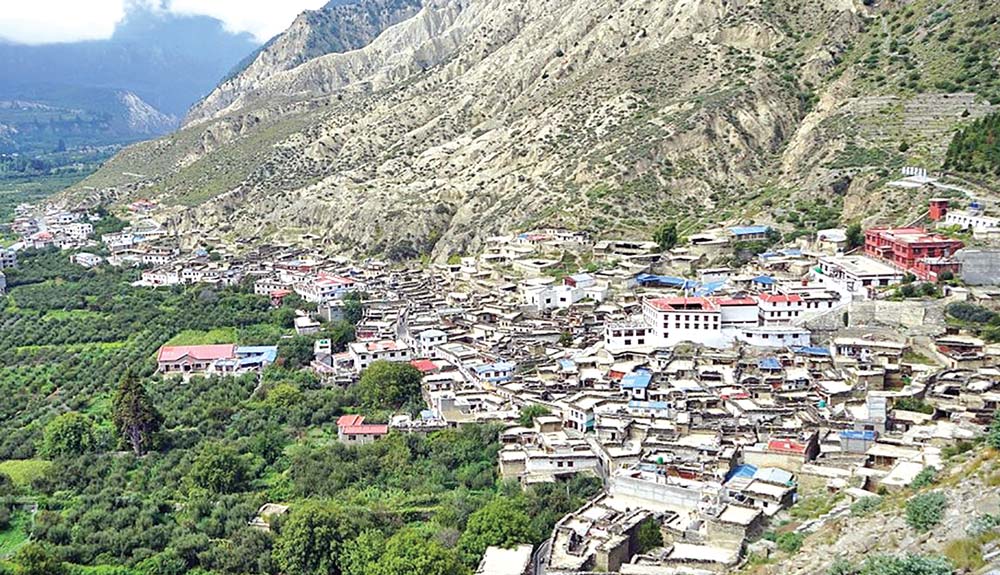
Marpha (Mustang), 31 May: The Kali Gandaki River, flowing like a serpent, and the traditional settlement of Marpha, nestled snugly at the foot of the Himalayas, surrounded by snow-capped peaks on all sides. The village is flanked by apple orchards, buckwheat fields, and potato farms! These scenes—whether etched in the minds of domestic travelers returning from beyond the Himalayas or foreign tourists—often linger like a dream, almost resembling a mythical paradise.
In the race to attract tourists by showcasing modern physical infrastructure, Marpha—a village nestled between the Dhaulagiri and Nilgiri mountains—holds its own against the likes of Agra, the Eiffel Tower, and the Burj Khalifa, but with far less expense.
The tightly clustered stone houses, their roofs lined with neatly stacked firewood, and the famous Samten Choling Gompa perched just above the settlement create a sight that makes Marpha’s homes and the monastery appear almost like a fortress.
This Samten Choling Gompa, a spiritual heritage of the Thakali community, and the village of Marpha nestled beside it, can undoubtedly be called a magnetic force for tourism. Man Bahadur Hirachan, Ward Chairperson of Marpha in Mustang’s House-Pajhong–2, explains that the traditional authenticity of Marpha—considered the origin of the Thakali community—is itself the heart of its touristic appeal.
The Thakali people say, “The traditional architecture of the Thak Khola—the ancestral homeland of the Thakali community—can still be seen in Marpha. Efforts by the Thakali community and cooperation from local authorities have successfully preserved its authenticity, making Marpha an attractive tourist destination.”
Man Bahadur Hirachan further explains that Mustang, as a whole, is emerging as a major tourist hub—not just because of the Annapurna and Dhaulagiri trekking routes or the sacred pilgrimage site of Muktinath (revered by both Buddhists and Hindus), but also due to the indigenous Thakali community’s unique settlements like Kagbeni.
In recent years, Mustang has become a magnet not only for international tourists but also for domestic travelers. With the rise in visitors, the Kali Gandaki riverbanks in Lete, Marpha, and Jomsom have seen a surge in hotels and restaurants catering to tourists.
Many travelers—whether pilgrims heading to Muktinath Temple or adventurers crossing Upper Mustang’s Lo Manthang towards the Nepal-China Korala border—often choose to stay overnight in Marpha to acclimatize before moving forward.
A Taste of Thakali Hospitality
Ramila Thakali, a local hotel entrepreneur, shares that tourists visiting Marpha are particularly drawn to the Thakali community’s warm hospitality, traditional cuisine, and local beverages. Highlights include:
-
Marpha Wine (world-famous apple brandy)
-
Dried apple snacks (syau ko sukuti)
-
Mustang’s organic potatoes
-
Local buckwheat liquor (uwa ko raksi)
-
Himalayan lentil dishes (gédāgudi ko dāl)
According to Ramila, most tourists who visit Mustang explore the traditional village of Marpha and relish its globally renowned Marpha Wine, along with local food and attire.
The traditional, tightly clustered houses and the maze-like narrow alleys of this settlement are often compared to Asan in Kathmandu. Walking through rows of uniformly designed houses and shops displaying Mustang’s local products, one might feel as if they’ve stepped into a bustling city of a developed country rather than a remote Himalayan district.
Tourism Boom in Mustang
Bishnu Prasad Bhushal, the Chief District Officer of Mustang, reveals that last year, the region welcomed 775,000 domestic and international tourists. With the expansion of the Kali Gandaki Corridor Road, tourist numbers have been increasing by over 30% annually.
To ensure visitor safety, the local administration has launched a campaign:
-
“One Minute with Drivers” (reminding them of road safety)
-
“Two Minutes with Travelers” (educating them on altitude sickness prevention)
Bhushal explains that this initiative aims to reduce accidents and minimize altitude-related health risks in the high Himalayas.
While Mustang’s main tourist attractions include Muktinath, Kagbeni, and Lo Manthang, Marpha—famous for its apple brandy—has become a powerful magnet for travelers. However, the Thakali community is growing concerned about the increasing use of modern construction materials like concrete, which threaten the region’s traditional authenticity.
Before 2023, the Thakali community primarily relied on traditional farming and small-scale hotel businesses. Now, many are shifting towards commercial apple farming, leasing both private and public land. While this boosts the economy, there are fears that the unique cultural identity of Mustang may erode if unchecked urbanization continues.
Writer: Mitra Bhandari