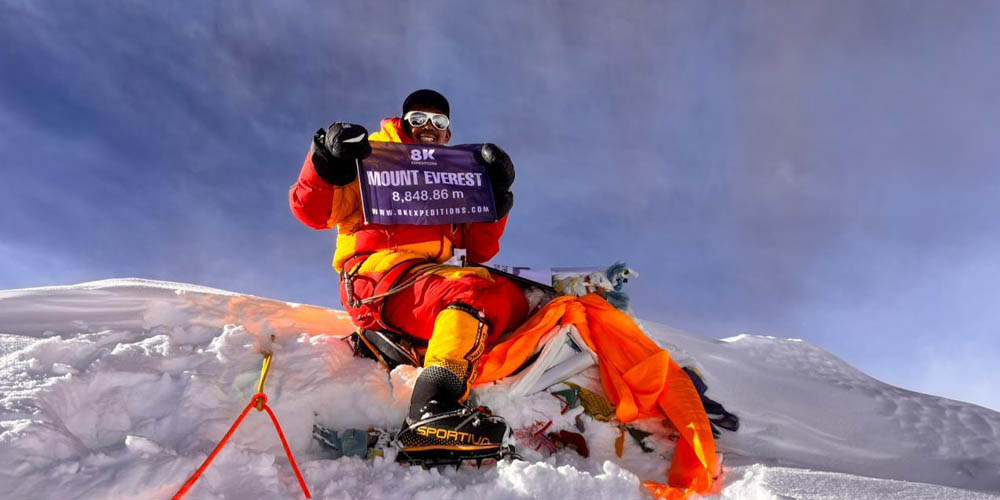
Kathmandu, 30 May: Tashi Gyaljen Sherpa from Forche village in Solukhumbu had reached the summit of Mount Everest four times within a span of 14 days, 10 hours, and 11 minutes and was on his way back to the village. The villagers had come up to a ridge just above the village to welcome him. But among the crowd of well-wishers, one person Tashi was eagerly looking for was missing. That absent person was none other than Ang Chhiring—Tashi’s own father.
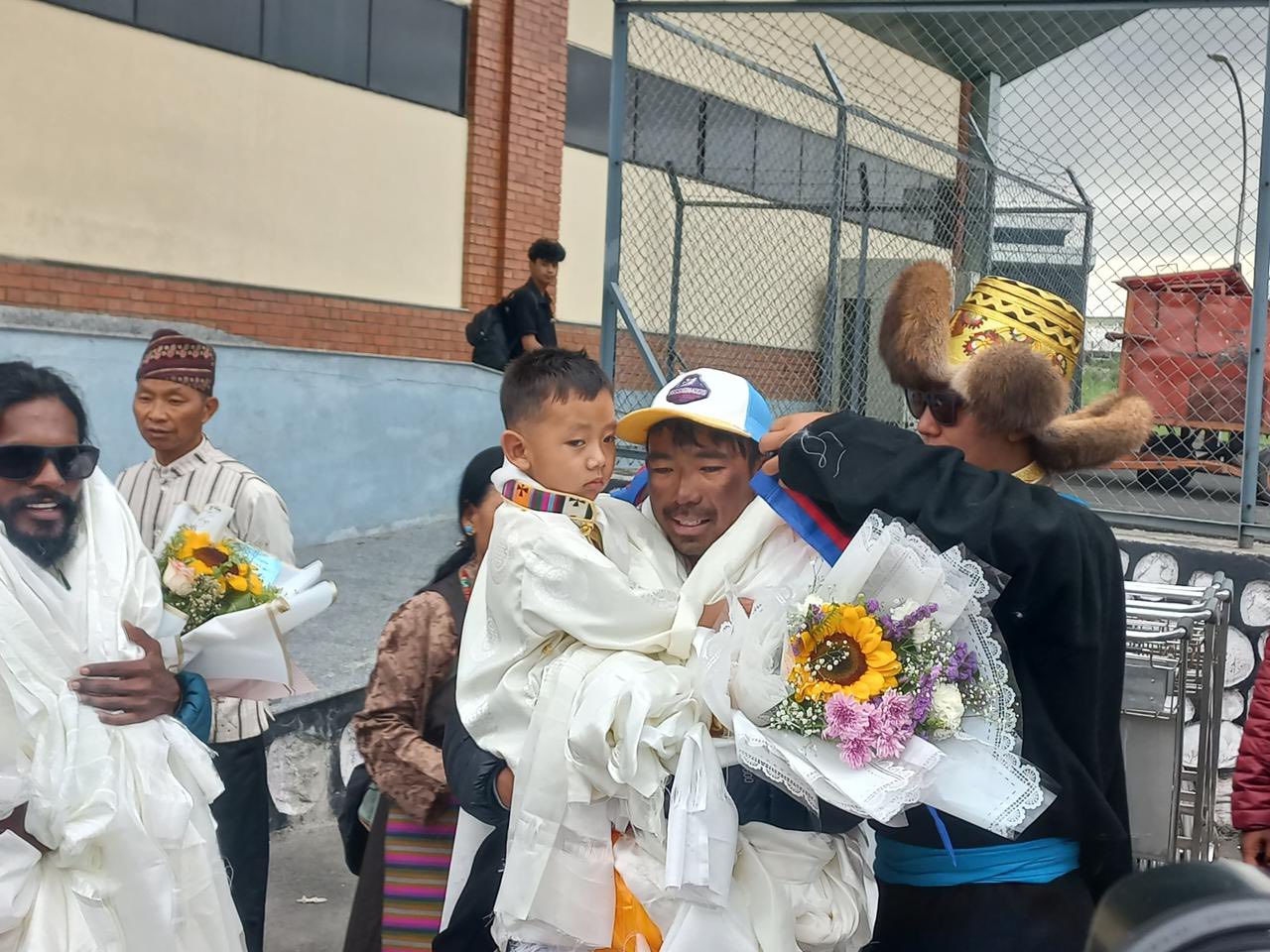
When Tashi reached the courtyard of his home, his father—radiant like the sun atop the ridge—stood waiting at the doorstep, holding a khada in his hands, anticipating his son’s return. Yet, even then, Tashi’s eyes searched for someone else—someone who could never be there. His heart longed for his mother, who had bid her final farewell fifteen years ago. “How happy she would have been if she were standing here with Father right now,” he thought.
After his father draped the khada around his neck, they embraced. Tears of joy streamed down both their faces—like melted ice cascading down a burst glacial lake. “Outwardly, I may have seemed happy, but deep down, I was so worried for you, my son,” his father whispered. Hours after descending from Lukla to Kathmandu, Tashi shared with the writer at Kaphan’s Siddhartha Hotel on Wednesday, *”For the first time in my life, I saw tears in my 78-year-old father’s eyes. But those were not tears of sorrow.”*
Because his father knew—he understood the risks and the heart of a climber. He, too, had summited Everest three times. But a decade ago, while carrying loads up and down the Himalayan trails, Ang Chhiring Khumbu fell on the treacherous Khumbu Icefall. His aging legs betrayed him. His right leg begged for the support of a cane. With that cane came the end of his livelihood—and the abrupt halt of his youngest son Tashi’s education. That was the day Ang Chhiring’s dream of educating his son and making him “someone great” shattered.
That same son—who once had no will to walk, burdened by the weight of his family’s struggles—was now returning home. But this time, it was different. Tashi had just set a world record: summiting Everest four times in 15 days—a feat nearly impossible for ordinary climbers.
Pasang Lhamu Village Municipality-4, Forche Village may appear breathtakingly beautiful, but behind its scenic charm, every household carries stories of Himalayan hardships and courage. Among them is 28-year-old (soon to be 29 as per citizenship records) Tashi Gyaljen, a young man who has already set a world record in just seven years of climbing.
This May, Tashi summited Mount Everest four times within 15 days—on the 9th, 14th, 19th, and 23rd—a historic feat in a single season. Though he only began carrying heavy loads in the mountains in 2018, he had already summited Everest five times and Cho Oyu once before this achievement.
Tashi never imagined he would one day stand atop Everest. His journey began as a mission to fulfill his father’s dream. After completing his SLC from Sir Edmund Hillary Secondary School in Khumjung in 2072 BS, his father sent him to Kathmandu for higher studies. He pursued a Hotel Management diploma, then a Bachelor’s degree in the same field.
But his father’s earnings couldn’t cover his Bachelor’s degree. So, Tashi switched to studying journalism at Pushpa Lal Memorial College. During his second year, his father’s leg gave out—leaving him unable to work. His older siblings were already married, and his younger sister was still in school. The responsibility of running the household and caring for his father fell on Tashi’s shoulders.
“I suddenly felt the pressure to earn money—quickly and in large amounts,” Tashi recalled, reflecting on the situation seven years ago. “At that time, the only way to make fast money was by carrying loads in the mountains.”
In 2018, he joined Alpine Glory, a climbing company, for his first Everest expedition via the Chinese side. But with no prior training or mountaineering knowledge, he failed to summit. After returning to the village, he enrolled in basic and advanced climbing courses at a local mountaineering training center—determined to try again.
In 2019, Tashi successfully summited Mount Everest from the Chinese side through the company Fortin Peak Expedition, and that same year, he also conquered Cho Oyu. After that, he went on to summit Everest again in 2022, 2023, and 2024—even climbing it twice in 2024.
In Forche Village, there is hardly a household where at least one member hasn’t summited Everest. Some of Tashi’s fellow villagers have climbed it as many as 17 or 14 times. “Two years ago, I realized—everyone climbs Everest. If I don’t do something extraordinary, I won’t stand out, and my financial situation won’t improve,” Tashi said. “That’s when I decided to set a record by summiting four times in 20 days.”
Though Tashi had a plan, executing it was far from easy. The biggest hurdle? Money. He didn’t have the funds to finance such an ambitious expedition. Fortunately, this year, his elder brother Chirring Tashi helped connect him with supporters—James Lamb from Scotland, the Little Foundation, Inspire Trek, and ATKE Expedition—who believed in his vision and backed his mission.
Tashi’s first ascent this year was as part of the rope-fixing team, a critical role in Everest expeditions. Carrying 300 meters of rope (weighing 30 kg) and other gear, he worked tirelessly, finally reaching the summit at 5 PM on May 9. “The weather was so clear and perfect that day—even a match lit at the summit wouldn’t have gone out,” he recalled. At the top, he offered a khada (prayer scarf) to Everest, seeking forgiveness and blessings: “Forgive me, for this time I will step on your summit four times. Please bless me.”
Perhaps the mountain heard his plea.
On his fourth and final ascent this season, Tashi once again offered a khada—this time in gratitude—to Everest and his ancestral deity, Lobuche, thanking them for their protection and blessings throughout his historic achievement.
The second ascent this year, on May 14 at 8 AM, was technically the easiest. But on the descent, as Tashi passed through the treacherous Nuptse Face between Camp 2 and Camp 1, an overwhelming homesickness (home-sick) suddenly hit him.
He couldn’t hold back.
Memories of the grueling rope-fixing effort and years of struggle flashed before him. Exhausted and emotional, he collapsed on the trail and wept alone. “I don’t know what happened—it was like a sudden wave of longing. I couldn’t control myself,” Tashi recalled, his voice trembling. “I just broke down and cried like a child.”
That moment of raw vulnerability, high on the world’s deadliest mountain, revealed the true weight of his journey—not just the physical endurance, but the emotional toll of pushing limits, far from home.
For his third ascent, Tashi took on a special mission—guiding Bangladeshi climber Ikramul Hasan Shakil, a man he had promised two years earlier to help summit Everest. Shakil was no ordinary mountaineer—he had walked from the sea to Everest in 84 days, completing the Great Himalayan Trail, and was now aiming for the summit. Nepal’s Makalu E-Traders and international brands had sponsored his climbing gear, from boots to clothing.
On May 23 at 6:11 AM, Tashi and Shakil stood atop Everest together—another dream realized.
After the grueling third climb, Tashi was completely drained. He planned to rest for a day at Base Camp. But when Lakpa Sherpa, director of ATKE Expedition, congratulated him with such enthusiasm, his fatigue vanished instantly. That very evening, he pushed back up—reaching Camp 2 by nightfall. The next day, he advanced to Camp 4 and began his fourth summit push at 8 PM.
This final climb would prove to be the most dangerous and challenging of them all.
On his historic fourth ascent, Tashi overtook nearly 200 climbers on the route. Battling fresh snowfall and searching for buried ropes in the dark, he reached the summit at 3:11 AM—accompanied only by Phurba Tenjing Sherpa from ATKE Expedition, who was summiting for his first time. A handful of other climbers followed behind.
Tashi’s biggest fear? Getting stuck in a traffic jam during descent. The wind was so fierce that snow pellets lashed his face like whips, stinging worse than a slap. Yet on their way down, they encountered only about 30 climbers—the rest had turned back due to worsening weather.
With this achievement, Tashi etched his name in Everest history, joining the elite ranks of record-breaking climbers. But he feels no pride—only gratitude.
“There are many Sherpas faster and stronger than me,” he says humbly. “But because I had to focus on safely guiding my client to the top, I ended up with this record. It was duty, not ambition, that brought me here.”
Tashi carries two visions in his heart:
-
To uplift his educationally disadvantaged village—a dream already taking shape as younger generations pursue academic progress.
-
To put Nepal on the global map through tourism, adding his “brick” to the nation’s prosperity.
Yet, one painful reality shadows these hopes: “The state has never truly recognized Sherpas—who risk their lives in the mountains—as full citizens.”
“Forget social security or benefits. At the very least, children of Sherpas who die on Everest should get free education,” Tashi says, frustration simmering. “These fallen climbers are martyrs of the Himalayas. But their families still beg foreigners for help to educate their kids. When will we rise above this?”
Life’s hardships have forged Tashi into maturity. His four-year-old son, now clinging to his side, must never face the struggles he endured.
He knows success has no final measure—“Even if you conquer Everest, you must descend to base camp.” Yet this record? Pure grit. “For 16 days, I barely slept. By 2 AM each night, I was already up. Dreams aren’t built on rest.”