Coordinator Tulachan said, “There was a crowd right on the first day, and everyone who comes here returns home happy.” He mentioned that the income generated from the yaks and chauris brought in by various groups during the fair is used for their care and conservation. In the Himalayan region, the male animal that looks like an ox is called a yak, while the pure-bred female that resembles a cow is known as a “nak,” and a hybrid between the two is called a chauri. Around 300 yaks and chauris have been brought to the fair by different groups. A single patient typically drinks between one to seven glasses of raw chauri blood.
It is believed that the chauris grazing at an altitude of 3,700 meters above sea level, feeding on Himalayan herbs like panchaule, niramasi, jatamasi, and yarsagumba, produce blood that helps alleviate ailments such as tonsillitis, cough, indigestion, joint and nerve-related problems, and even enhances sexual vitality. Up to 20 glasses of blood can be drawn from a single adult chauri.
Considering the potential health risks to humans from parasites present in raw blood, the Livestock Division of Thasang Rural Municipality provides free deworming medicine and testing. Blood is extracted from the chauri by piercing its neck with a small, sharp iron tool called a chulesi. In addition to the blood, chauri milk is used to make and sell cheese, yogurt, ghee, and chhurpi (hardened cheese). In the grazing areas of Thasang Rural Municipality, about 700 yaks and chauris are raised by ten local farmers. The Himalayan Yak-Nak Conservation Committee has welcomed Nepal’s government decision to officially declare the first-ever Yak Day.
The organizers have stated that during the fair, which will run from Baisakh 6 to 15 (April 18–27), there will be information sessions about yaks and chauris, efforts to promote tourism, opportunities to learn from the experiences of herders living in the Himalayan region, an exhibition of yaks and chauris involved in the traditional “Tara” game, awareness programs on biodiversity conservation, and cultural performances.
Every year during the months of Baisakh (April-May) and Shrawan (July-August), large crowds gather in Mustang to drink raw blood from yaks and chauris. In the five local municipalities of Mustang, more than 4,000 yaks and chauris are being raised.
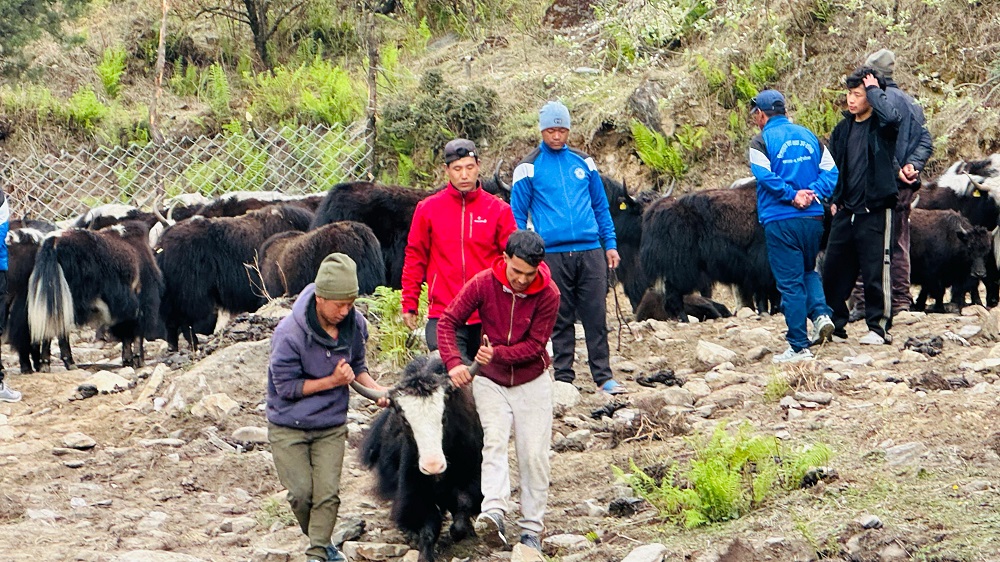
Local governments have also launched various subsidy programs, including improvements to shelters, for yak and chauri farmers. They are working in coordination with the Himalayan Yak-Chauri Farming and Conservation Management Committee to protect the rights and promote the welfare of those involved in this sector.
Meanwhile, medical professionals state that although there is a tradition of using raw animal blood as a remedy, there is no scientific evidence to prove it cures illnesses. Raw blood can contain toxic substances, and in medical science, fresh blood is not classified as an edible part. However, because the animals grazing in the Himalayan pastures have high levels of hemoglobin, the blood can be extracted and discarded if necessary.