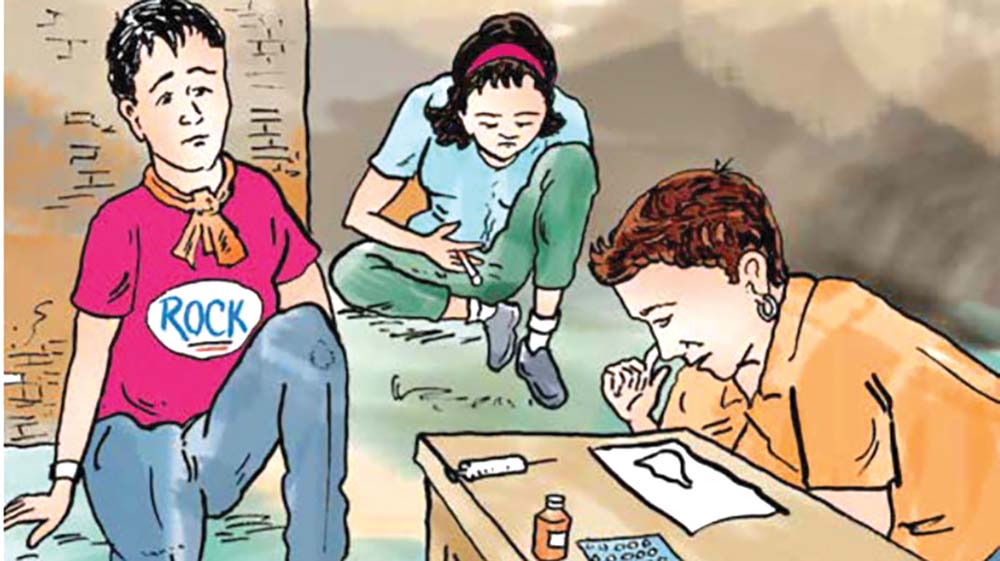
Kathmandu, 4 April: Nirmala (name changed), a resident of Samakhusi in Kathmandu, has a 20-year-old son, Ayush, who has been addicted to drugs for nearly five years. Despite numerous efforts by the family to help him quit, they have not been successful. As his addiction worsened, Ayush became involved in theft, robbery, and gang activities, leading to repeated arrests and releases by the police.
Similarly, Kamal, the 26-year-old son of Sita Thakuri from Dang, fell into drug addiction at the age of 14. During his teenage years, he was also accused of involvement in the rape of a minor. After being released from a juvenile correction center, he again fell back into drug abuse. Due to Kamal, the Thakuri family has faced countless economic and social hardships.
In Maharajgunj, Kathmandu, Sandesh’s addiction led to separation from his wife. A father of one daughter, his condition worsened over time, and he began physically abusing his elderly mother almost daily. As a result, his family admitted him to a rehabilitation center.
In recent times, drug abuse has spread among the youth from urban areas to rural communities. Stakeholders have started expressing concern that if effective measures are not taken in time, the situation could become alarming. Basanta Kunwar, head of Narconon Nepal, who has long been active in the rehabilitation of drug users, says it is particularly worrying that most users fall within the age group of 15 to 25.
He warns that drug addiction could devastate families, society, and the nation if not addressed promptly. “Our survey shows that there are around 1 to 1.1 million drug users in Nepal. This means one person in every five households is affected,” he said. He added that traffickers often lure students from grades 8 to 12 into addiction through various temptations, emphasizing the need to include drug education in school curricula and strengthen community awareness programs.
According to data from the Narcotics Control Bureau Nepal, drug trafficking, smuggling, and usage have increased by nearly 10 percent over the past five years. Informal surveys by security agencies suggest that the real situation could be far worse. In the fiscal year 2019/20, 4,546 individuals were arrested for drug-related crimes, including 149 foreign nationals. Authorities seized cannabis, hashish, heroin, opium, cocaine, and 335,710 units of pharmaceutical drugs from them.
In the last fiscal year 2024/25, around 8,000 individuals were arrested on charges of drug trafficking, with more than 5 million units of pharmaceutical drugs confiscated. According to government data, Nepal has 134,000 registered drug users.
However, as this figure only includes those arrested or undergoing rehabilitation, the actual number of drug users is believed to be much higher—estimated at over 1.1 million.
Although the police have been running special campaigns to control drug abuse—given that youth, who are the drivers of national development and transformation, are increasingly falling victim—the problem remains unresolved. Since drug trafficking and smuggling are often carried out by organized groups, it is necessary to develop stronger security strategies and increase resources for effective control.
Krishna Prasad Koirala, chief of the Narcotics Control Bureau, stated that efforts are ongoing to control drug use, trafficking, and smuggling. He noted that open borders make it particularly challenging to control drug movement through various channels. “International coordination and cooperation are crucial for controlling drug-related activities,” he said, adding that strengthening manpower and resources in the bureau could significantly improve the situation.
Former Inspector General of Nepal Police, Hemanta Malla, emphasized that the annual increase of 8 to 10 percent in drug abuse should be taken very seriously. He stressed the need for effective control of drug production, trafficking, demand, treatment, and rehabilitation. “The current efforts to control drug trafficking and smuggling are not sufficient, and the state must pay serious attention to this issue,” he said.