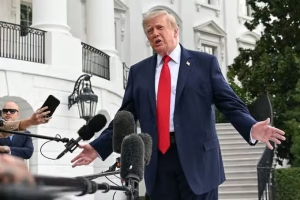
U.S. President Donald Trump has announced plans to raise tariffs on imported steel and aluminum by up to 50% starting next week. Addressing employees and workers at a U.S. steel plant in Pennsylvania, he said, “We are going from 25% to 50%.”
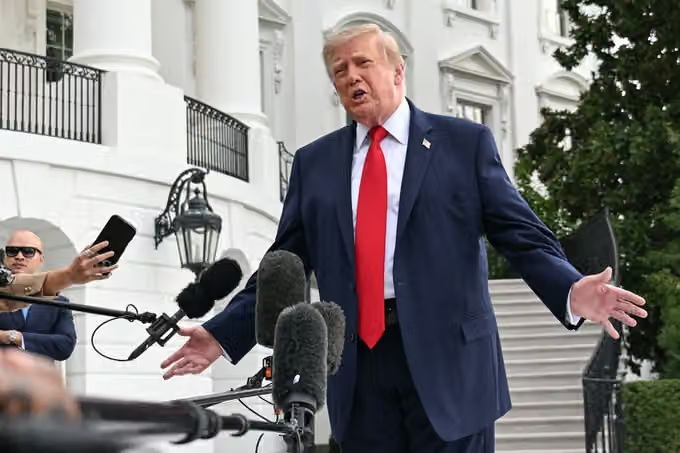
Speaking to a crowd of supporters dressed in blue in Pennsylvania—a key swing state that helped secure his victory in the last election—Trump added, “Nobody’s going to get around this.”
Shortly after, President Trump posted on his own social media platform, Truth Social, stating, “Starting Wednesday, June 4, new tariffs with higher rates will also be applied to aluminum.”
This past January, after returning to the White House, President Trump imposed sweeping tariffs on both allies and rivals—moves that rattled the global trade system and shook financial markets.
He has also introduced sector-specific tariffs, targeting goods such as automobiles. On Friday, defending his trade policy, he argued that the tariff increases have helped protect American industry.
“If we hadn’t imposed tariffs on metal imports like steel and aluminum during my first administration, that sector wouldn’t even exist today,” he stated.
On Friday, while President Trump discussed the planned partnership between U.S. Steel and Japan’s Nippon Steel, he did not provide any new details about the previously controversial agreement that had faced bilateral opposition.
Despite the recently announced planned partnership between U.S. Steel and Nippon Steel, he emphasized that U.S. Steel would remain under American control. He also stated that the company would not be encouraged to use foreign labor for any of its operations.
Speaking to reporters after returning to Washington late Friday, President Trump said he had yet to approve the deal. “I still have to approve the final agreement with Nippon, but that final deal hasn’t reached me yet. However, they have made a very strong commitment,” he said.
Last week, former President Trump stated that U.S. Steel’s headquarters would remain in Pittsburgh, and that the deal with Nippon Steel would create at least 70,000 jobs and contribute an additional $14 billion to the U.S. economy.
Speaking in Pennsylvania, Trump said, “As part of its commitment, Nippon will invest $2.2 billion to boost steel production at the Mon Valley Works–Irvin Plant. An additional $7 billion will be spent on modernizing steel mills, expanding ore mines, and constructing facilities in locations such as Indiana and Minnesota.”
The proposed $14.9 billion sale of U.S. Steel to Japan’s Nippon Steel had previously faced political opposition from both sides. Former President Joe Biden, shortly before leaving office, blocked the deal citing national security concerns. Concerns over the new partnership still remain.
The United Steelworkers Union (USW), which represents thousands of hourly workers at U.S. steel plants, stated after Trump’s speech that it had not participated in any discussions with Nippon Steel or the Trump administration and had not been consulted on the matter.
USW International President David McCall said, “We cannot speculate on what a ‘planned partnership’ means.”
He added, “Regardless of the deal’s structure, our primary concern remains the impact of merging U.S. Steel with a foreign competitor on national security, our members, and the communities where we live and work.”
During the campaign, Trump opposed Nippon Steel’s acquisition plan. However, upon returning to the presidency, he has signaled openness to some form of investment.