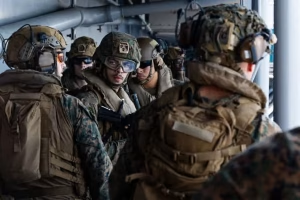
Former US President Donald Trump has announced that the American military has conducted one of the most powerful operations in Middle Eastern history, resulting in the complete destruction of all military targets on Iran’s Kharg Island. In a post on his social media platform, Truth Social, Trump detailed the scope of the attack carried out by the US Central Command, stating that “every military installation” on the strategic island was obliterated.
Kharg Island, a small but highly strategic landmass located approximately 22 miles off the Iranian coast in the northern Gulf, is of immense geopolitical importance. It serves as a critical terminal for the export of Iranian oil, making it a potential flashpoint in any military confrontation. Trump explicitly noted that he chose a path of restraint regarding the island’s crucial petroleum infrastructure. “I have taken the path of not destroying the oil-related structures on the island,” he wrote. However, he issued a stark and immediate warning to Iran and any other actors: any interference with the freedom and safety of navigation through the Strait of Hormuz would force him to “immediately reconsider” that decision. The Strait of Hormuz is a vital chokepoint through which a significant portion of the world’s oil supplies transit. He also called on Iran to disarm and to “preserve what is left of your country.”
In a separate statement on Truth Social, Trump refuted reports circulating in various media outlets, including The Wall Street Journal, which claimed that five American tanker aircraft had been severely damaged or destroyed by an Iranian missile attack at Prince Sultan Air Base in Saudi Arabia. Citing unnamed US officials, those reports had suggested significant damage to American assets. Trump denied these claims, though details regarding the source of the denial were not elaborated upon in his brief post. The backdrop to these escalating tensions remains the ongoing conflict in the region, with Lebanon’s Health Ministry reporting that over 770 people have died since the latest phase of the conflict began, underscoring the broader humanitarian toll of the regional instability.