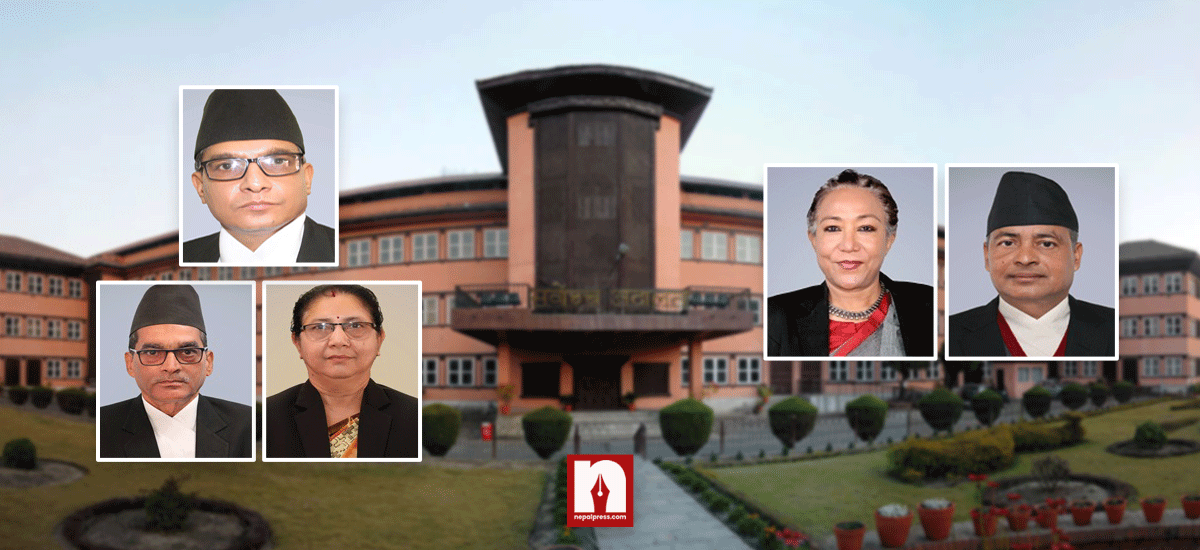
Kathmandu, 16 Jul: The issue of when married daughters will also have equal rights to ancestral property, as per the constitutional and legal provisions, has led to differing opinions in the five-member full bench of the Supreme Court.
Three judges have interpreted that only women who marry after the date of the amendment to the Muluki Ain (National Code) following the promulgation of the constitution will be entitled to that right. The opinion of two judges, stating that women will have equal rights to shares only after the 11th amendment to the Muluki Ain and that the provision will be effective from that time, has been in the minority.
Judges Manoj Kumar Sharma, Saranga Subedi, and Abdul Aziz Muslim have advocated the view that the provision should be implemented only after the promulgation of the constitution. The opinion of judges Sapana Pradhan Malla and Mahesh Sharma Paudel, who interpreted that the effective date (cut-off date) should be set from the 11th amendment of the Muluki Ain, has been in the minority. The 11th amendment of the Muluki Ain was made on 10th Ashoj, 2059 (September 26, 2002).
Since the opinion of the three judges—Sharma, Subedi, and Muslim—in the five-member bench has gained a majority, it will be recognized as the final decision. Although considered progressive from the perspective of gender justice, the opinion of judges Malla and Paudel has remained in the minority.
“Denying a Daughter Her Share…”
A couple had three daughters. After the first wife passed away in 2049 BS, the father remarried, and they had one son and one daughter together. The eldest daughter from the first wife was living in the U.S.
The father and stepmother refused to give her a share in the ancestral property, arguing that she had married in the U.S. in 2043 BS and had obtained citizenship there.
Claiming that her father and stepmother had neglected and mistreated her, she filed a lawsuit demanding her rightful share—one part out of six.
In Jestha 2068 BS, the Kathmandu District Court ruled in her favor, granting her one-sixth of the property. This decision was upheld by the then-Patan Appellate Court in 2070 BS.
The parents appealed to the Supreme Court.
In 2076 BS, the Supreme Court referred the case to a three-member full bench, citing complex legal questions. While the case was ongoing, the law was amended. The full bench then recommended that a five-member constitutional bench resolve the confusion over which law should apply.
The constitution, promulgated in 2072 BS, mandated equal inheritance rights for sons and daughters. Based on this, the Muluki Ain (Civil Code) was amended, enforcing equal property rights from 14 Asoj 2072 onwards.
Married Daughters Cannot Claim a Share
Justices Manoj Kumar Sharma, Saranga Subedi, and Abdul Aziz Muslim ruled that daughters married before 2072 BS would be governed by the old inheritance laws.
They stated, “The law in force at the time of filing the case is the applicable law.”
Since the eldest daughter had married in Chaitra 2051 BS—before the 2064 BS amendment to the Muluki Ain, which first introduced inheritance rights for married daughters—the three justices ruled that she was not entitled to a share.
With this majority opinion, the appellate and district court decisions were overturned, and the daughter was denied her claim.
Dissenting Opinion
Justices Sapana Pradhan Malla and Mahesh Sharma Paudel, however, held a different view. They argued that the daughter should have received her share.
According to them, the 11th amendment to the Muluki Ain on 10 Asoj 2059 BS had already granted daughters inheritance rights. The 2072 BS amendment only expanded these rights to include married daughters.
They believed the district and appellate court decisions should have been upheld.
Final Outcome
Since the majority opinion prevailed, the daughter lost her legal claim to ancestral property. While the dissenting justices viewed the case through a progressive gender justice lens, their stance remained a minority.
“The Daughter Should Get Her Share”
Justices Sapana Pradhan Malla and Mahesh Sharma Paudel, in their dissenting opinion, argued:
“Denying a share to a daughter who has already sought justice and is awaiting a court ruling does not align with the spirit and provisions of the constitution and the law.”
The two justices pointed out that while the case was pending, the law was amended to grant married daughters equal rights to ancestral property. They emphasized that since the eldest daughter’s legal right had already been established, whether she was married or unmarried was irrelevant.