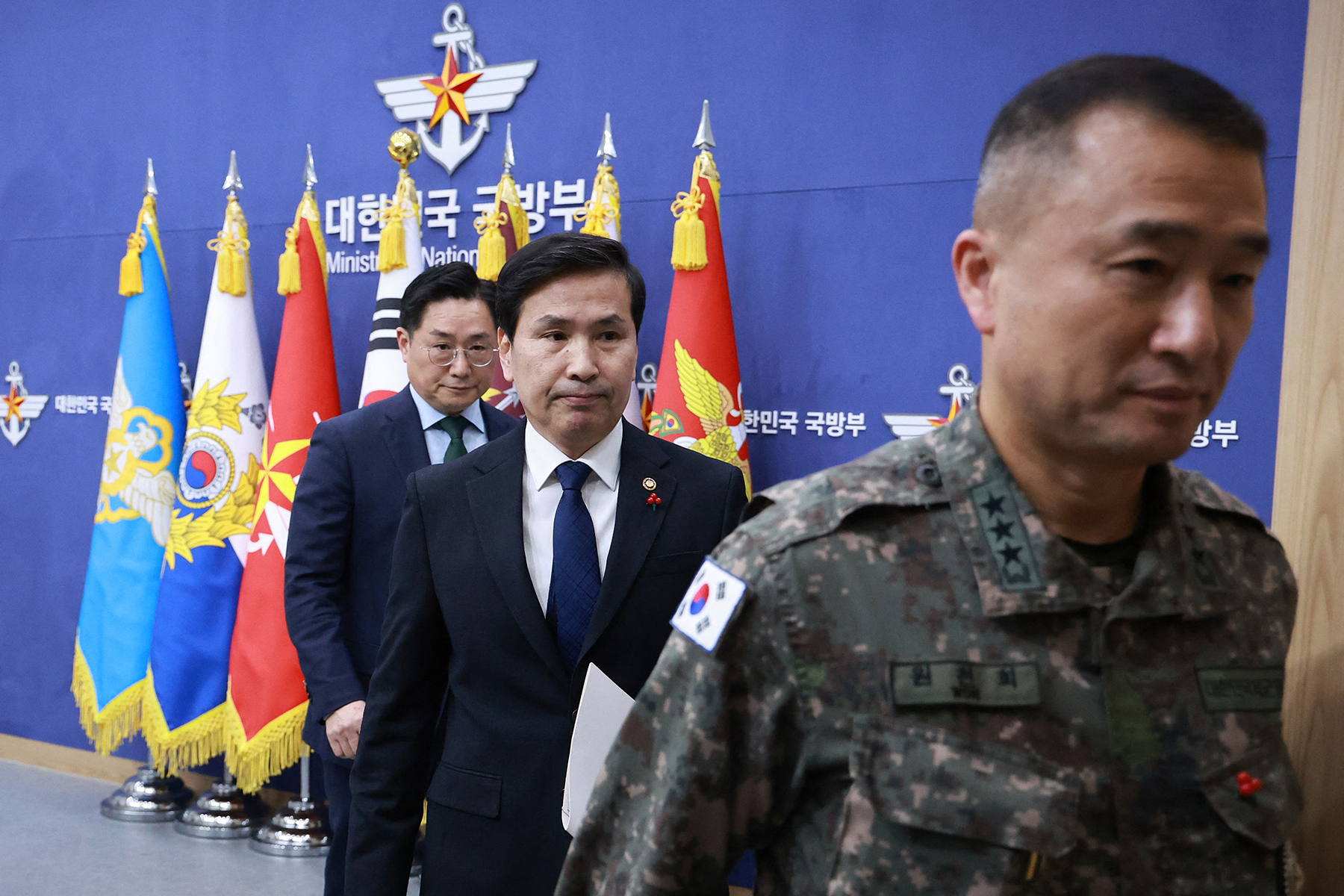
The chairman of South Korea’s ruling People’s Power Party has said it is appropriate to remove President Yoon Suk-Yeol from office, saying he poses a grave threat to the country. The surprising comments by Han Dong-Hoon, head of Yoon’s People Power Party, almost ensured that enough lawmakers would vote to impeach the president on Saturday. Han said on Thursday he would block the impeachment. Another party leader said all 108 PPP members would unite to support Yun in Saturday’s vote.
Han said his stance changed on Friday because Yun refused to admit he had done anything wrong by declaring martial law on Tuesday night. “In light of the new facts, it is necessary to immediately suspend President Yun Suk-Yeol from his duties to protect the Republic of Korea and its people,” Han said.
Han said, “Yoon has not taken any action against the military officer who ‘illegally interfered’ and he is still reluctant to admit that this action was wrong. Therefore, if President Yoon continues to hold the office of president, there is a serious risk for South Korea and its people. Extreme actions like the current crisis situation could be repeated.”
Yun had suspended civilian rule and deployed the military to parliament late on Tuesday, but was forced to reverse his decision within hours after opposition protests. The opposition holds a majority in South Korea’s 300-member legislature and some lawmakers from the PPP would need to defect to achieve the two-thirds majority needed for impeachment. According to a survey released by Real meter on Thursday, 73.6 percent of respondents in the capital supported impeachment.
Thousands of protesters continued to demonstrate in central Seoul and near the parliament building on Thursday evening, demanding the president’s resignation. If the impeachment motion is passed, Yun will be suspended until the Constitutional Court rules. If the judges agree, Yun will be impeached and a new election will be held within 60 days.
If South Korea’s ruling party is seeking to remove President Yoon Suk-Yeol (or another current president), it suggests significant political tension and potential dissatisfaction within his own political faction or coalition. This scenario is unusual, as ruling parties generally support their presidents unless there is a deep rift over policies, scandals, or leadership.
The process to remove a president in South Korea involves impeachment, which requires:
-
National Assembly Approval: A motion for impeachment must be proposed and approved by a two-thirds majority in the 300-seat National Assembly. The ruling party would need significant support from opposition parties unless it holds a supermajority.
-
Constitutional Court Ruling: After the National Assembly’s vote, the Constitutional Court must review the case. At least six of its nine justices must agree to uphold the impeachment for the president to be removed.
South Korea’s last impeachment occurred with President Park Geun-hye in 2017 due to corruption allegations, which led to massive public protests and a loss of political support.