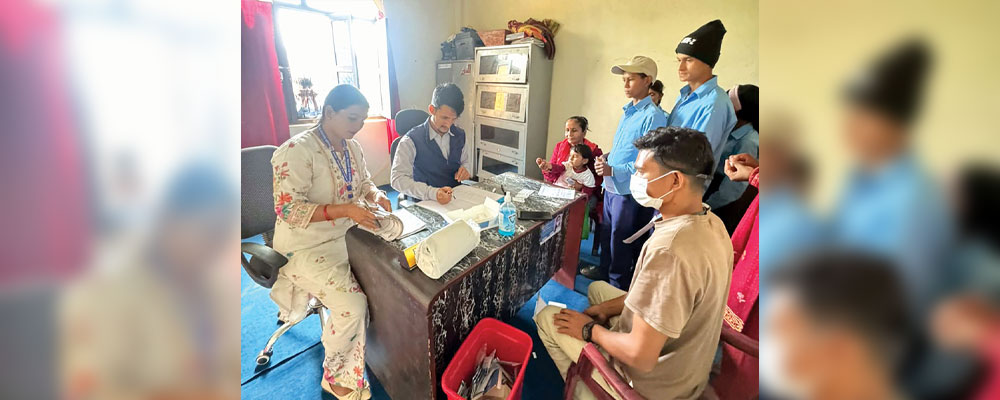
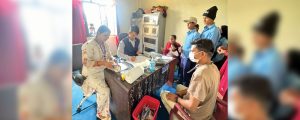
Dehradun (India), 22 March: “Come, take at least one of the utensils and information,” said Ganeshraj Bohora of Kanchanpur while showing the utensils of Vijaysal to all the customers who came to his stall, “There are many benefits of keeping water in these utensils and eating them.”
Bohora told the visitors of the Indo-Nepal Trade Fair in Dehradun, India, starting from Friday, about the many benefits of keeping water in Vijaysal utensils and eating them. “Keeping water in these utensils overnight and drinking it on an empty stomach in the morning cures diabetes, high blood pressure, cholesterol, body aches, and is also good for controlling body aches and weight,” he said.
The customers were listening to him with interest. “It is not appropriate for a potter to talk about Ayurveda, I don’t know much about it, I should search for it on the internet,” he added. He feels that it is more about providing information about it than selling goods. If everyone understands its importance, he understands that it will not take long to sell so many goods. That is why he was urging everyone to take photos and watch videos on YouTube. “Those who don’t buy today will go home and watch on YouTube and come back tomorrow to buy, so I am asking everyone to take photos of this,” he said.
He was happy with the good business at the previous two festivals and this time, he had brought 102 wooden utensils. This time, he said, nine were sold before the inauguration. “In the first year, 150 and the second year, 230 were sold in 2-3 days, this time too, the start is good,” he said. He has made amkhoras, glasses and cups made of Vijayasal wood. He has also made small attractive pieces for those who do not spend much money.
Kanchanpur Bhimdatta Municipality-1, Bhansi Merit Mahila Marketing, owner Bohora, said that she started making Vijayasal utensils since 2057 BS. “Earlier, they used to make a lot of utensils, but now they can’t get wood. At one time, they used to make up to 10,000 utensils a year, but now even 3-400 are not enough,” he said.
He said that after placing Vijayasal on the list of protected plants, it has become difficult to get wood. According to him, this wood is mostly found in the forests of Kanchanpur, Kailali and Kapilvastu. Currently, the timber from Dhalepade in the forests of Kanchanpur has to be purchased through a tender, which costs Rs 3,300 per cubic foot, but it is still difficult to get, he said.

After stopping getting wood, he has recently distributed 300 seedlings of Bhimdatta, Bedkot and Belori. He said that he has also planted three trees himself. “It has been about 20 years since I planted it, and it has grown to a height of 20-22 feet. It is not only for wood, but the bark and leaves are also used medicinally,” he said.
At the festival, Dehradun residents have shown equal interest in wooden utensils made from Vijayasal, such as Nepali Rudraksha and Bodhichitta garlands, Salyan Khukuri, various Dhaka costumes produced in Palpa, sinki, Nepali pote, masyaura, as well as Bhir bee honey produced in Rukum Rolpa, and Thangka paintings. Many people have liked Nepali handicrafts at the festival.
Ambi Dhital, the owner of Mandro Nepal, who came from Bharatpur, Chitwan to participate in the festival, said that she brought Nepali products such as masyaura, titaura, etc. “60 percent of our total production is exported abroad, this festival is expected to help expand the market in Dehradun,” she said.
Rajni Chitrakar, the owner of Rajdhani Handicrafts, who arrived from Kirtipur, Kathmandu, for the festival, said that she has participated in the festival three times before and came this time as the business was good in the past. “The Kanchanpur Chamber of Commerce and Industry has helped in bringing the goods here, provided the stalls free of charge, the festival has helped in marketing Nepali handicrafts,” she said.
Uma Khatri, the owner of Ashishek Beekeeping Firm in Ghodaghodi-2, Kailali, said that although the festival is a suitable place for promoting Nepali products, it is not easy to bring the products. “Participating in the festival helps in promoting Nepali products and finding new markets, but it is important to facilitate the transportation of goods across the border,” said Khatri, central vice-president of the Nepal Beekeeping Association. “It is still not easy to bring goods, the governments of both countries need to pay attention to this issue.”
Sangita Gurung, who runs Global Nature Agrotech in Nagarjuna, Kathmandu, said that she brought honey from Bhir bees produced in Rolpa and Rukum. “Mr. Omprakash Gurung himself goes to extract Bhir bee honey, many people prefer Bhir bee honey, besides, the sale of timur and millet flour is also good,” she said. “The festival made it easier to bring Nepali products here.”
Karun Rai, the owner of Koseli Dhaka in Koteshwor, Kathmandu, said that he brought various hand-woven costumes. “This is not only a costume, but also a promotion of Nepali costumes and Nepali handicrafts. We participated in the festival because there are a significant number of Nepalis in Dehradun,” he said.
Lion Tamang, the owner of Kuber Thangka and Arts and Traders in Bhaktapur, was also present at the festival. He has put up rudraksha and bodhicitta garlands, as well as thangkas worth up to Rs 50,000 for sale at his stall. “The festival is also an opportunity to promote Nepali painting at the international level, many have observed the painting with interest,” he said.
On the occasion, items made from allo, Salyani khukuri, Dhaka cloth, Nepali pote and other jewelry, shoes made in Nepal, and various handicrafts have been put on display. There are 50 stalls from Nepal and 150 from India at the festival.