Kathmandu, 19 Jul: Suman, who went to Korea, spent five years there. After returning, he tried everything from farming to running a commercial buffalo farm, but failed. Now, his tea shop has brought him happiness and satisfaction.
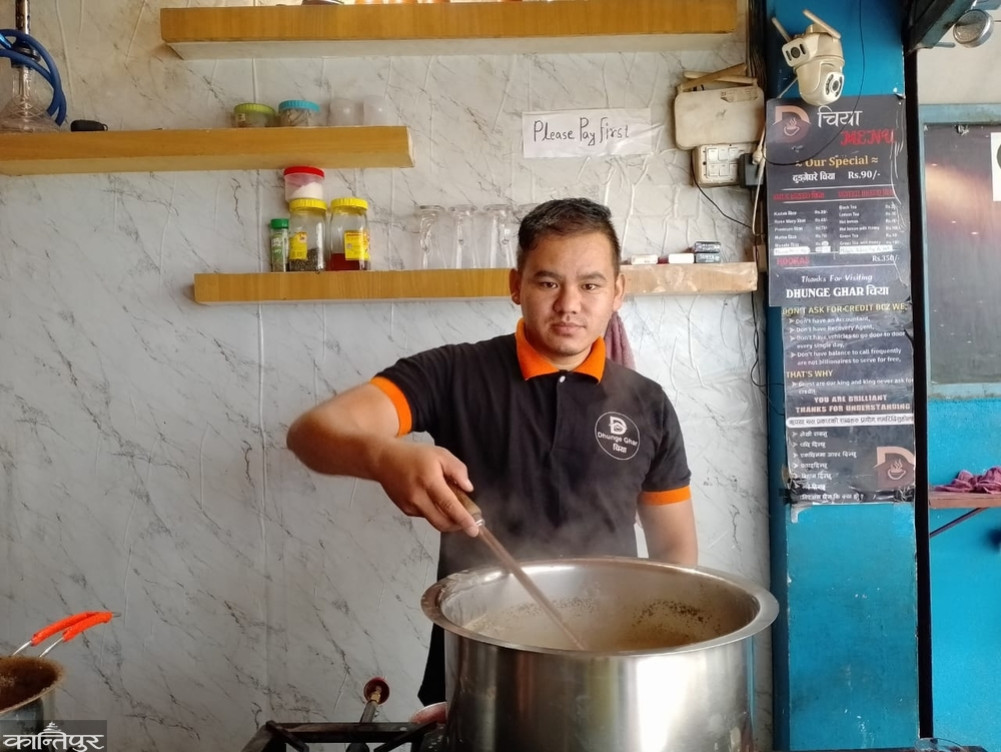
Almost every table is crowded with tea lovers. Suman Shreesh Magar is busy keeping up with the orders.
The rich aroma of cardamom, bay leaf, clove, pepper, cinnamon, black cardamom, and ginger fills the air. Tea boils vigorously, and the murmurs of tea enthusiasts echo all around. This is where Suman finds his joy.
Located just past the police station at Satdobato Chowk, ‘Dhungeghar ko Chiya’ has become a new junction for tea lovers.
Looking back, Suman’s journey has been full of ups and downs. He had gone to Korea on a labor visa, spent five years there, and returned home only to exhaust his time and savings in unsuccessful attempts at farming and running a commercial buffalo farm. But now, he seems truly content with what he does. His satisfaction feels like it adds flavor to every cup of tea he serves.
After losing some of his Korea earnings in a failed village venture, Suman moved to Kathmandu two years ago. While struggling to get by in a rented room and searching for opportunities, he began each day with a cup of fragrant tea he brewed himself. His wife, Dolma Moktan, would tell him every day, “How did you learn to make such delicious tea?” He would reply, “My grandfather used to make tea just like this, full of aroma—I learned it from him.”
One day, during a casual conversation, Dolma said, “You make such amazing tea. Why not open a tea shop instead?”
Suman didn’t mind his wife’s suggestion. He began searching for a place, and soon, a small and cozy tea shop—Dhungeghar ko Chiya—was ready.
There’s a special reason behind the name. His great-grandfather had built the first stone-roofed house in their village, which became known as Dhungeghar (stone house). “In memory of my village home, I named the tea shop Dhungeghar Chiya,” he shared.
With an investment of 1.2 million rupees, Suman opened the tea shop and poured his heart and soul into it. Like his grandfather used to do, preparing the spice mix for tea became his daily morning ritual. By 5 a.m., he starts blending the spices at home, and by 6, he’s already at the shop opening the shutters.
And then came the routine—cleaning, arranging tables and chairs, and boiling milk to a bubbling froth.
Recalling the early days, Suman said, “At first, only a few close relatives came by. But gradually, more people started coming in, drawn by the taste.”
Where Dhungeghar used to consume just two packets of milk a day, it now uses at least 50 liters daily.
According to Suman, word of mouth—or “mouth publicity”—is what made his tea shop successful. As tea lovers kept coming back, he expanded his menu. Now, he offers everything from regular masala tea at NPR 30 per cup, to rosemary tea at NPR 65, strong kadak tea at NPR 80, and Dhungeghar’s special tea at NPR 90.
Encouraged by the growing number of loyal customers, Suman has now hired three staff members.
His tea’s popularity spread further through social media. In the beginning, Suman actively used online platforms to promote his business. “Sometimes we can barely manage the crowd,” he says with a smile. “But that kind of pressure brings happiness and satisfaction.”
As evening falls, the crowd of tea lovers only grows. Joyful with his success, Suman believes that if you dream big and work with dedication, anything is possible. Inspired by the response, he’s now planning to expand and open more branches of his tea shop elsewhere. “There will always be obstacles when you start something,” he says. “But if you can overcome them, success will definitely follow.