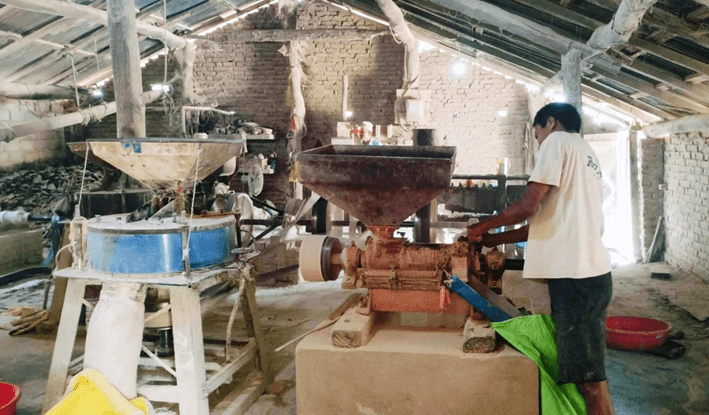
Kanchanpur, 29 April: Chitra Bahadur Chaudhary of Beldandi Rural Municipality–3, Baiwaha, has been operating a grinding mill for the past decade. By running the mill, he has been earning more than one lakh rupees per month.
Chitra Bahadur Chaudhary of Beldandi Rural Municipality–3, Baiwaha, shared that he established his mill with a loan of Rs. 2 million from the Srijanshil Savings and Credit Cooperative. His mill is equipped with facilities for grinding wheat into flour, extracting mustard oil, and processing paddy into rice.
“He borrowed around Rs. 2 million from the cooperative in phases,” he said. “So far, he has managed to repay Rs. 1.8 million through his earnings, and only about Rs. 200,000 remains. He plans to settle the remaining amount within the next two to three months.”
Reflecting on his earlier days, Chaudhary recalled that, due to a lack of investment, he used to spend his days working in the fields, where the harvest would only suffice for household consumption, leaving little to cover other expenses. Since joining the cooperative and establishing the mill, he said, financial hardships have significantly eased.
“He earns around Rs. 150,000 per month,” Chaudhary said. “After covering expenses such as workers’ wages, equipment maintenance, and electricity bills, we are able to save about Rs. 70,000 each month.” He added that the savings are regularly deposited into the cooperative.
With the income from the mill, Chaudhary has been able to purchase four katthas of land in the village and support the higher education of his two sons in Dhangadhi. He also shared that, as the village is located near the border, residents from the Indian village of Tatarganj frequently come to his mill for grinding and processing services.
Chaudhary shared that the mill processes about four quintals of grain daily for Indian customers alone. Altogether, including both Nepali and Indian clients, around 10 quintals of grain are processed at the mill each day. Since there are no other grinding mills nearby, he said, the mill often sees a heavy flow of customers.
“More Indian customers come for mustard oil extraction and grain milling,” Chaudhary said. “Since the service charges here are lower compared to mills across the border in India, they prefer coming here.” He added that if customers leave behind the bran after milling paddy, he provides the service without charging any additional fee.
Chaudhary mentioned that they charge Rs. 1.5 per kilogram for grinding wheat, Rs. 2.5 per kilogram for maize, and Rs. 7 for extracting mustard oil. By selling the bran left over from paddy milling and the cake residue from mustard oil extraction, he generates additional income.
He further said that he plans to use his savings to purchase land in a market area and eventually build a concrete house. According to him, the mill has no shortage of customers, as it provides services whenever needed.