Kathmandu, 6 May: To change the world, one must first change oneself; to enforce rules, one must first abide by them. Mayor Harkaraj Rai of Dharan Sub-Metropolitan City stands as a living example of this principle.
Considering the problems of Dharan’s citizens as his own family’s problems, Harkaraj waged a decade-long battle against the deeply rooted political system that had become a breeding ground for corruption. In his efforts to prevent the exploitation of public resources under political protection, he even shed blood on the banks of the Seuti River to stop illegal sand extraction. He is the kind of leader who stages sit-ins at the electricity office on behalf of his people.
After all, he is a son of the indigenous community. Persistent and uncompromising in his stance against malpractice while carrying the people’s problems on his shoulders, Harka takes a rock-solid stand. There may be very few issues that he hasn’t raised his voice on, and day or night, he relentlessly works to live up to the trust the citizens have placed in him.
Harkaraj, who won the hearts of his supporters through social media, never had an inherent desire to pursue politics. What he truly desired was to stand with the people and speak out against the wrongdoings perpetrated by corrupt politicians. Because the state failed to listen to his voice, he believed he had to become a leader of the people in order to make the people’s voices heard. That belief led him to participate in elections—not out of political ambition, but as a response to public demand. However, when he faced political power, money, and pressure from contractors and their networks, he encountered setbacks early on, like a stone in the first bite of food. He lost his first election, but his dedication to service never wavered.
Identifying the severe water crisis—an issue that previous elected officials had failed to address—as Dharan’s most pressing problem, Harkaraj once again ran as an independent candidate in the local elections of Baisakh 2079 B.S. (April 2022). With a microphone strapped to his shoulder, he walked from place to place, asking for votes. One of his main campaign promises was to provide drinking water to every household in Dharan, no matter what it took. The people believed in his unwavering stance, and ultimately, the citizens of Dharan voted for him and elected him Mayor of Dharan Sub-Metropolitan City.
Once a protester on the streets fighting for citizens’ rights, Harkaraj now found himself in a position to deliver those very rights and make decisions for the people. Whether it was appointing the head of BP Koirala Hospital, ensuring access to drinking water, or halting illegal resource extraction—he closely observed and addressed every issue. Balancing all sides, he continued to grow even more beloved among the people of Dharan.
Many times, Mayor Harkaraj faced disputes during municipal executive meetings, frequent confrontations with ward chairs, and even non-cooperation from fellow elected representatives on various issues. Despite these challenges, he remained determined. By mobilizing voluntary public labor, he inspired many to contribute through physical effort and ultimately succeeded in fulfilling his promise of bringing drinking water to the city.
When he proposed setting up a soap factory on unused forest land, Harkaraj was dragged into legal trouble. But after winning the case, he cheerfully went on to establish and operate the soap factory, providing employment to several local residents. He even encouraged the people of Dharan to take pride in and enjoy using locally produced goods.
Navigating the political maze and trying to bring elected representatives—who were backed by political parties—under a unified vision was no easy task. These past years have been difficult for Harkaraj. As for the years ahead, whether they will be easier or more challenging remains to be seen. But one thing is clear: the entrenched practice of exploiting the state’s resources under the shadow of politics—while neglecting the actual delivery of services and facilities to the people—must come to an end.
Even in the past, he regularly used social media to inform the public about his work—and he still does. In a recent television interview, he said, “It was through social media that I was able to connect closely with the people of the city. That’s why I can never abandon it.”
After serving in local government for nearly a decade and a half, Harkaraj Singh came to the Singha Durbar (the central government offices in Kathmandu). However, Prime Minister and UML Chairman K.P. Oli, who currently leads the government, refused to meet him. In response, Hark said, “Today I’ve come alone to ask for water, but I hope the day never comes when I have to bring the people of Dharan with me.”
His demand was legitimate: Dharan is part of Nepal, and the people of Dharan are Nepali citizens. They, too, deserve equal access to the services and facilities provided by the state. He had requested the central government’s budget be allocated to solve Dharan’s drinking water crisis—but the government turned a deaf ear.
Why was the UML government upset with Harka?
During the by-election in Kirtipur, he supported Rajman Manav, an independent candidate for mayor. This act displeased the Oli-led government, and their arrogance could not tolerate it. But eventually, even they had to give in. Harka was invited to the Prime Minister’s Office for a direct discussion, where he was told, “I will allocate the budget for water in Dharan. Tell the people that water is coming.”
For Harka, who comes from a British Army family, becoming the mayor of Dharan was never about prestige or personal gain. If his goal had been to amass wealth for himself and his family, it wouldn’t have been a big deal. But his true mission, rooted deep in his heart, was to rebuild Dharan—and to a large extent, he has already proven that commitment through action.
Is there anything that cannot be achieved if one truly tries?
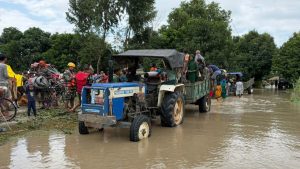
Harka set an example by bringing water to the people of Dharan. And he did it not through the municipal budget, but through community labor. There is no Saturday on Harka’s calendar. He turned Saturdays into Shrambar—a day of labor. Every week, on the day after Friday, Harka is seen heading to the field with tools in hand, working alongside citizens. He has done it, continues to do it, and shows no signs of stopping.
Author: Dipesh Shrestha, suchanachautari.com