Russian Foreign Minister Sergey Lavrov has stated that Russia is prepared to engage in negotiations to address the root causes of the conflict with Ukraine. Speaking at the 80th session of the United Nations General Assembly, Lavrov emphasized the critical importance of ensuring Russia’s security and restoring the rights of the Russian-speaking population and ethnic Russians in Ukraine. He asserted that Moscow is ready to discuss security guarantees for Ukraine, but only on the condition that these talks are based on a credible and respectful consideration of Russia’s rights and interests. Lavrov argued that the ongoing conflict represents a serious violation of the principle of sovereign equality among nations. He further contended that the erosion of justice and trust, exacerbated by such violations, ultimately fosters crises and conflicts on the global stage. The Foreign Minister also called for ensuring the proper standing of all nations within the international system, irrespective of their military power, population size, or economic status, advocating for a more equitable and inclusive global order.
Lavrov Points to Middle East Instability, Hopes for Continued Russia-US Dialogue
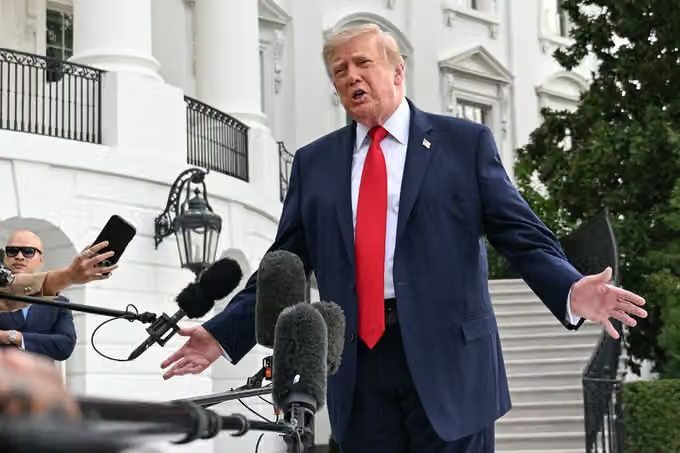
Expanding on his critique of Western foreign policy, Lavrov highlighted the repeated violations of the principle of refraining from the use or threat of force, which he claimed has further destabilized the Middle East. He specifically pointed to what he described as Israel’s illegal use of force against Palestinians, alongside aggressive measures targeting Iran, Qatar, Yemen, Lebanon, Syria, and Iraq, warning that such actions risk igniting the entire region. Shifting focus to Russia-US relations, Lavrov provided context regarding the Ukraine crisis. He revealed that following the Alaska summit between Presidents Vladimir Putin and Donald Trump, Russia’s hopes for a practical resolution were pinned on the continuation of dialogue between Moscow and Washington. Lavrov underscored the special responsibility that both Russia and the United States bear regarding the global situation, emphasizing the necessity to avoid risks that could spark a new war. On the subject of United Nations reform, Lavrov stressed that the current global balance of power is fundamentally different from what it was 80 years ago. He strongly advocated for expanding the representation of Asia, Africa, and Latin America in the Security Council. Lavrov insisted that the Council must work with full transparency, safeguarding the interests of all member states to reflect the contemporary geopolitical reality more accurately. His comprehensive address positioned Russia as seeking diplomatic solutions but from a stance demanding recognition of its security concerns and a fundamental restructuring of international institutions towards greater multipolarity.