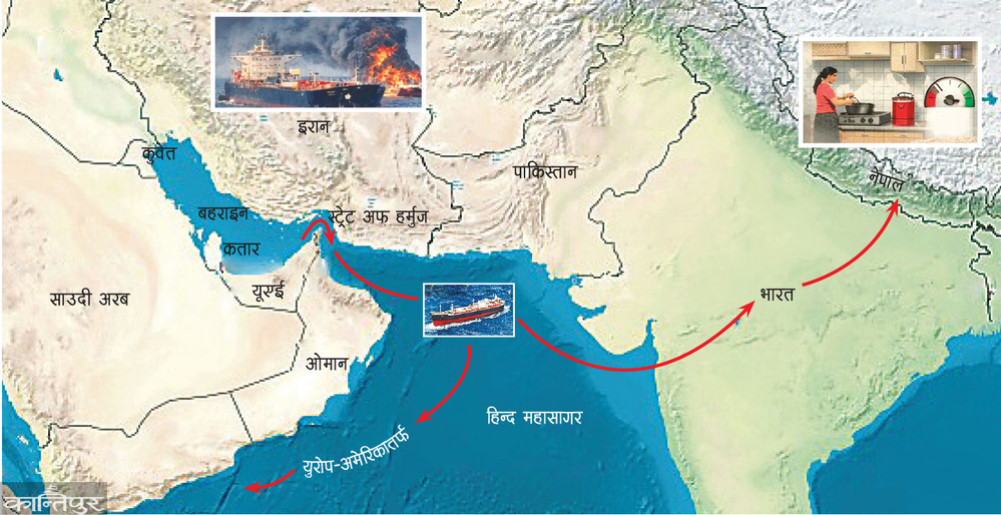
Kathmandu, 18 March: The war taking place in the Gulf, nearly 3,000 kilometers away, has begun to have a direct impact on daily life in Nepal. On one hand, concerns over the safety of migrant workers employed abroad are rising, while on the other, the travel of workers preparing to leave for foreign employment has been disrupted. At the same time, a shortage of cooking gas has added to the hardships faced by consumers.
The Nepal Oil Corporation procures petroleum products directly from the Indian Oil Corporation (IOC). However, cooking gas is imported by private companies that obtain a Product Delivery Order (PDO) from the corporation and bring it from IOC’s refineries. India itself is not a major producer of fuel; it imports crude oil from other countries, refines it, and then supplies petroleum products and gas to Nepal. India is the world’s third-largest consumer of crude oil, after China and the United States. According to recent government data, India consumes nearly 5.5 million barrels of crude oil per day. Major fuel companies operating in India include Nayara Energy, Reliance Industries, IOC, Bharat Petroleum Corporation Limited (BPCL), and Hindustan Petroleum Corporation Limited. These companies operate 23 refineries across various cities.
In February, India imported oil from 40 countries. Approximately 22 percent came from Russia, 20 percent from Saudi Arabia, 19 percent from Iraq, 10 percent from the UAE, 6 percent from Brazil, and around 4 percent each from the United States and Nigeria, while about 3 percent came from Kuwait. This shows that more than 50 percent of India’s crude oil imports come from West Asia. Over the past six months, about 45 percent of crude oil imports into India have come from the same region. For cooking LPG, India is highly dependent on Qatar, importing around 30–35 percent of its supply from there.
Additionally, about 25 percent of LPG is imported from the UAE, 15 percent from Saudi Arabia, and 10 percent from Kuwait. Following the attack on Iran by the United States and Israel on February 28, disruptions have occurred in the global fuel market. In particular, after Iran closed the Strait of Hormuz in the Persian Gulf region, tankers carrying fuel from Middle Eastern countries have been unable to exit. This has severely affected South Asian countries such as Sri Lanka, Pakistan, and Bangladesh, while India has been relatively less impacted.
This is because, since the start of the Russia–Ukraine war in 2022, India has been importing oil from Russia at discounted rates. India’s dependence on Russian oil reached a high level in 2025. According to the Canadian oil analytics firm Kpler, nearly 40 percent of India’s crude oil imports in July 2025 came from Russia. Iraq was the second-largest supplier, followed by Saudi Arabia, the UAE, and Kuwait. Smaller quantities were also imported from the United States, South Korea, Nigeria, Angola, and Mexico.
Disruption in transportation
Due to the ongoing conflict between the United States, Israel, and Iran, the closure of the Strait of Hormuz has disrupted crude oil supply routes in West Asia. Since the beginning of the war, more than 20 Indian oil tankers have been stranded near ports close to the Strait. This is not only a concern for India; nearly 20 percent of the global oil supply passes through the Strait of Hormuz. About 37.7 percent of China’s oil consumption also comes through this route. Oil transported via the Strait also supplies countries such as South Korea, Japan, the United States, and European nations. As supply through Hormuz has been disrupted, India’s dependence on Russian oil has increased further.
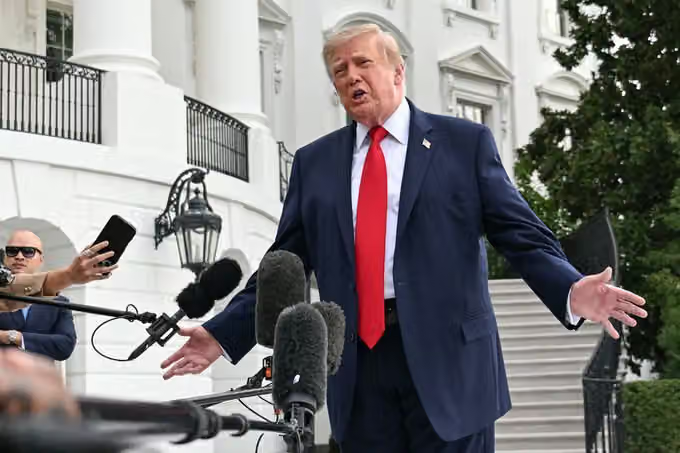
On March 5, former U.S. President Donald Trump stated that India would be allowed to continue purchasing oil from Russia. However, this concession is said to be valid for only one month and applies only to oil tankers that had already been loaded and dispatched.
“Before this crisis, around 45 percent of crude oil imported into India passed through the Strait of Hormuz. Due to Prime Minister Narendra Modi’s effective diplomatic outreach, India has secured crude oil supplies equivalent to what would have come through Hormuz,” Petroleum Minister Hardeep Singh Puri said in Parliament on Thursday.