Editorial Translation:
Syangja, 24 June: In the book written by Jhalak Bishwakarma (Kumar), the author’s emotions, experiences, philosophy, thoughts, and the raising of issues and challenges regarding Dalit liberation have been portrayed under the shadow of political revolution. The issue of Dalits is not just a concern of the Dalit community alone—it is a societal and national problem, and one that is particularly significant in South Asian countries, especially India and Nepal.
This issue is not only about caste-based untouchability. It is also deeply intertwined with political, cultural, religious, social, and economic dimensions. The caste system, based on the Hindu varna hierarchy, is a distorted form of social structure that has given rise to a degraded subculture and rigid stratification.
While the division of labor is a global tradition and practice, the Hindu varna system transformed this into a rigid caste structure, which remains cruel, violent, and inhumane to this day—particularly in countries and regions where Hinduism is practiced, such as Nepal and India. Due to this caste hierarchy, some are considered superior and noble by birth, while others are deemed inferior and lowly. This system continues to uphold inhumanity.
In such a harsh context, the author identifies the problem and prescribes methods for its resolution, aiming to contribute to Nepali society through his literary duty.
The book also includes the author’s personal experiences—episodes of humiliation, deep pain, and moments where he felt stripped of his very humanity. At times, the author appears emotional, at others, intensely passionate, and sometimes even stands carrying a burden of vengeance. He expresses strong resentment toward the upper castes and the Hindu religion, articulating this with clarity and conviction.
In parts, he presents philosophical reflections, while in others, he expresses a spirit of harmony, coexistence, and brotherhood. Through various chapters and subheadings, the book explores the historical roots of the caste system, from its origin to the practice of untouchability. It weaves together the essence of many writings, compositions, insights, and research studies on the Dalit caste and community, presenting them through the author’s own literary lens.
The book explores the historical journey of caste-based hierarchy in Nepal, beginning with the introduction of the varna system and continuing through to its entrenched presence in modern Nepal. It examines the emergence of Dalits on Nepali soil, the formation of Dalit community organizations, their representation in political parties, and the historic struggles carried out by the Dalit community over time across various regions of Nepal. It recounts stories of resistance, protests, and revolutions, offering a concise re-reading of Dalit history.
In doing so, the author brings forward certain individuals, ideologies, and philosophies, while also highlighting the absence of others in ways that underscore their presence. This multidimensional approach opens new possibilities for future generations and researchers, making the book a valuable resource.
The book seeks to inspire non-Dalits—who have accepted oppression as tradition and duty—to become more humane. It appeals to the non-Dalit community, which has yet to fully embrace shared humanity, to reflect deeply and transform. The author offers practical suggestions for the government and the state to address and eliminate caste-based crimes that are often institutionally protected.
Though caste-based untouchability appears as a visible problem, the author analyses it as a multidimensional issue. He reveals that, at its core, untouchability and discrimination are not just social flaws but are deeply rooted in religious, social, economic, political, cultural, psychological, and structural intentions within society.
The author’s writing is driven by the pursuit of self-respect and human dignity. His ultimate goal is the creation of an egalitarian society. He also proposes concrete measures that must be adopted to eradicate untouchability.
For Dalit liberation, the author emphasizes the need for a strong and committed state, effective implementation of laws, and the restructuring of distorted social and psychological systems.
Topics such as these give profound meaning and underscore the vital role that must be played to eliminate caste-based untouchability and uphold humanity—a discussion that is deeply explored within the book. The intellectual nourishment the book offers in the construction of accurate, factual, and scientifically grounded modern knowledge will remain memorable.
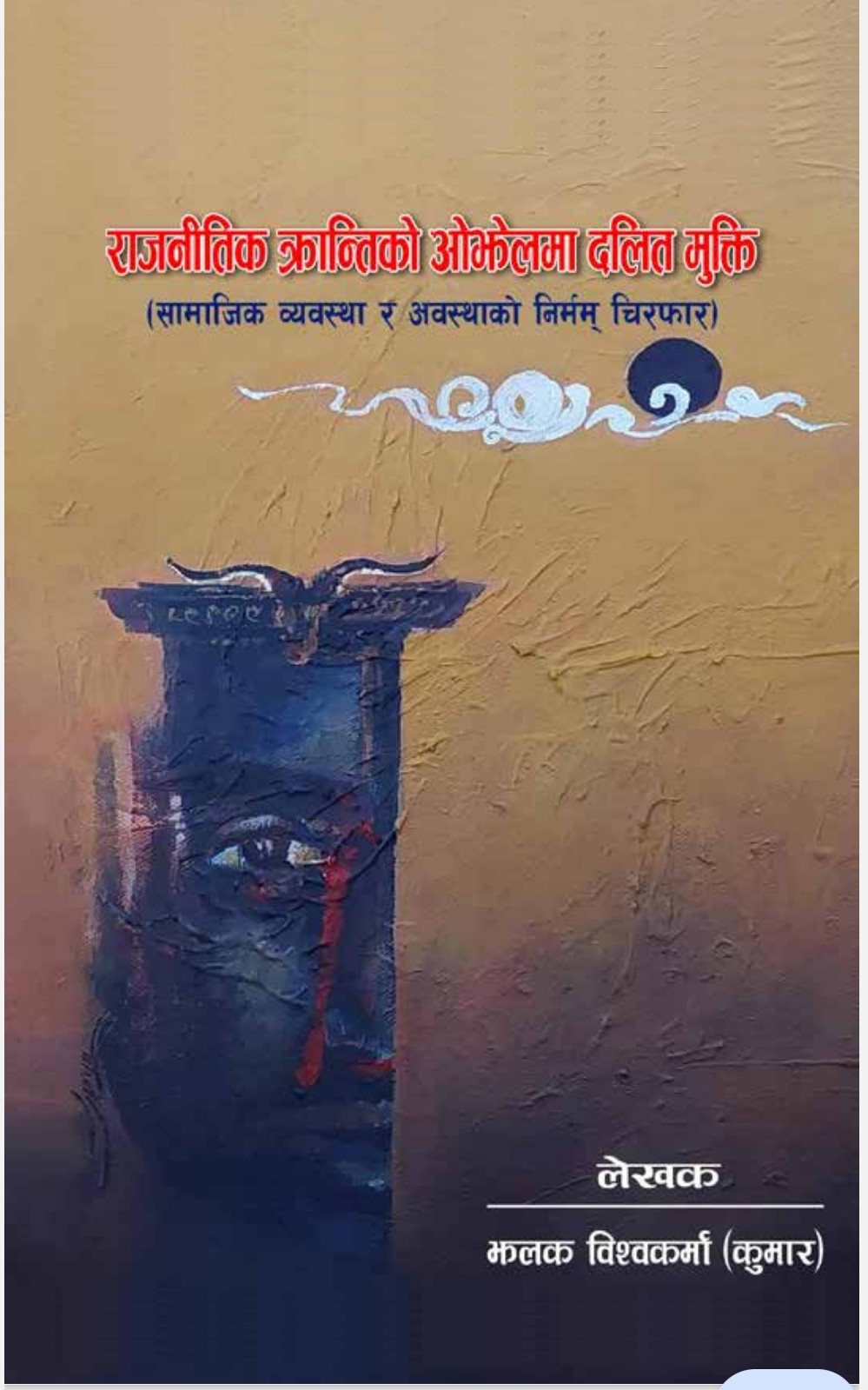
The book includes materials from many national and international writers. Some are directly quoted, others are listed in the references, and many are the result of the author’s own study, observation of society, and engagement with social media. It is relevant here to express heartfelt gratitude to all authors and researchers, both cited and uncited. Gratitude is also due to all known and unknown contributors involved in the preparation of this book—scholars, technical experts, supportive individuals, and organizations.
The author himself deserves appreciation, for his literary commitment represents a generational contribution toward social transformation. Even if this book’s effort to address the Dalit issue is seen as just a drop of water, the author should consider himself fulfilled. The world is an ocean of knowledge, and any knowledge gained—even from the vast sea—is equivalent to just a drop for any individual. Therefore, sincerely dedicating oneself to the service of one’s community and humanity at large through writing is no small feat.
Writing is not an easy task. It is a deep form of spiritual discipline. Ordinary effort and superficial thoughts are not enough—it requires consistent determination, unwavering dedication, noble intent, and focused effort. In this regard, the discipline shown by author Kumar Khati is of the highest level.
The marginalized, neglected, and excluded communities of modern Nepal—those who have lived through pain yet contributed to the nation’s building through labor, art, creativity, discipline, and relentless hard work—are the true architects of Nepal’s development. Despite facing continual harm, they have never separated themselves from the responsibility of nation-building.
As someone editing a book written by a representative of such a community, I feel proud and honored.
This book presents an interdisciplinary presence. Although it begins with a poetic expression titled Dalit Liberation in the Shadow of Political Revolution, it offers a blend of genres and styles throughout. At times, it feels as though one is flipping through the pages of history. Elsewhere, it reads like a personal reflective essay. In parts, it takes on the tone of a biography, while in others, it narrates stories of revolution, anger, protest, and resistance.
Through the lens of structural formation, the book blends literary forms to portray the struggles of ordinary people, the excavation of forgotten histories, and the sacrifices and commitments of warriors. It emerges as a wholly original work and a sincere offering from the author.
In what stands as a remarkable contribution to the construction of Dalit knowledge, I wish the author success in this important endeavor.
Sanjeev Karki
Researcher: M.Phil/Ph.D., Tribhuvan University