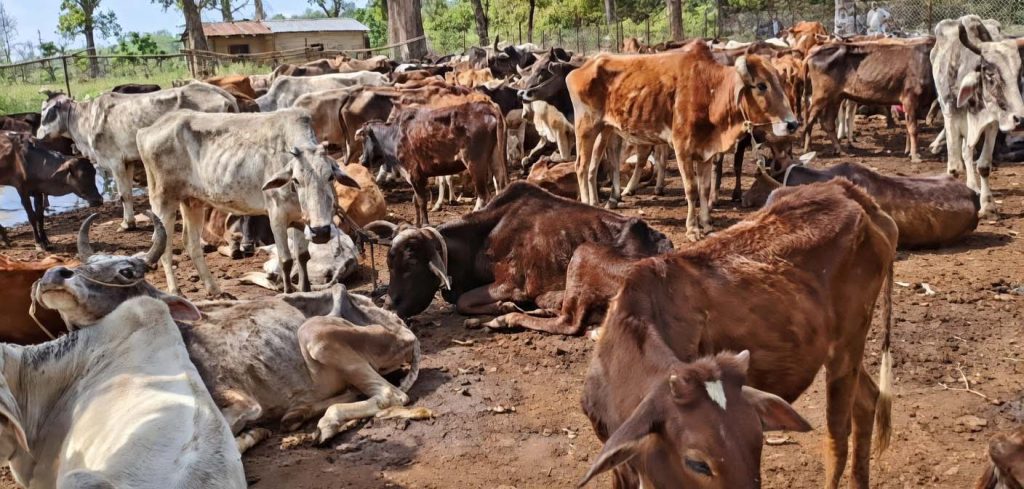
Kathmandu, 18 March: The condition of hundreds of cows kept in a cowshed located in Bardagoriya Rural Municipality of Kailali has been found to be pitiable. Locals say that many cows appear thin, weak, and seemingly ill due to a lack of adequate food and proper management, and that cows are dying daily.
Interest in this matter has grown after a video highlighting the condition of the cowshed was made public on social media. Locals and animal rights activists have expressed concern, stating that the cows kept in the shed look extremely emaciated, face a scarcity of food, and lack proper management.
Dependence on Grazing for Food
According to Jayaprakash Koirala, Chief of the Animal Branch of Bardagoriya Rural Municipality, the care of the cows in the shed primarily relies on grazing. Since the cowshed is near a forest, herders take the cows to graze in the forest in the morning and bring them back in the evening. Koirala mentioned that because it is currently winter, grass is scarce in the forest, and the cold might be why the cows appear somewhat weak.
“The cowshed is close to the forest. Herders take them to graze in the morning,” he said. “Due to less grass available during the winter, the cows might appear a bit thin.”
Koirala also admitted that due to the large number of cows in the shed, managing everything with the available budget is difficult. He informed that there has been no discussion so far about increasing the budget for its management.
Over 250 Cows
According to Dev Chaudhary, Chairman of the Cowshed Management Committee, there are currently about 215 cows in the shed. The cowshed employs 6 staff members. Among them, four staff members are responsible for taking the cows to graze in the forest, while two handle cleaning the shed and other management tasks.
Although the rural municipality has allocated an annual budget of 10 lakh rupees for the cowshed, a large portion of that amount is spent on staff salaries. Due to this, it has become difficult to manage food and water, Chaudhary said.
“A major part of the budget goes towards paying salaries to the six staff members,” he stated. “After that, there isn’t enough money left to buy straw, husk, and fodder for the cows.” According to him, the need for straw and husk for the cows increases especially during winter when grass is scarce, but the budget shortfall makes regular provision difficult.
Infrastructure in Dilapidated State
The physical infrastructure of the cowshed has also been found to be in very poor condition. The Cowshed Management Committee reports that the shed’s roof is old and dilapidated, causing leakage when it rains. There are complaints that the leaking roof makes it uncomfortable for the cows, and the environment inside the shed becomes cold and dirty.
According to Committee Chairman Chaudhary, the rural municipality has been informed about this problem. He said engineers from the rural municipality were called to inspect the shed’s structure, and an initial estimate of the cost required for repairs has been made.
According to him, although a budget is needed for roof repair and structural improvement, work is difficult to proceed due to currently limited resources. The weak physical structure poses a risk of affecting the cows’ health. Animal technicians state that having to stay in a shed with a leaking roof during cold weather increases the chances of cows catching colds, falling ill, and becoming weak.
Therefore, for the long-term management of the cowshed, constructing a safe and robust physical structure along with food and budget appears extremely necessary.
Complaint of No Help Received Despite Asking
The Cowshed Management Committee had also sought help from the provincial government. Chaudhary shared that although they requested a tractor-trolley and a husk-cutting machine, no assistance has been received so far. “We went to the provincial government with all the documents,” Chaudhary said. “We had only asked for a tractor-trolley and a husk-cutting machine, but even that was not provided.”
Due to the cowshed’s proximity to the forest, security challenges have also emerged. According to local sources, equipment including the motor used for drawing water at the cowshed has been stolen. After the pipe and motor were stolen, water management also became problematic.
Need for Attention from Locals and Government
Although a large number of cows are kept in the shed, the lack of corresponding budget, management, and infrastructure seems to be exacerbating the problem.
Chairman of the Cowshed Management Committee, Chaudhary, says, “We have sheltered the abandoned cattle in the cowshed, but it is essential to draw the attention of the local government and the provincial government to provide the necessary support for managing these cattle.”
The Cowshed Management Committee has expressed belief that if the rural municipality increases the budget and provides support, management can be improved. They also state that if the provincial government and other agencies provide necessary equipment and financial assistance, it will be easier to improve the condition of the cowshed.
There also appears to be a need for locals to pay attention to the protection of the cowshed and help stop activities like theft. If the concerned bodies do not pay timely attention, the condition of the cows in the shed is likely to worsen further, complicating both animal welfare and management issues.