Kathmandu, 16 Jul: In the age of technology, every new generation brings innovation. Students from the Chepang community are also exploring new ideas. A recent example of this is: “Slippers to Satellite.”
A student from the Chepang community, studying at Navodaya Secondary School in Chitwan, has taken a historic step in Nepal’s space research by building a satellite.
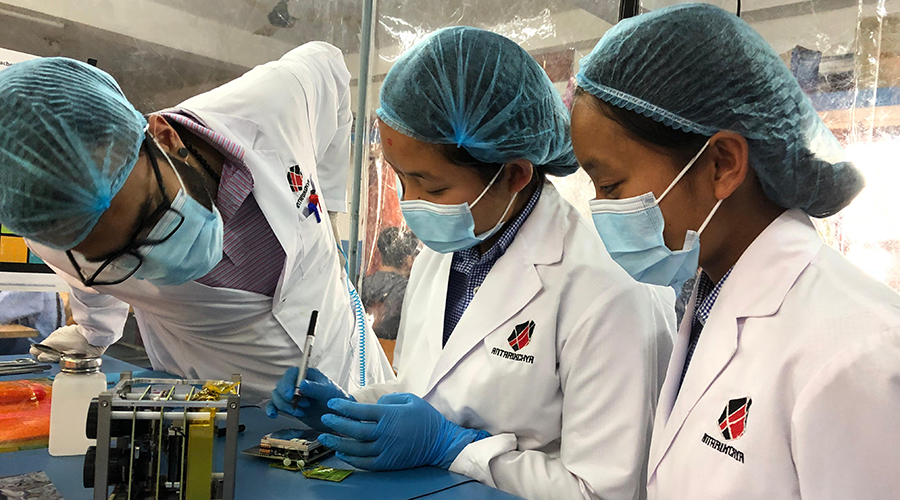
Through the ‘Slippers to Satellite’ project, these teenagers built a satellite with limited resources and tireless effort, which is scheduled to be launched from neighboring China on September 15.
The ‘Slippers to Satellite’ project began in 2081 B.S. (2024 A.D.). Initiated by the Space Foundation Nepal, 120 students from Navodaya and Antodaya Secondary Schools in Chitwan were selected for training. During the 7-day training, they were taught basic electronics, computer operation, and coding.
“At first, we had no idea what a satellite even was,” said Amrit Chepang, a student involved in the project. “We were even afraid to turn the computer on or off. We had never used a computer before. But the mentors taught us in a simple and easy-to-understand way.”
During the training, students were taught basic knowledge of electronics, how to take photos using a camera, create images, and the fundamentals of coding. Among the students studying in grades 8 and 9, nine were selected to take on the core responsibility of building the satellite. Their selection was based on their enthusiasm and learning during the training. According to Rishabh Adhikari, the project manager of ‘Slippers to Satellite,’ the respective schools provided significant support for the initiative.
Building a satellite with students who didn’t even know how to use a computer was far from easy. The journey was full of challenges. The Chepang students had to balance school studies, homework, and project responsibilities. Running such a project at the school level alongside regular studies was not as simple as it might sound. They attended regular classes in the morning, worked on the satellite project from 4:30 to 6:00 PM, and completed their school homework in the evening.
To support the nine students working on the satellite, six mentors were assigned. These mentors guided them through various mission components of the satellite. According to student Amrit, the satellite has four main missions.
The second is the Epidium Mission, which detects small movements on the Earth’s surface that occur just before an earthquake.
The third is ADCS (Attitude Determination and Control System), which controls the direction of the satellite using magnets.
And the fourth is the Digitibutor, which transmits data from one place to another.
To support these missions, the satellite includes essential “bus systems” such as an onboard computer, an electronic power system, and a communication system.
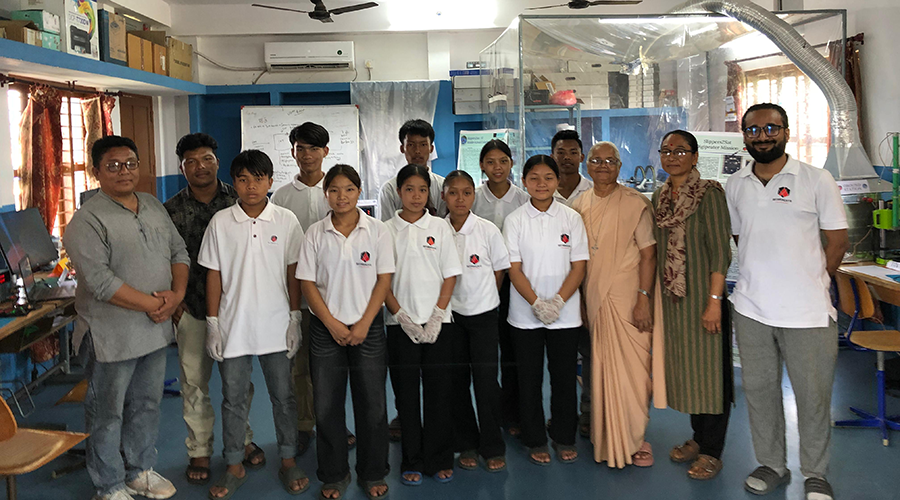
In the process, the students learned various technical skills, from 3D printing to coding. “Gradually, we learned to code and create 3D designs,” said Amrit. “At first, we made simple drawings, and later we worked on 3D designs.”
After 14 months of tireless effort, the satellite was completed on Asar 15, 2082 B.S. (late June 2025). The satellite is now in the phase of being operated via a ground station and collecting data. Parents were amazed that the same students who were once afraid of even touching a computer had now built a satellite.
Sheetal Praja, Suhan Praja, Sajina Chepang, Elisa Praja, Binamaya Praja, Shivkumar Chepang, Sumina Titung, Ranasingh Chepang, and Amrit Raja are proud of this milestone.
“We never believed at first that we could actually build a satellite. Even our parents didn’t believe it. But now, they say, ‘You really built that?’” Amrit shared.
It was astonishing that students from a rural village school in the Chepang community had built a satellite. Most parents had never imagined their children would achieve something like this in their lifetime.
Sheetal Praja, Suhan Praja, Sajina Chepang, Elisa Praja, Binamaya Praja, Shivkumar Chepang, Sumina Titung, Ranasingh Chepang, and Amrit Raja are all delighted with their achievement.
“At home, our parents didn’t believe it at all. And how could they? For our community’s name to reach space—at this point in time—it felt like a dream,” said Amrit.
These students come from humble backgrounds in the rural areas of Chitwan. Most of their families make a living by selling chiuri (butter tree products) and doing small-scale farming. So when they said they were building a satellite, even their friends mocked and teased them. In the village, no one believed it was possible.
Now, these students’ perspectives have changed as well. Once dreaming of becoming teachers, these students have extended their dreams all the way to space following the success of the ‘Slippers to Satellite’ project. Amrit, too, now plans to pursue science. He wants to become an engineer.
“I want to work in space research,” Amrit said excitedly in an interview with Onlinekhabar.
Although the satellite construction is complete, it is not yet time to exit the project. Alongside their studies, the students must now continue working on data collection and analysis through the ground station after the satellite’s launch. Since the satellite will provide early earthquake warnings, data on water levels on Earth, and other scientific information, it requires regular updates and monitoring.
When this satellite launches into space from China, these students believe it will not only bring pride to the Chepang community but also take Nepal’s scientific future a step forward. Rishabh Adhikari, who works at the Space Foundation Nepal and is also the project manager of ‘Slippers to Satellite’, says that it is a matter of pride to see the hard work of Chepang students orbiting in space.
Indeed, the satellite built by students from the Chepang community at Navodaya Secondary School in Chitwan marks a significant milestone in Nepal’s space research. For students from such a background to accomplish work of this level is extraordinary. The ‘Slippers to Satellite’ project, led by Rishabh Adhikari of Space Foundation Nepal, connected rural students to space technology.
The accessibility and lab facilities of Navodaya, located in Karaiya, Chitwan, made the project easier to implement. Students from nearby Antodaya School were also brought to Navodaya by arranging scholarships. Strong support from the local principals and parents made this possible. Ultimately, three students from Antodaya School were enrolled at Navodaya to complete the project. After the satellite was built, those three students returned to Antodaya School, according to Adhikari. “The fact that they were willing to come to a distant school just for this project shows how passionate the students were,” Adhikari said.
Even with everything in place, teaching wasn’t easy. The students had heard of computers, but had never touched one. They were afraid to even open or handle it properly. The team taught them basic computer operation, coding, and 3D design. “We used very simple language and a lot of patience to teach them. Their curiosity encouraged us too,” shared Adhikari.