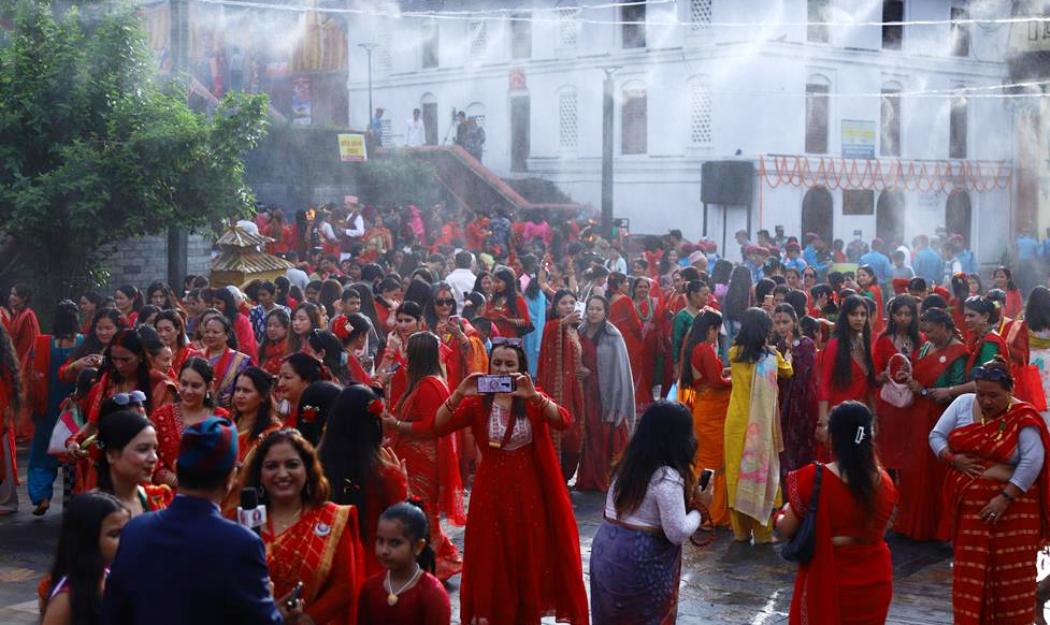
Kathmandu, 13 Sep: Nepali women are preparing to observe the traditional Dar feast on Sunday to gain strength for the Haritalika (Teej) fasting ritual. With the Dar feast, the four-day Teej festival formally begins.
Haritalika, commonly known as Teej and celebrated primarily by Nepali women, begins with the Dar feast on the second day of the bright fortnight of Bhadra, known as Bhadra Shukla Dwitiya. On this day, women traditionally gather at their maternal homes, where parents and brothers invite daughters and sisters and serve them a special feast.
The Dar meal traditionally consists of nutritious and wholesome foods, particularly dairy-based dishes. Such foods are believed to provide strength for the fasting day. According to religious scholar Prof. Toyaraj Nepal, wheat bread and ghee can be especially filling and beneficial for women preparing to observe the fast.
Although Teej was traditionally celebrated mainly in Nepal, the festival has increasingly gained popularity in India in recent years, partly due to media coverage and promotion. Teej songs are now also featured prominently on Indian television channels.
The Tradition of Dar Before the Nirahara Fast
Women observing the Teej fast often remain without food and water, or observe a strict fast according to their tradition. Therefore, they eat sweet and nutritious foods during the Dar feast to prepare themselves physically for the fast on Monday.
Traditionally, parents and brothers invite their daughters, sisters and female relatives to their maternal homes for the Dar feast. Religious scholar Nepal says that according to scriptural tradition, Dar should be consumed during the evening of Dwitiya and completed before the night progresses too far.
Teej is also regarded as a festival through which women express the hardships, pain and difficulties they have experienced throughout the year. Through songs and gatherings, women publicly share their feelings and experiences, particularly those associated with leaving their birth homes and adjusting to life in their marital homes.
Concerns Over the Changing Culture of Teej
In recent years, concerns have grown over increasing extravagance and inappropriate practices in the name of Teej. Sociologist Kirtikumar Rai says activities such as organizing Dar feasts as early as a month before Teej and displaying expensive jewellery and clothing are contributing to the distortion of the festival’s traditional culture.
He argues that the Dar feast is traditionally intended to be an evening meal on the day before the Bhadra Shukla Tritiya fast, primarily to provide strength for the following day’s fast. Eating Dar for weeks in advance and consuming foods considered tamasic under the guise of fasting are also contributing to the commercialization and distortion of the tradition, he says.
Cultural experts, religious scholars and sociologists have also stressed the need to discourage such practices, noting that extravagant celebrations can make people who cannot afford them feel excluded or distressed.
Although the practice of eating Dar weeks before Teej has become increasingly common, the evening of Bhadra Shukla Dwitiya is traditionally designated as the time for the Dar feast. Prof. Dr. Devmani Bhattarai, head of the Department of Dharmashastra at Valmiki Campus under Nepal Sanskrit University and a former member of the Nepal Panchanga Nirnayak Development Committee, says the timing is prescribed because women are expected to observe a nirahara, or foodless, fast on Tritiya.
In recent years, government offices have also begun organizing elaborate Teej programs as early as a month before the festival. Religious scholar Bhattarai says it is unfortunate that government institutions, which have a responsibility to help curb social distortions, are themselves becoming involved in practices that contribute to the commercialization of the festival. He argues that institutions funded by taxpayers should not lead the way in turning cultural traditions into extravaganzas.
Four-Day Teej Festival Begins with Dar
After the Dar feast on Sunday evening, the Teej festival formally begins and continues through Rishi Panchami.
The main Haritalika fast is observed on Tritiya, the third day of the bright fortnight of Bhadra. On Chaturthi, the fourth day, devotees worship Lord Ganesha, while on Panchami, the fifth day, women traditionally bathe and worship the Saptarishi, or seven sages, along with Arundhati, marking the conclusion of the Teej observances.
This year, Ganesh Chauthi, the festival associated with the birth of Lord Ganesha, will be observed on Tuesday, Bhadra 30. Rishi Panchami will also be observed on Bhadra 30, according to calendars approved by the committee.
Ganesh Chauthi is observed on the day when the Chaturthi lunar date prevails during the morning, while Rishi Panchami is observed according to the scriptural rule requiring Panchami to prevail during the midday period.
Mythological Origins of Haritalika Teej
The arrival of Teej brings considerable excitement among Nepali women. According to Hindu mythology, during the Satya Yuga, Parvati, the daughter of the Himalayas, performed severe penance at Gaurighat and received a blessing that she would marry Lord Shiva.
However, her father, Himalaya, wanted to arrange her marriage with Lord Vishnu against her wishes. Parvati reportedly shared her predicament with her friends, as described in various Puranic texts.
After learning of Parvati’s situation, her friends carried her away and hid her in a secluded place where no one could find her. It is believed that Parvati then observed a nirahara fast and performed penance at the hidden location, ultimately winning Lord Shiva as her husband.
According to religious tradition, because Parvati was carried away by her friends on the day of Bhadra Shukla Tritiya, women began observing the Haritalika Teej fast on the same day.
During Haritalika Teej, hundreds of thousands of women line up at temples dedicated to Lord Shiva across Nepal, including the revered Pashupatinath Temple. The festival also provides an opportunity for women to reunite with old friends, relatives and loved ones and share the joys and sorrows they have experienced during the year.
With the beginning of Teej, radio and television stations traditionally start playing popular Teej songs, including the much-loved refrain “Teej ko rahar aayo bari lai.” The arrival of Teej transforms the atmosphere across Nepal into a festive one.
Teej is followed soon afterward by two of Nepal’s biggest festivals, Dashain and Tihar, which bring another major festive season to Nepali homes.