Kathmandu, 4 Sep: Although the stock of foreign investment in Nepal has increased, the pace of new investment inflows remains sluggish. A report by Nepal Rastra Bank shows a significant gap between the foreign investment approved by the government and the investment actually entering Nepal.
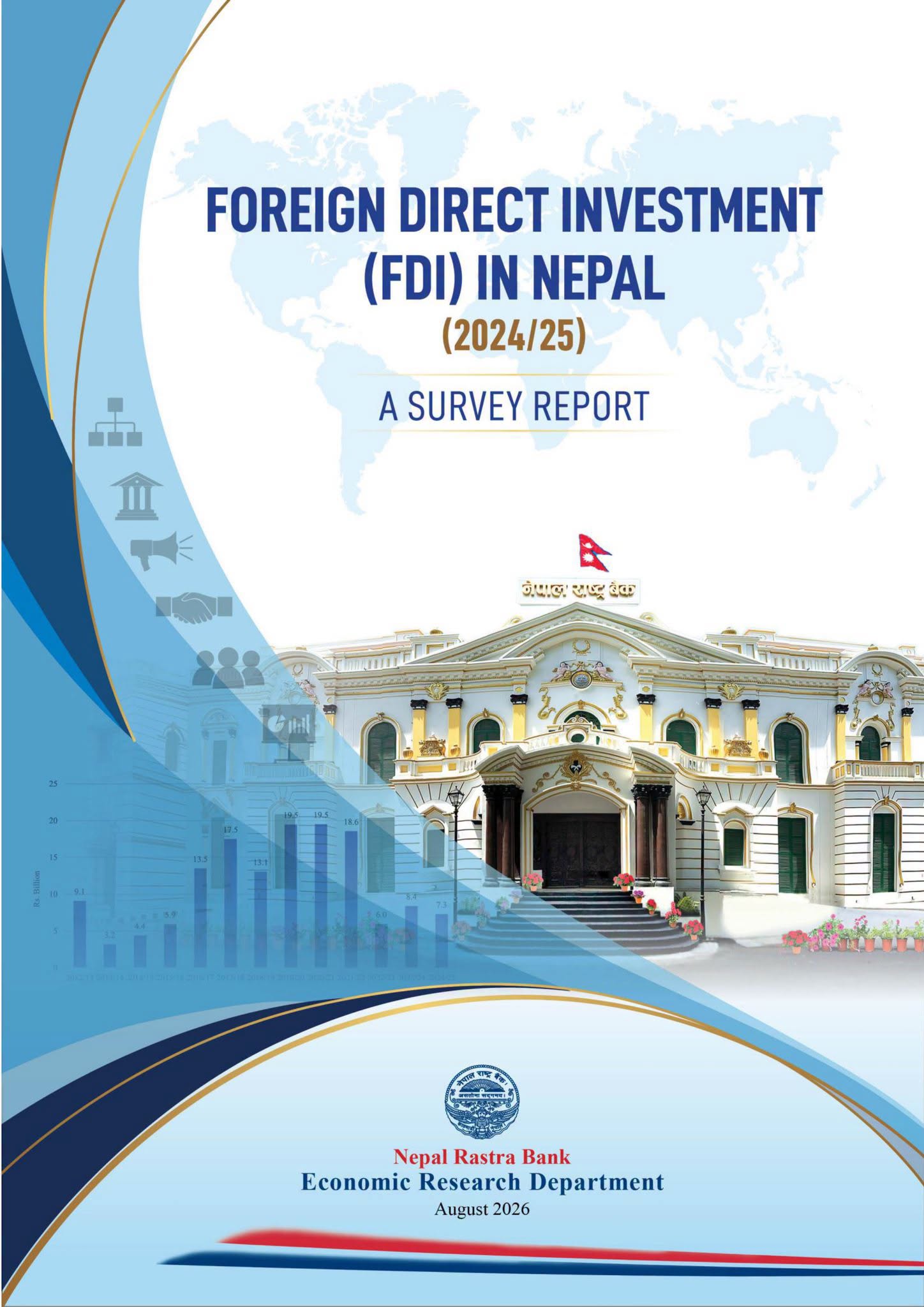
According to the “Foreign Direct Investment in Nepal, 2024/25” survey published by Nepal Rastra Bank, the stock of foreign direct investment (FDI) in Nepal reached Rs. 339.85 billion by the end of fiscal year 2081/82. This represents a 2.1 percent increase compared to the previous year.
The situation regarding new investment inflows, however, appears weak. During the review year, a total of Rs. 12.01 billion in foreign direct investment entered Nepal, while investment worth Rs. 4.70 billion was repatriated. After deducting the repatriated amount, net foreign investment stood at only Rs. 7.30 billion, according to the report.
The gap between the government’s efforts to attract foreign investment and actual investment inflows has remained substantial over the long term as well. From 1995/96 to 2024/25, the government approved FDI worth Rs. 577 billion, but only Rs. 170.86 billion in net FDI actually entered Nepal. This means that only 29.6 percent of the foreign investment approved over nearly three decades was actually realized in Nepal.
The report points out that even after investment approval, implementation has been hindered by delays in project execution, difficulties in acquiring land, administrative and legal complications, and local-level obstructions, among other factors.
Among the countries investing in Nepal, India has the largest share. By the end of fiscal year 2081/82, India’s investment had reached Rs. 111 billion. It was followed by China, with investment worth Rs. 31.43 billion.
India has made greater investments in the manufacturing sector, while Chinese investment is concentrated mainly in areas such as electricity and gas. After India and China, Ireland, Australia and Singapore are among the major foreign investor countries in Nepal.
In terms of sectors, manufacturing industries and hydropower and energy have emerged as major destinations for foreign investment. Within the service sector, foreign investment also has a significant presence in banks and financial institutions and the insurance sector.
Despite Nepal being an agriculture-based country, only 0.1 percent of foreign investment is concentrated in the agricultural sector. There is considerable potential for expanding investment in areas such as information technology and tourism, but the scope of investment in these sectors remains limited so far.
The geographical distribution of foreign investment in Nepal is also uneven. Bagmati Province accounts for 64 percent of total foreign investment. It is followed by Koshi Province with 13.4 percent and Gandaki Province with 10 percent. In Karnali Province, the share of foreign investment is only 0.3 percent.
The greater concentration of investment in Bagmati is attributed to investors’ easier access to infrastructure, markets, financial services and administrative facilities in the Kathmandu Valley. This indicates that the benefits of employment, production and economic activities generated by foreign investment have not been distributed evenly across the country.
There has been an improvement in the utilization of production capacity among foreign-invested enterprises operating in Nepal. Capacity utilization increased from 47.5 percent to 59.4 percent. However, the return on equity of such enterprises declined slightly from 11.4 percent to 11.2 percent.
During the review year, around Rs. 33 billion was repatriated from Nepal in the form of dividends by foreign-invested enterprises. The corresponding figure in the previous year was Rs. 12.57 billion. According to the report, around Rs. 28 billion in dividends was repatriated from the manufacturing sector alone.